
Christina Vosbikian, Blavatnik Fellow in Life Science Entrepreneurship, Harvard Business School
Contact: cvosbikian@mba2025.hbs.edu
Abstract
What is the message? The value of an MBA is informed by a robust coursework, people, and career support, proven benefits for students seeking not only a career in healthcare, but opportunities to innovate within the industry.
What is the evidence? The author draws from market trends, media reports, scholarly articles, and her own experience as an MBA student at Harvard Business School.
Timeline: Submitted: July 10, 2025; accepted after review October 1, 2025.
Cite as: Christina Vosbikian. 2025. Innovating in Healthcare: The Case for an MBA. Health Management, Policy and Innovation (www.HMPI.org). Volume 10, Issue 2.
Special thanks to Brian Walker, Harvard Business School, for his support on this paper.
According to the Graduate Management Admission Council (GMAC), 2024 saw a record 12% increase in MBA applications – marking a sharp reversal in two prior years of lagging application rates. As the Wall Street Journal noted, the rebound was most pronounced in full-time, in-person programs, where applications rose 32% – the highest level in a decade.¹ ²

Conjecture varies about why the MBA is, seemingly, on the rise. Some cite economic uncertainty, which presumably makes the opportunity cost of a two-year hiatus feel less stark for MBA hopefuls. Others cite a post-COVID right-sizing of demand. Still others turn to doomsday scenarios and speculate that AI may be pushing white-collar workers to up-skill themselves to insulate against their own looming obsolescence.
Yet even amid these encouraging trends, articles like When Harvard MBAs Can’t Find Jobs: How the Job Market Has Changed highlight a more sobering reality – especially for those entering fields like healthcare, where complexity and fragmentation require more than just general business training.³ This article and others note that MBAs may not be getting the “dream jobs” that were once synonymous with a top degree and that, even if they are, the path is anything but smooth.
Why is this? The Wall Street Journal cites the hiring freeze in “top” sectors like tech and finance, the evolving nature of work whereby technical skills trump general management knowledge, the influx of alternative education pathways, and the rise of the “unspoken” job market where internal hiring and other non-public hiring is replacing external searches for advanced positions. Anecdotally, many point to the MBA as being outdated in a time when the democratization of productivity technology like AI or great equalizers like social media have possibly made it easier than ever before to succeed as a business owner through self-teaching and informal channels. One need only to look at formal education drop-outs like Mark Zuckerberg or Steve Jobs to see why. Those who cite these titans of industry often forget many success stories, often in healthcare, in which MBA alumni have launched and led companies after completing their degrees – like Epic Systems’ Judith Faulkner, Elevance Health’s Gail Boudreaux, and many others.
Let us take a look at the numbers behind MBA graduates and their employment using HBS as an example. Despite the Wall Street Journal’s provocative headline, HBS’s data show a steady 23% to 30% of graduates not seeking employment post-MBA from 2020 to 2024 – and either starting their own businesses, going back to prior employment, with only 4% to 5% postponing their job search, continuing their education or otherwise filling their time.⁴
If we consider “double-digit” post-MBA employment buckets, the data show that Private Equity, Consulting, Tech, Entrepreneurship and Company Sponsorship – remain the most popular paths for graduates over time. That said, Consulting, the path perhaps most associated with general management programs, has declined in popularity. This could be driven by industry hiring trends, but it could also be a symptom of the overall change in what today’s MBA value proposition and post-program job search looks like.
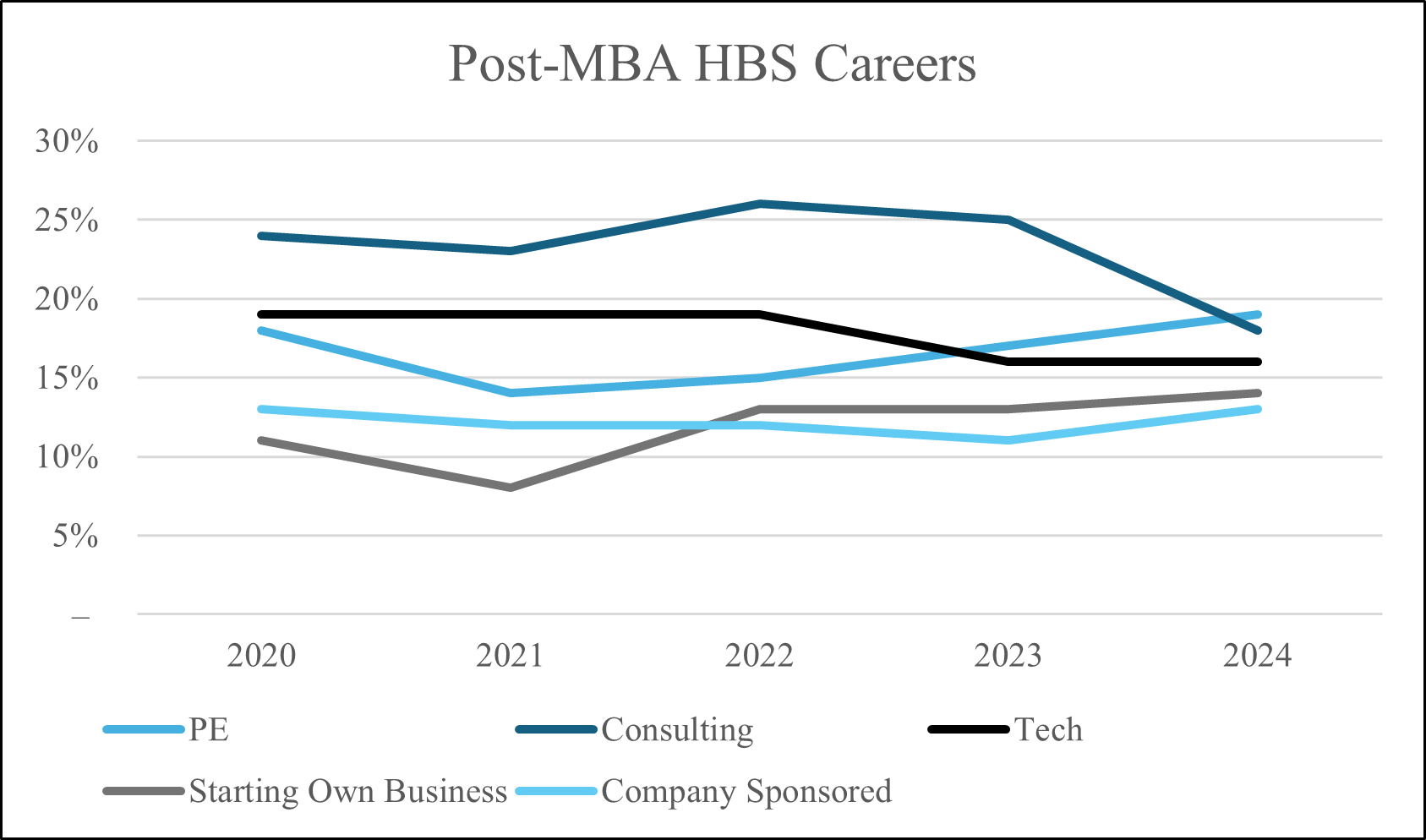
The Wall Street Journal’s point – that the road to post-MBA employment is paved with different motivations and competitive factors – should not be ignored. If the value of the MBA is no longer “guaranteed” placement in top, legacy industries, what is the value? This is the question MBA hopefuls and top programs alike are grappling with.
In this article, we will add to this discussion by examining the case for the MBA, as it pertains to a career in healthcare, drawing both from industry trends and my own direct experience.
Healthcare and the MBA
As of 2023, approximately 50% of healthcare CEOs held an MBA, compared to an average of 43% across all industries.⁵ At Harvard Business School, the percentage of graduates pursuing careers in healthcare has hovered at 5% to 7% between 2020 and 2024.⁴ It is worth noting that this count may obfuscate an even higher percentage of MBAs pursuing careers in healthcare. At least at HBS, a number of graduates, myself included, are entering or re-entering the industry by starting their own healthcare companies, whether in life sciences or healthcare IT / services.
Healthcare-Specific MBA Programs
Many fulltime MBA programs allow students to specialize in healthcare. One prominent example is the Health Care Management Major at the University of Pennsylvania’s Wharton School that boasts 2,200 alumni, according to the program’s website.⁶ These include C-Suite and senior executives at DaVita, Kaiser Permanente, Oak Street Health, UnitedHealth, and other healthcare giants.
Of programs routinely in the top 10 of MBA rankings, whether in formal tracks or specialized programming, most boast some form of focus on healthcare. Whether through coursework, healthcare-focused networks, or direct career support, there are many reasons an MBA can be of great value to those pursuing a career in healthcare.
Other Core Tenets of the MBA for Healthcare Hopefuls
Coursework. Most MBA programs, Harvard Business School’s included, have some level of course requirements. Beyond that, students are free to choose coursework that interests them – whether to help them explore completely new fields or delve deeper into areas of interest.
At HBS, students spend their first year in the Required Curriculum (RC), with no choice in coursework. The second year, or Elective Curriculum (EC), is completely at students’ discretion. During this year, HBS has classes like Innovating in Healthcare taught by Professor Regina Herzlinger, Entrepreneurship in Life Sciences with Senior Lecturer Satish Tadikonda, and Innovating in Healthcare Delivery with Professor Robert Huckman.
Innovating in Healthcare is an example of both, with the first quarter focused on learning the pillars of successful healthcare innovation by examining industry leaders, and the subsequent three focused on creating cohort-based learning where students work on and share learnings from building their own healthcare ventures while pursuing their MBA.
Professor Regina Herzlinger, the Nancy R. McPherson Professor of Business Administration at HBS, recently reflected on why she created healthcare-specific programming at the school:
“…I started a second-year EC MBA course, Innovating in Health Care. It was not about wish fulfillment in health care, but about how to make innovation happen. At that time, the school did not teach many verticals, but health care innovation requires so much specific knowledge that they allowed me to open this course. Virtually all the other courses in health care management in other schools were about hospitals, and hospitals are great, but they cannot be the only way that health care is delivered. For example, 20 percent of the US population lives in rural areas, but they have 1 percent of the ICU beds. I thought that all these creative MBAs could do something. The endpoint was to build a plan for innovative health care. This year I had six prize-winning teams, who obtained their series A and beta sites for their ideas, and I am so proud of them.”
Professor Herzlinger’s class has, indeed, been a springboard for healthcare innovators. My own cohort, the Class of 2025, obtained $5 million in seed funding and won the HBS Shark Tank prize; Grand Prize of the Social Enterprise track at the New Ventures Competition; the iF Gold Design Award; and a Blavatnik Fellowship.
What makes the course so special is our focus on the fundamentals. Is a healthcare innovation primarily a technology, consumer-facing, or cost-cutting innovation? When companies succeed or fail, what can we learn about how they approached the core six factors of healthcare innovation: structure, financing, technology, public policy, accountability, and consumers?
As I have begun my own journey of healthcare entrepreneurship, founding Coord Health, a consumer-facing venture focused on serving OBGYNs and their patients, I constantly consider the pillars Professor Herzlinger taught us – which we saw play out in the stories of Agilon Health, Podimetrics, Sword Health, Epic, Phreesia, Ajax Health, and others.
People: Alumni, Professors, Peers. Professors and other people encountered during an MBA are likewise critical. In my own journey, I have benefited immensely from the close mentorship of the professors mentioned, as well as Professor Trever Fetter, a seasoned healthcare executive.
Career Support. Finally, whether through HBS’s general career center or programming from the Health Care Initiative, the direct career support HBS and other MBAs provide for those looking for healthcare careers can be invaluable. For myself, these have manifested in the Blavatnik Fellowship for Life Science Entrepreneurship, which offers me a springboard after graduation to continue working full-time on my Coord Health venture.
The MBA: Offering Flexibility to Innovate and Grow in Healthcare
Healthcare, perhaps more than any other industry, requires a multidisciplinary approach and the space to explore what benefits can be created for patients, providers, and payors alike. In a time when the value of the MBA may feel murky to some, I hope this reflection and context present the case for why the degree is uniquely suited for those seeking to contribute to the business of healthcare – and to do well while doing good.
References
- Graduate Management Admission Council. Application Trends Survey 2024. Available at: https://www.gmac.com/market-intelligence-and-research/research-library/admissions-and-application-trends/application-trends-survey-report-2024. Accessed August 30, 2025.
- Korn M. Applications to M.B.A. Programs Soar. Wall Street Journal. November 2024. Available at: https://www.wsj.com/lifestyle/careers/applications-to-m-b-a-programs-soar-aeb6fce0. Accessed August 30, 2025.
- Westfall C. When Harvard MBAs Can’t Find Jobs: How the Job Market Has Changed. Forbes. January 15, 2025. Available at: https://www.forbes.com/sites/chriswestfall/2025/01/15/when-harvard-mbas-cant-find-jobs-how-the-job-market-has-changed/. Accessed August 30, 2025.
- Harvard Business School. Employment Data. Available at: https://www.hbs.edu/recruiting/employment-data/Pages/default.aspx. Accessed August 30, 2025.
- Becker’s Hospital Review. The most common degrees for healthcare CEOs. April 2023. Available at: https://www.beckershospitalreview.com/hospital-management-administration/the-most-common-degrees-for-healthcare-ceos/. Accessed August 30, 2025.
- The Wharton School, University of Pennsylvania. Health Care Management Major – MBA Alumni. Available at: https://hcmg.wharton.upenn.edu/programs/mba/alumni/. Accessed August 30, 2025.