
Tags: Review Article
Ron Varghese, Robbins Institute for Health Policy & Leadership, Baylor University
Abstract
What is the message? U.S. hospitals face fragmented operational pressures across capacity, staffing, resource coordination, and equitable access. This paper proposes the CARE Framework, Capacity Optimization, Adequate Workforce Alignment, Resource Coordination Across Hospitals, and Equitable Access to Care, as a practical structure for using AI Command Centers to improve hospital operations while accounting for human factors, source-data reliability, and financial sustainability.
What is the evidence? Evidence is drawn from U.S. and international hospital examples showing improvements in bed assignment, discharge efficiency, staffing prediction, transfer coordination, ICU strain, and financial performance after command-center implementation. The paper also uses healthcare management literature to distinguish AICCs from traditional dashboards and to explain implementation limits involving adaptive staffing, source-data reliability, and return-on-investment attribution.
Keywords: Artificial Intelligence, Hospital Operations
Timeline: Submitted May 11, 2026; accepted after review July 12, 2026.
Cite as: Ron Varghese. 2026. The CARE Framework: A Pathway for AI Command Centers to Streamline Hospital Operations in the United States. Health Management, Policy and Innovation (www.HMPI.org). Volume 11, Issue 2.
Current State of Hospital Operational Pressures
U.S. hospitals face increasing pressure to deliver high-quality care amidst a variety of complicated operational challenges. Since the COVID-19 pandemic, emergency department overcrowding has become more pronounced, resulting in longer wait times for patients before they receive treatment or are admitted to inpatient units [1]. This crowding contributes to the unprecedented strain on the healthcare workforce. Over 130,000 registered nurses have left the field since 2022, and one million nurses are projected to leave the workforce by 2030 [2]. 86,000 physicians are predicted to leave the field within the next decade as well [3]. With fewer staff available to manage patient care, hospitals experience delayed discharges, while the added workload on remaining personnel yields high burnout and fatigue.
In addition to staffing shortages, hospital supply chains have struggled to keep up with growing workload and patient surges. The shortage of ventilators and personal protective equipment during the COVID-19 peak, as well as other disease-outbreak surges with high patient overflows, highlight the challenges of coordinating resources among facilities, especially in rural or underserved areas [4]. These operational pressures exacerbate existing, persistent inequities in chronic disease outcomes and access to timely specialty care, particularly for Black, Hispanic, rural, and low-income populations, as fragmented systems limit visibility into patient needs and create additional access barriers [5]. Collectively, these issues lead to the overarching problem of fragmented hospital operations. If patient flow, staffing, and equipment are managed separately, system-wide inefficiencies compound, leading to poorer overall health outcomes for patients.
Current Approaches to Managing Hospital Operations
Against these operational pressures, hospitals traditionally have tried to improve efficiency through digital dashboards, departmental analytics, or lean management systems [6]. However, these tools often leave patient flow, staffing, and supply chain decisions disconnected. Administrators may still rely on spreadsheets, calls, or incomplete data, and dashboards that track beds, staffing, and equipment may not provide a coherent real-time view of hospital performance [7]. COVID-19 exposed these limits when hospitals struggled to predict surges and allocate resources quickly [8]. Because traditional approaches are often reactive to problems, hospitals need systems that anticipate and coordinate patient flow, workforce, and resources in real time. This drives the need for a comprehensive, data-driven system: the AI Command Center (AICC).
The AICC refers to a centralized operations model that combines real-time data, predictive analytics, escalation pathways, and assigned follow-up. Its inputs, outputs, and decision points differ by setting: a single hospital may use it for patient flow, a health system may use it for OR, clinic, and service coordination, and a multi-hospital network may use it for patient and resource routing. This paper explains how AICCs can be operationalized in hospital systems using the CARE Framework: Capacity Optimization, Adequate Workforce Alignment, Resource Coordination Across Hospitals, and Equitable Access to Care.
Using national and global examples, the paper describes each CARE pillar and outlines management actions that can be implemented through an AICC or pillar-specific AI-enabled operational tools: it explains how AICCs differ from ordinary reporting dashboards by linking prediction to operational decisions; describes each CARE pillar; and discusses implementation requirements, including human factors, data quality, financial risk, and the need to interpret reported savings cautiously.
The Usage of AI Command Centers in Hospital Operations
AI Command Centers (AICCs) offer hospitals a new way to help address operational challenges. Inspired by NASA’s mission control center, which covers the operational logistics of the International Space Station, AICCs cover the operational logistics of hospitals by combining real-time and predictive analytics on patient flow, staff deployment, and resource availability [9]. In practice, an AICC functions as a centralized operations hub that integrates electronic health record, bed, staffing, and supply chain data into shared operational views. However, the AICC model is intended to extend beyond visualization. Rather than only displaying current conditions, an AICC pairs real-time visibility with predictive analytics, escalation pathways, and assigned operational follow-up. Its value comes from turning shared data into coordinated action, not simply monitoring hospital performance [7]. The AI contribution may be advanced machine learning, simpler predictive rules, or older coordination technology connected to faster operational decisions; therefore, the paper emphasizes what centers did and how they organized decisions, rather than treating reported savings as rigorous causal proof.
Despite these benefits, U.S. adoption remains limited. Of 6,093 U.S. hospitals, only 68 have a fully operational AICC [12]. About 1% of U.S. hospitals and roughly 300 hospitals globally have implemented AICCs [10]. Still, many hospitals use predictive AI tools that can serve as AICC building blocks. Seventy-one percent of U.S. hospitals use some predictive AI, and 86% of system-affiliated hospitals integrate AI tools with electronic health records [13]. Most applications remain confined to single functions such as scheduling, imaging, or billing, leaving AI in silos rather than providing the system-wide visibility and coordination AICCs can offer [14]. The CARE Framework demonstrates how AICCs can integrate predictive analytics across capacity, staffing, resources, and access.
The CARE Framework
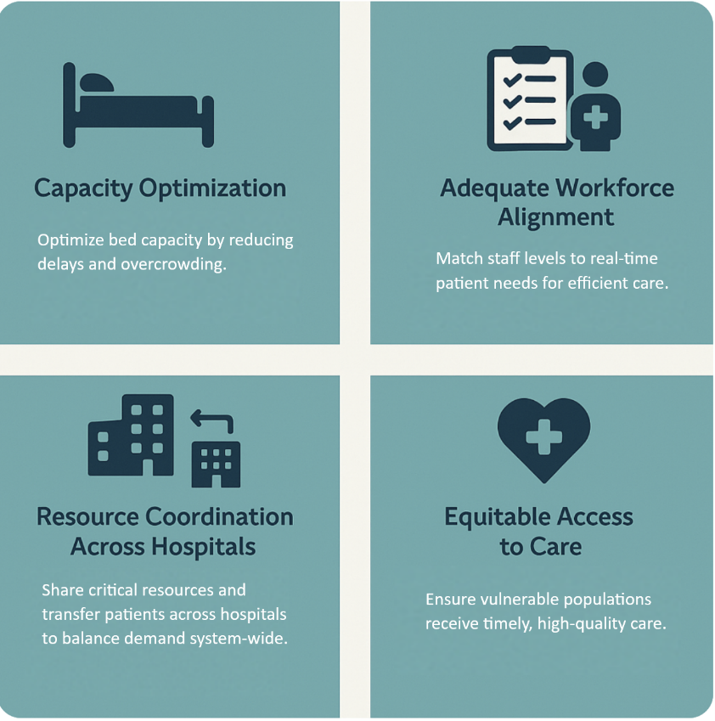
This paper presents the CARE Framework, which includes Capacity Optimization, Adequate Workforce Alignment, Resource Coordination Across Hospitals, and Equitable Access to Care (Figure 1). Each pillar represents an operational decision area. The acronym CARE was selected because the pillars support patient care through more responsive and sustainable systems. Capacity Optimization focuses on forecasting bed capacity, shortening discharge times, and reducing emergency department bottlenecks. Adequate Workforce Alignment matches staffing resources to predicted patient acuity to avoid underuse or overuse. Resource Coordination Across Hospitals tracks, predicts, and redistributes critical resources during surges to support timely transfers and system-wide balance. Equitable Access to Care uses AICCs to identify gaps in service capacity and improve timely access across hospitals. The first two pillars are mainly intra-hospital or intra-system opportunities; resource coordination is explicitly inter-hospital; and equity can operate at both levels. Together, the pillars show how AICCs can convert fragmented operations into an integrated, predictive care model.
Figure 1: Key Components of the CARE Framework
Capacity Optimization
Capacity optimization is a foundation of effective hospital operations, ensuring that patients move smoothly from admission to discharge without unnecessary delays. In many U.S. hospitals, overcrowded emergency departments (ED) and prolonged boarding times disrupt the entire care continuum, increasing patient risk and reducing throughput efficiency. AICCs address this issue by using real-time dashboards and predictive modeling to track bed availability, anticipate discharges, and manage system-wide patient transfers. Here, inputs include ED boarding, staffed beds, surgery schedules, discharge readiness, and transport status; outputs include bed priorities, discharge forecasts, and bottleneck alerts.
Hospitals in Canada and the United Kingdom demonstrate how AICCs can be helpful in capacity management. At Canada’s Humber River Hospital, command-center analytics reportedly supported discharge timing and bed turnover, creating 35 additional inpatient beds [15]. Humber River Hospital reduced acute conservable bed days by 52% and ED patient wait times by 23%, despite an 8% increase in ED visits [16]. Similarly, the UK’s Bradford Teaching Hospitals used real-time data across an 800-bed network to help staff anticipate bottlenecks and place patients in the wards best suited to their care [17, 24]. Bradford reduced bed misallocations by 90% and increased early discharges from 35% to 54% [17]. These case-study outcomes are useful as implementation examples, but they should not be read as causal estimates of AICC impact.
Within the United States, AICCs have shown reported operational gains at Johns Hopkins and Tampa General hospitals. At Johns Hopkins, the AICC brought together access-line staff, bed placement nurses, transport staff, and admitting staff to coordinate incoming transfers, ED admissions, operating room status, staffed beds, and beds waiting to be cleaned [18]. They assigned ED patients to beds 38% faster (3.5 hours faster) after the admission decision [18]. The reported mechanism was faster bed assignment, transfer coordination, and earlier response to inpatient bottlenecks. Occupancy rates rose from 85% to 92% after the implementation of the AICC, with $16 million in incremental savings generated for the hospital. Another example includes Tampa General Hospital, where 30 new beds freed by eliminating 20,000 excess days in patient stay helped generate $40 million in annual savings [19]. These cases show how AICCs can tie capacity data to decisions, while the savings figures should be interpreted as reported operating outcomes rather than isolated causal effects.
Management Actions for Implementing Capacity Optimization:
For healthcare administrators and executives, capacity optimization should be managed using three key indicators: time-to-bed, ED boarding hours, and discharges by noon [20]. Leaders should review these metrics in a daily capacity huddle and assign clear ownership for actions such as accelerating discharges, opening surge beds, and prioritizing inpatient placement from the ED [21]. When these metrics are monitored consistently, hospitals can intervene earlier to reduce boarding and avoid system-wide congestion.
This pillar can be supported through a full AICC or through specific platforms such as TeleTracking or LeanTaaS, which apply AI to bed placement, discharge prediction, ED-to-inpatient throughput, and real-time capacity forecasting [22]. This pillar supports smoother patient flow, reduces bottlenecks, and promotes safer care delivery through more balanced use of hospital capacity.
Adequate Workforce Alignment
Adequate workforce alignment means the ability of hospitals to consistently match available personnel with the intensity and timing of patient care demands. In other words, it means having the right people in the right place at the right time to meet patient needs. This, in practice, is often harder to implement than it sounds. Traditional staffing methods struggle to adapt in environments where patient acuity can change within hours. AICCs address this challenge by using predictive analytics to anticipate census changes and coordinate workforce distribution across departments or entire hospital systems [9].
Hospitals in Australia and Britain illustrate the use of AICCs in predicting and adjusting healthcare personnel. Australia’s Alfred Health has enhanced the accuracy of scheduling for nurses and minimized unexpected overtime through AICCs, which improved staff satisfaction [23]. Similarly, Britain’s Bradford Royal Infirmary implemented AICCs to monitor patient flow and staffing pressure across units [24]. Although quantifiable outcomes are unavailable to the public for these hospitals, the following cases illustrate how AICCs can use available data to optimize the number of staff according to the current circumstances in a hospital. In this pillar, the main decision-point is whether leaders should adjust schedules, float-pool coverage, or redeployment before a unit is understaffed. These hospitals show how AICCs can contribute to properly utilizing the workforce and aiding staff well-being.
Duke University Hospital and the Cleveland Clinic are U.S. hospitals that have shown measurable results with workforce management. Duke Health reported a 95% accuracy rate in predicting staffing needs through using AICC-related tools, leading to $40 million in annual labor savings and a significant reduction in nurse burnout [25]. Similarly, Cleveland Clinic reported that AI-assisted staffing and scheduling reduced workforce response times and allowed supervisors to identify stress points before patient care is affected [26]. These instances show how AICCs help executives make evidence-based staffing interventions that influence staff well-being, patient care, and financial performance. This unique benefit of AICCs shows that staffing precision should be of importance for organizational sustainability.
Management Actions for Implementing Adequate Workforce Alignment
Healthcare leaders must ensure that their workforce is used effectively, starting with real-time monitoring of staff use and anticipation of overall patient surges and droughts via AICCs [10]. The administrative staff should conduct predictive staff meetings every morning to estimate changes in patient volumes and redeploy employees before they run out of capacity [27]. The AICC staffing data allows HR departments and nursing leaders to design float pools and redeploy nurses more efficiently, reducing premium labor costs and improving workforce utilization [28].
It is important to note that leaders should be aware of the human and clinical challenges involved in adaptive staffing. Redeployment is not interchangeable labor, especially in specialized units that require specific competencies, credentials, and orientation. For example, a nurse trained for one ICU environment may not be immediately prepared to work safely in another specialty ICU without orientation, cross-training, or supervisory support. Staff may also resist being flexed away from familiar units on short notice. Therefore, AICC-based staffing should be paired with competency mapping, cross-training, float-pool planning, and frontline feedback to ensure redeployment is safe and practical [29].
In practice, these workforce-alignment actions can be supported through an AICC or through workforce-focused platforms such as UKG and Qventus, which use AI to forecast staffing demand, optimize schedules, and enable real-time redeployment decisions during surges [30]. By incorporating these processes into everyday operations, leaders can maintain workforce preparedness and ensure staff satisfaction, where each staff member can provide the best care possible for patients.
Resource Coordination Across Hospitals
Resource coordination across hospitals is particularly helpful during periods of extreme strain, such as seasonal influenza surges or mass casualty events. During the COVID-19 pandemic, hospitals globally experienced severe operational strains due to shortages of ventilators, ICU beds, personal protective equipment, and infusion pumps [31]. Facilities operated in silos, where a given hospital could run out of required supplies, but nearby hospitals had idle supplies [32]. In this pillar, AICC inputs come from multiple facilities, and outputs include regional strain alerts, transfer recommendations, and resource-allocation priorities. AICCs can predict PPE shortages, manage ICU utilization, and facilitate quicker redistribution of essential resources or patient transfers across multiple hospitals. AICCs, especially those made by General Electric (GE), are data agnostic, meaning that hospitals with varying electronic health records (EHRs) can still feed their data to AICCs for combined analytics [10]. This interoperability enables hospitals with disparate data systems to cooperate efficiently in times of emergencies.
The Saudi Arabia Ministry of Health is a global example of inter-hospital AICCs effectively managing resource coordination in times of crises. AICCs were implemented in all 308 hospitals around the country [10]. The live visibility of ICU beds, available ventilators, and surgical resources were provided to all hospitals, allowing administrators to transfer patients or resources using inter-regional hospital networks. The decision-points were based on where a patient, ventilator, or surgical resource should move within the network. Compared with pre-COVID-19 baseline performance, the network reported a 27% decrease in hospital length of stay and a 60% reduction in surgical wait times, even during peak COVID-19 operational strain [33]. This case illustrates that AICCs may serve as the connective structure between hospitals where supply and demand are brought in line.
There are also examples of AICCs enabling effective resource coordination among U.S. hospitals. The AICC at Oregon Health and Science University received data from all 62 hospitals in Oregon to provide real-time information on ICU occupancy, ventilator utilization, N95 masks, and PPE distribution. Here, the input was statewide data rather than one hospital’s bed board, which helped leaders see where strain was emerging. The system assisted in filling patient populations and alleviated stress on the ICUs of urban and rural facilities in Oregon during the COVID-19 pandemic [34]. On average, the number of days ICUs were stressed (i.e., 80% total ICU capacity or higher) across the country, was approximately 500 days during COVID, while the number of days of stressed ICUs in Oregon was 16 days [35]. Another example of resource coordination is Advent Health in Central Florida, where one AICC connected 11 hospitals and 18 emergency departments. According to this system, hospital-to-hospital lateral transfers increased by over 600% during the pandemic, allowing 2,500 patients to be reallocated to open locations with open ventilators and ICU units [36]. These examples show how AICCs can facilitate hospitals’ ability to share strain during surges while sustaining care delivery.
Management Actions for Implementing Resource Coordination Across Hospitals
For healthcare administrators and executives seeking to manage resources better, data transparency across facilities is integral to gaining maximum benefit. Executives must think about and establish interoperability agreements to enable the exchange of information across hospitals, irrespective of the EHR platform, to identify real-time equipment capacity and availability [37]. The information produced by AICCs will help leadership teams model surge scenarios and know how to reallocate resources during future surges.
Platforms such as Palantir Technologies and WellSky can also support this pillar by strengthening cross-hospital data integration and providing analytics for regional patient transfer, bed capacity visibility, and resource distribution across facilities [19, 38]. The formation of regional logistics teams that move patients, supplies, medications, and staff across hospitals, can further improve resilience as sites approach capacity, allowing for better overall patient care [39]. That helps the AICC output lead to a transfer, resource move, or escalation rather than the creation of another report.
Equitable Access to Care
Increasing equitable access to care is essential to helping hospital systems fulfill their mission of serving patients with fairness and efficiency. Inequities in care tend to be concealed in disjointed hospital operations. These gaps can be seen with AICCs, where data can be integrated among different departments and locations. When wait times, discharges, and transfer approvals are stratified by geography, insurance, language, race, or service line, administrators can identify who is underserved and link that information to capacity decisions. AICCs helps address inequities in care by increasing access to care across diverse communities.
Examples from England and Australia suggest that AICCs can help decrease geographic and systemic inequality. The South Tees Hospitals in England used its AICC to help rural patients gain greater access to specialized services, performing 22% more surgical operations and providing access to 15% more ICU beds during periods of high strain [40]. In Australia, the New South Wales Hospital AICC connects metropolitan and rural hospitals to monitor care delays, reducing rural patient transfer times by 18% and increasing access to care for these patients [23]. These outcomes show how AICCs can bridge service gaps between urban and rural hospitals, ensuring that patients receive timely and equitable access to critical care.
AICCs in U.S. hospitals have also helped increase equitable access to care. Using predictive analytics, Deaconess Health System was able to add capacity without new buildings to serve 2,000 more patients annually, which helped treat underserved populations [41]. Similarly, implementing regional dashboards within Providence Swedish Health System helped in organizing staffing and capacity in many states, providing treatment to more than 5,000 rural patients in the recent year [42]. These U.S. hospitals show how data-driven coordination can expand hospital capacity and create a more inclusive healthcare network. The access benefit depends on whether leaders use the information to change routing, scheduling, transfer approval, or outreach decisions.
Management Actions for Implementing Equitable Access to Care
For healthcare leaders, advancing equity requires administrators to consider demographic and geographic data such as wait times, transfer rates, and patient outcomes within AICCs to identify disparities and emerging trends [43]. Equity analytics platforms such as Arcadia and Veradigm can support this work by using AI-enabled predictive analytics and stratified dashboards to surface disparities in wait times, transfer patterns, and outcomes by race, language, insurance status, and geography, making inequities visible and trackable over time [44].
Leadership teams can establish unified transfer and diversion protocols that automatically direct patients from lower resourced hospitals to those with available capacity, ensuring system-wide balance [45]. Executives should conduct regular reviews of equity scorecards and communicate progress transparently to both staff and the community to promote trust and shared responsibility in achieving equitable care.
Equity-focused expansion also requires financial planning; if an AICC increases transfers, admissions, or specialty access for underinsured or uninsured patients, the hospital may experience higher uncompensated care and not fully realize the financial benefits of the AICC. This does not weaken the ethical case for equitable access, but it does mean that leaders should monitor payer mix, uncompensated care, charity care, avoided transfers, and downstream reimbursement when evaluating AICC return on investment [46]. This is especially important because many hospitals already operate with limited margins and face pressure from labor costs, supply costs, Medicare and Medicaid underpayment, and rising uncompensated care.
Implementing and Operationalizing an AI Command Center
To utilize the CARE framework effectively, hospitals must first implement an AI Command Center (AICC). Generally, large academic or multi-hospital systems are best positioned to lead the adoption of AICCs due to the scale of data and coordination involved, as well as the significant capital investment required [9]. Medium to smaller-sized hospitals can participate by partnering with larger health system AICCs and feed their data virtually. It is important to note that an AICC is only as reliable as the source data entered by each facility. Bed status, staffing availability, discharge readiness, supply counts, and patient acuity can be delayed, incomplete, or shaped by local workflow pressures. Therefore, AICC implementation should include data governance, standardized definitions, audit checks, and leadership accountability before outputs are used for staffing, transfer, or resource decisions. This approach has been demonstrated to be effective through Oregon Health and Science University’s AICC and the state’s surrounding hospitals during the COVID-19 pandemic [35]. This type of collaborative approach ensures hospitals of all sizes benefit from AICC insights and move toward a connected data-driven healthcare network.
Although there are AI-enabled platforms discussed in this paper that support individual CARE pillars (e.g., TeleTracking, Qventus, and Palantir), GE Healthcare’s Command Center model is positioned as a comprehensive solution that integrates these pillar-specific capabilities into a single, unified AI Command Center to operationalize the CARE framework across hospital operations [47]. This comparison is presented to distinguish between pillar-specific implementations and enterprise-wide command center models rather than to endorse a specific vendor.
Starting an AICC from the ground up will require a multidisciplinary effort involving administrators, IT specialists, executives, physicians, and nurses [9]. Early engagement of diverse staff ensures that the AICC reflects the hospital’s unique operational challenges and addresses staff apprehension about AI. When clinicians and frontline teams participate in shaping the system, they develop a sense of ownership that promotes trust and confidence in technology. Likewise, involving executives and department leaders in this process creates an environment of collaboration where both clinical and administrative stakeholders are invested in the AICC’s success.
Historically, the operational capabilities of AICCs are implemented in phases, with, for example, an initial focus on capacity management, then on staffing alignment, and subsequently, on other areas of operations covered under the CARE framework [48]. In the process of implementing AICCs, administrators and executives can learn from early adopters. For example, Johns Hopkins Hospital has hosted hundreds of peer visits and helped over 20 other institutions, such as Duke Health, New Haven Health, and HCA Healthcare, launch their own AICCs based on their experiences [18]. Such collaboration will accelerate adoption and help hospitals to turn data insight into system-wide improvements in operational performance.
Administrators must also plan for a significant investment; building a state-of-the-art AICC could cost roughly $10,000,000 or more [49]. Although upfront costs are significant, hospitals have reported substantial returns: Virginian Franciscan Health achieved a 12:1 ROI, Johns Hopkins generated $16 million in savings, and Tampa General and Duke Health each reported $40 million in savings [50-52, 25]. While these savings are promising, they should be interpreted cautiously. In many hospitals, command center implementation occurs alongside broader performance improvement work, process redesign, staffing changes, and leadership attention to throughput. Therefore, the impact of AICCs could be more safely interpreted as an enabling infrastructure that helps hospitals organize, accelerate, and sustain operational improvement efforts. In sum, launching an AICC is a significant investment, but the return may justify the cost when the center is paired with process redesign, reliable data, and clear decision ownership. Reported financial gains should still be attributed cautiously.
Conclusion
AI Command Centers (AICCs) can reshape how hospitals operate by creating interconnected systems that use real-time data and predictive analytics to improve patient flow, resource utilization, and overall care quality. Guided by the CARE framework, they bring structure and foresight to hospital management. When hospitals implement AICCs with reliable data, clear workflows, and human oversight, these centers can support more efficient and equitable care in an increasingly complex healthcare system.
References
- Kurhayati K, Emaliyawati E, Trisyani Y. An updated scoping review of factors associated with length of stay in emergency department. Journal of Multidisciplinary Healthcare. 2025;18:3191-3203. https://doi.org/10.2147/JMDH.S525451
- American Nurses Association. Nursing shortage fact sheet. 2022.
- Spoehr C. New AAMC report shows continuing projected physician shortage. Association of American Medical Colleges. 2024. https://www.aamc.org/news/press-releases/new-aamc-report-shows-continuing-projected-physician-shortage
- Sandhu P, Shah AB, Ahmad FB, et al. Emergency department and intensive care unit overcrowding and ventilator shortages in US hospitals during the COVID-19 pandemic, 2020-2021. Public Health Reports. 2022;137(4):796-802. https://doi.org/10.1177/00333549221091781
- Ndugga N, Hill L, Artiga S. Key data on health and health care by race and ethnicity. KFF. 2024.
- Lawal AK, Rotter T, Kinsman L, Sari N, Harrison L, Jeffery C, Kutz M, Khan MF, Flynn R. Lean management in health care: definition, concepts, methodology and effects reported: systematic review protocol. Systematic Reviews. 2014;3:103.
- Rabiei R, Almasi S. Requirements and challenges of hospital dashboards: a systematic literature review. BMC Medical Informatics and Decision Making. 2022;22(1):287. https://doi.org/10.1186/s12911-022-02037-8
- Filip R, Gheorghita Puscaselu R, Anchidin-Norocel L, Dimian M, Savage WK. Global challenges to public health care systems during the COVID-19 pandemic: a review of pandemic measures and problems. Journal of Personalized Medicine. 2022;12(8):1295.
- Small T, Baker L, Egizi A, Lesser P, Sindha I. Assessing the value of a command center model in large health care delivery systems. Deloitte Center for Government Insights. 2024.
- GE HealthCare. AI command center outcomes in U.S. hospitals. GE HealthCare Reports. 2025.
- OR Today Magazine. Tampa General Hospital and GE Healthcare’s CareComm saves $40 million. OR Today. 2020.
- American Hospital Association. Fast facts on U.S. hospitals, 2025. American Hospital Association. 2025.
- Olsen E. More hospitals using predictive AI, but disparities persist: ASTP. Healthcare Dive. 2025.
- Baten R. How are US hospitals adopting artificial intelligence? Early evidence from 2022. Health Affairs Scholar. 2024;2(10). https://doi.org/10.1093/haschl/qxae123
- Humber River Health. Humber’s Quality Command Centre helps deliver better, faster, and safer patient care: year one in review. GE HealthCare. 2019.
- Analytics Informs. Command Center Analytics Revolutionize Healthcare. Analytics Magazine. 2018.
- HTN Health. Case study: Bradford Teaching Hospitals NHS FT command centre. HTN Health Tech News. 2024.
- Keating K. Capacity Command Center celebrates 5 years of improving patient safety, access. Johns Hopkins Medicine. 2021. https://www.hopkinsmedicine.org/news/articles/2021/03/capacity-command-center-celebrates-5-years-of-improving-patient-safety-access
- Tampa General Hospital. Tampa General Hospital and GE Healthcare’s CareComm saves $40 million, cuts 20,000 excess days and reduces length of stay. 2024.
- Bailey R, Segon A, Garcia S, Kottewar S, Lu T, Tuazon N, Sanchez L, Gelfond JA, Bowling G. Increasing and sustaining discharges by noon: a multi-year process improvement project. BMC Health Services Research. 2024;24(1):478. https://doi.org/10.1186/s12913-024-10960-x
- Al Harbi S, Aljohani B, Elmasry L, Baldovino FL, Raviz KB, Altowairqi L, Alshlowi S. Streamlining patient flow and enhancing operational efficiency through case management implementation. BMJ Open Quality. 2024;13(1):e002484. https://doi.org/10.1136/bmjoq-2023-002484
- Anumolu S, Samant M. Optimizing hospital bed capacity: how lean-AI integration prevents capacity constraints from multiplying demand. Intelligent Hospital. 2026;100048. https://doi.org/10.1016/j.inhs.2026.100048
- Australian Digital Health Agency. DHA annual report. Australian Digital Health Agency. 2024.
- NHS Confederation. Managing patient care through an AI-powered command centre. NHS Confederation. 2024. https://www.nhsconfed.org/case-studies/managing-patient-care-through-ai-powered-command-centre
- Sohail S. Duke Health to deploy GE Healthcare’s Hospital Pulse Tile for Command Center. Healthcare IT News. 2024.
- Cleveland Clinic. How AI assists with staffing, scheduling and once-tedious tasks. Cleveland Clinic Consult QD. 2025.
- Singh K, Nashwan AJ. Innovative forecasting models for nurse demand in modern healthcare systems. World Journal of Methodology. 2025;15(3):99162. https://doi.org/10.5662/wjm.v15.i3.99162
- Knight S. How to master float pool management in hospitals. Shiftmed Blog. 2025. https://www.shiftmed.com/insights/knowledge-center/how-to-master-float-pool-management-in-hospitals/
- American Nurses Association. Patient classification and acuity systems. 2017. https://www.nursingworld.org/globalassets/practiceandpolicy/work-environment/nurse-staffing/website-staffing-and-acuity-systems-pdf-final_2017.pdf
- Hijazi S. AI-enabled hospital workflow automation and efficiency tools: the new operating system for modern health systems. Research2Guidance. 2025. https://research2guidance.com/ai-enabled-hospital-workflow-automation-efficiency-tools-the-new-operating-system-for-modern-health-systems/
- Arabi YM, Myatra SN, Lobo SM. Surging ICU during COVID-19 pandemic: an overview. Current Opinion in Critical Care. 2022;28(6):638-644. https://doi.org/10.1097/MCC.0000000000001001
- Peiris D, Feyer AM, Barnard J, Billot L, Bouckley T, Campain A, Cordery D, et al. Overcoming silos in health care systems through meso-level organisations: a case study of health reforms in New South Wales, Australia. The Lancet Regional Health – Western Pacific. 2024;44:101013. https://doi.org/10.1016/j.lanwpc.2024.101013
- Saudi Ministry of Health. Ministry of Health reports advancements in Ada’a health indicators. Ministry of Health Saudi Arabia. 2024.
- Wentz-Graff K. OHSU Mission Control offers modern, high-tech solution to historic challenge. OHSU News. 2019.
- Radley D, Baumgartner J, Collins S. 2022 scorecard on state health system performance. The Commonwealth Fund. 2022.
- Advent Health. AdventHealth Mission Control drives improved emergency department outcomes. AdventHealth. 2022.
- Pylypchuk Y, Everson J. Interoperability and methods of exchange among hospitals in 2021. ASTP Health IT Data Brief. 2023.
- WellSky. Care coordination software: WellSky. 2026. https://wellsky.com/care-coordination-software/
- Zamani H, Parvaresh F, Isfahani MN. Optimizing patient flow logistics: strategic challenges, tactical solutions, and future directions. BMC Health Services Research. 2025;25:1382. https://doi.org/10.1186/s12913-025-13516-9
- NHS England. NHS artificial intelligence (AI) giving patients better care and support. NHS England. 2024. https://www.england.nhs.uk/2024/12/nhs-ai-giving-patients-better-care-and-support/
- Deaconess Health System. Deaconess Health System increases access to care with Capacity Management System. GE HealthCare Command Center. 2023.
- Providence Swedish. Regional command center helps create capacity for 19,000 additional patients annually at Providence Puget Sound. GE HealthCare Command Center. 2025.
- Boyer B, Huber K, Zimlichman E, Saunders R, McClellan M, Kahn C, Noach R, Salzberg C. Advancing the future of equitable access to health care: recommendations from international health care leaders. Health Affairs Scholar. 2024;2(8):qxae094. https://doi.org/10.1093/haschl/qxae094
- Lavi S. Arcadia vs Veradigm (2026): pricing and hidden fees revealed. ITqlick. 2025. https://www.itqlick.com/compare/arcadia-analytics/allscripts-ehr
- Richert ME, Diao G, Mancera A, Badesch B, Neupane M, Amirahmadi R, Sarzynski SH, et al. Statewide transfer coordination and patient transfer rates among hospitals during occupancy stress. JAMA Network Open. 2025;8(12):e2546002. https://doi.org/10.1001/jamanetworkopen.2025.46002
- American Hospital Association. 2024 costs of caring: America’s hospitals and health systems continue to face escalating operational costs and economic pressures as they care for patients and communities. American Hospital Association. 2025. https://www.aha.org/guidesreports/2025-04-28-2024-costs-caring
- Oscarson N, Paxman E. Healthcare Operations Command Center ecosystem 2021. KLAS Research. 2021.
- Oosterlinck K, Eveline D, Follet P, Djellouadji S. Measurable improvements in bed and staff capacity with hospital command centers. IQVIA. 2021.
- Kettering Health. Kettering Health Network opens NASA-like command center. Strive. 2019. https://ketteringhealth.org/greene-memorial-hospital-receives-a-safety-grade-from-leapfrog-group/
- Franciscan Health. Virginia Mason Franciscan Health Mission Control helps synchronize the entire patient experience. GE HealthCare Command Center. 2021.
- Freeman G. Hopkins Command Center improves quality with coordination. Clinician. 2017.
- Roth M. Artificial intelligence delivers $40M in real savings to Tampa General. HealthLeaders Media. 2020.