
Tags: Perspective
Kendall Owen, University of Central Florida, Fernanda Gushken, University of Miami/Jackson Health System, KD Frick, Johns Hopkins University
Contact: vina.frick@jhu.edu
Abstract
What is the message? The authors explore how the biological aspects of women’s health that are distinct from men’s health, create opportunities for businesses to innovate, specifically through problem identification, leadership prioritization, product development, and changing processes.
What is the evidence? An analysis of academic research articles, as well as government and industry data.
Timeline: Submitted: August 25, 2025; accepted after review September 30, 2025.
Cite as: Owen, Kendall, Gushken, Fernanda, Frick, K. Davina. 2025. Business Interest and Innovation in Women’s Health: It’s More Than Improving the Function and Margin for OB/GYN Practices. Health Management, Policy and Innovation (www.HMPI.org). Volume 10, Issue 2.
Introduction
What does the “business of women’s health” imply?
The term is sometimes interpreted as narrowly as the business of producing reproductive health services, hence our title. However, there are several examples of efforts to expand the definition of women’s health and the related conceptualization of the business of women’s health. For example, the mission of the Jacob Institute for Women’s Health is to: “Identify and study aspects of healthcare and public health, including legal and policy issues, that affect women’s health at different life stages” (https://jiwh.publichealth.gwu.edu/about accessed on 2025-08-20). Further, the institute’s official journal, Women’s Health Issues, describes itself as, “a peer-reviewed… journal…related to women’s health care and policy…dedicated to improving the health and health care of all women throughout the lifespan and in diverse communities” (emphasis in the original, https://www.sciencedirect.com/journal/womens-health-issues, accessed on 2025-08-20).
Neither source formally defines women’s health; each emphasizes a lifetime approach extending beyond reproductive health. Generative AI system Claude proposes a working definition: “the branch of healthcare that focuses on the treatment and diagnosis of diseases and conditions that affect women’s physical and emotional well-being.” This includes gender-specific conditions and prevention to reproductive health.
All individuals assigned female at birth face must take care of their reproductive systems, regardless of intent to have children. There are also conditions that inordinately affect individuals assigned female at birth, including breast cancer and autoimmune conditions.[1],[2] At the same time, all who present as female may experience mental well-being issues linked to discrimination and inequity.
Essue et al. outline a lifelong model that highlights virtuous and vicious cycles for society related to investment or disinvestment in health.[3] Building on this, our goal is to present a narrower conceptual model that examines how health impacts business and then the opportunities available to business when accounting specifically for women’s health as a part of the innovation process.
The Impact of Health on Business
Even a model narrower than Essue et al.’s must move beyond viewing the business impact of women’s health as simply the improved management of a healthcare practice for women; the same would be true for men. A discussion of the impact of men’s health on business could be treated similarly. This discussion will focus on the unique aspects of women.
Reducing health to a single sector ignores the daily struggles related to health and understates the broader impact of health on business and society.[4] For example, poor maternal health has lasting generational effects, shaping a young child’s development, behavior, school performance, and ultimately, adult health and productivity.[5] Women’s health directly influences labor force performance and economic production, with broader consequences for society.
Women’s health impacts the labor force both within healthcare and across other industries. It also affects the production of goods and services related to women’s health, influences women’s (and the family’s) health behaviors connected to broader markets, and drives research that expands knowledge of the implications. These same factors feed back into women’s health, creating a cycle that can drive innovation and economic growth.
The business of providing women’s healthcare fits into a much larger framework in which other businesses impact women’s health — and women’s health can impact all businesses. Figure 1 illustrates the bidirectional relationship that health has across consumption, production, and human capital. Consumption related to health goes beyond healthcare, including categories such as alcohol, food, and gym memberships. While many goods and services, such as entertainment, may not directly affect health, healthier women generally earn more income and spend less on healthcare. This increases discretionary spending, stimulates demand, and accelerates economic growth. At the same time, women make up a significant share of the labor force — especially in healthcare — further reinforcing these dynamics.
Figure 1. Conceptual Model of Business Interests in Women’s Health
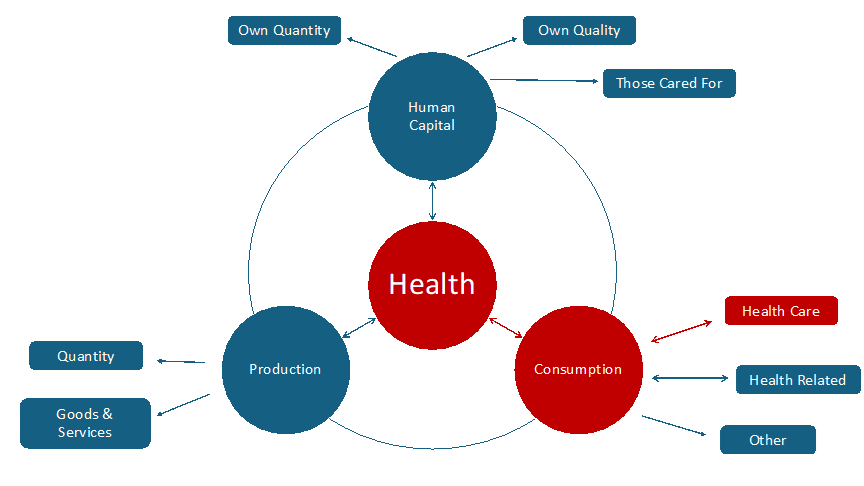
Human capital affects production and consumption, although the term is more often applied to production. Healthier individuals are more likely to pursue education and training (see Asigbee et al.[6] for an example) and develop stronger information processing skills, participate in the labor force,[7] and earn higher income.[8] These factors improve the efficiency of production and drive greater consumption.
Reasons for Business Interests in Women’s Health
Businesses have incentives to engage with women’s health that go beyond the production of health services specific to women. One estimate suggests that improving the lives and health of women, will increase annual GDP by approximately $1 trillion by 2040.[9] On average, women live longer and experience 25% more of their lives in poor health than male counterparts.[4]
Women’s health issues begin with reproductive health, including but not limited to abortion bans and maternal mortality. Additionally, chronic disease (particularly autoimmune conditions), mental health, and some cancers can affect women differently than men (e.g., unique conditions, conditions that are more severe for women, or conditions with a higher incidence for women). Notably, approximately 56% of the women’s health burden is made up gynecological conditions, headache disorders, and heart conditions.[9]
One study found that 64% of health interventions are less effective for women than for men, or women lack access altogether.[9] For example, asthma inhalers are 20% less effective in women.[10], [11], Research sometimes overlooks women’s conditions resulting in disability but not death.[9] Preventing disability can generate broad societal benefits. Improving women’s health expands participation in the labor force, increases productivity, reduces the prevalence of health conditions, and reduces early deaths, allowing women to contribute more significantly the economy.[9]
Labor Force
Women make up 40% of the global labor force.[12] Women outside the formal labor force still contribute to the economy, in part by helping to make those in the labor force more productive: caring for loved ones, cooking, cleaning, and raising children.
Workplace health benefits, including mental health support, expanding digital health offerings, and addressing cost barriers, have been shown to positively impact the productivity and participation of women.[13] Greater access to these benefits can decrease absenteeism and presenteeism, improve productivity, talent attraction, retention, workplace culture, and brand reputation.[13]
Women in the Healthcare Labor Force
Women account for more than three-quarters of healthcare workers, including physicians, dentists, veterinarians, nurses, medical assistants, and speech pathologists.[14] In the United States, approximately 85% of resident doctors in obstetrics and gynecology are women,[15] underscoring the importance of optimizing women’s health and workplace safety for the future of humanity.
Women may spend nearly nine years of their lives in sub-optimal health, limiting their ability to be present or productive at work.[9] In healthcare settings, that can increase the risk of medical errors. Decreased availability of female healthcare workers can delay appointments, result in fewer patients being seen, and ultimately decrease community health. Women’s health affects the health of society as a whole.
Healthcare Goods & Services
Women influence healthcare through money and time allocated to their own healthcare and that of those for whom they care. On average, women spend more on healthcare than men.[9] Women live an estimated 5.7 years longer than men, resulting in more years living with poor health.[9]
Many products are not tailored for gender-specific use, overlooking differences between men and women. For example, women are 52% more likely to have adverse side effects from medications than men and 36% more likely to have serious or fatal events.[9] Even safety features like seat belts and airbags rely on crash tests using dummies based largely on the male body’s build.[16] Goods and services driving women’s health can be used to identify health issues and treat dysfunctional body systems, to protect women from injury, to track health behaviors, and to support mental health.
Women’s health also influences the quantity and quality of general goods and services sold in the market and put to use. Healthier women spend less in formal healthcare settings, such as primary care appointments and ER visits, freeing up resources for other health-related products. As women are more commonly primary caretakers,[17] a society with healthier women can provide better care for others, contributing to economic growth.
Health Behaviors
Health behaviors include lifestyle factors and actions impacting health, e.g., alcohol consumption, smoking, diet, exercise, and seeking healthcare. A woman may exercise and diet, and then purchase a fitness tracker or diet plan. These could improve health and contribute to GDP. Women and men adopt different health behaviors; e.g., women are more likely to use meditation as a way to decrease stress and are more likely to experience stress reduction after meditation.[18] Variation in lifestyle factors is important in understanding opportunities to improve women’s health. Tailoring gender-specific strategies can amplify the impact.
Research
Women make up approximately 33% of researchers in the world.[19] Many of these women study women’s health conditions. Given women’s poorer health, over a third of the research workforce is limited in their availability to do research. Deficits in knowledge regarding women’s health impacts the health of researchers. For example, with an incomplete understanding of disorders like endometriosis, diagnosis and treatment may be delayed by years. While women are not the only ones capable of advancing research on women’s health, having researchers who share lived experiences with the populations they study can increase empathy and accelerate translation of findings into practice.
New research suggests that sex chromosomes are active in every cell of the body throughout the entire course of a person’s life, not just their early development.[20] Women, however, are often underrepresented in research areas like heart disease, HIV medications, or COVID-19 vaccinations.[20] Women only recently began to make up 50% of those included in clinical trials; these participants are mainly white women.[4] Women of different races or other diverse characteristics are often excluded due to their “complexity” or “complicated history.”[9]
Researching heart disease, cancer, and mental health in women could lead to fewer missed, inaccurate, or delayed diagnoses. Some disabling conditions lack efficient diagnostic procedures, creating long processes that lead to the need for research to produce higher precision diagnostics and treatments.[20] Less than 15% of funding goes towards research on women’s health-specific conditions.[9] More funding for women’s health-specific research, along with research on conditions affecting women disproportionally, could drive economic growth.[9]
Business of Innovation Considering Women’s Health
An exploration of how business might innovate in light of the realities of women’s health issues, particularly ones that are inherently biological, is a logical follow-up to the discussion on the impact of women’s health on business. For inherently biological issues, a moral argument would be made for business (and society at large) not to necessarily expect exactly the same of women, but to innovate to maximize opportunity and potential for growth around women’s health concerns. (This might extend to other demographic subgroups, but the biological nature of health concerns specific to women is unique.)
Figure 2 summarizes the process of innovation with women’s inherently biological health concerns in mind. Starting from the upper left-hand quadrant, innovation often begins with framing an existing issue in a way that identifies an opportunity for change that was not noticed before. Allowing the framing to explicitly recognize unique risks that, on average, impact more of women’s potential productive time than men’s, could help in the redesign of leadership, products, and processes to allow women to have a greater amount productive time, to be more productive, and to have greater choices of their use of time associated with well-being.
Figure 2. Business Innovation and Women’s Health

Moving around the circle, leadership willing to normalize the discussion of women’s health in decision-making, product development, and business processes will encourage the most relevant innovation. Leadership can develop a workplace culture providing space to discuss women’s health, its impact, and the moral, ethical, and economic implications of approaching women’s health issues directly. As mentioned earlier, women may spend nearly nine years of their lives in sub-optimal health;[9] leaders prioritizing facilitating human capital development, productivity, and positive life experiences around the less than optimal health experience is an opportunity to enhance economic growth for women, their families, and their communities.
Proceeding to the lower right-hand quadrant, some of the innovative product solutions will allow more women to choose to be more productive. These will more likely be produced to maximally benefit women if the framing is approached through the lens of leaders spearheading innovation focused on the biologically inherent concerns.
Finally, business processes that might be adapted include general human resource policies, benefits policies within human resources, and teamwork expectations and norms; these might be adapted to account for the cyclical nature of reproductive health issues, flare-ups that occur in many autoimmune conditions, and intensity of treatments for female-specific cancers. For example, the provision of health benefits through an employer that are used more by women, such as mental health or reproductive health support, will give women increased access to healthcare. Greater use is expected to yield increased participation and productivity in the workplace.[13]
More advanced technology can keep teams connected and allow for continued productivity. Better data facilitates understanding the impact of biologically inherent women’s health conditions on productivity. Technology may allow women to be as productive as they choose. Given these factors, the goal of innovating can be to allow women and those who depend on them, the maximum opportunity for economic success while accounting for biologically inherent women’s health concerns.
Conclusion and Preview
This article adds to the understanding of the business of women’s health by summarizing often underexplored opportunities for the innovation of products, processes, leadership, and problem identification. The goal is to enhance businesses by developing products, processes, and norms that account for women’s biologically inherent health issues rather than expecting them to behave exactly like men despite these issues.
One piece in this issue of HMPI focuses on women not being included in decisions on what innovation should occur, and another on encouraging innovation with a life course perspective. While many of the papers focus on healthcare, there remain opportunities to explore innovation both to improve women’s health and to account for women’s health in the way businesses is conducted.
References
[1] de Blok CJM, Wiepjes CM, Nota NM, van Engelen K, Adank MA, Dreijerink KMA, Barbé E, Konings IRHM, den Heijer M. Breast cancer risk in transgender people receiving hormone treatment: nationwide cohort study in the Netherlands. BMJ. 2019;365:l1652. doi: 10.1136/bmj.l1652.
[2] van Drongelen V, Rew J, Billi AC. Sex bias in autoimmunity: new findings and new opportunities. JID Innov. 2025;5(5):100391. doi: 10.1016/j.xjidi.2025.100391.
[3] Essue BM, Danforth K, Langer A, Acharya P, Knaul FM. The economics of investing in women and health. Nat Med. 2025 Aug;31(8):2532-2545. doi: 10.1038/s41591-025-03864-8. Epub 2025 Aug 7. PMID: 40775054.
[4] Johnson PA, Brindis CD, Donelan K, Goodwin M, Harris L, Kozhimannil KB, Rosenbaum S, Weitz TA. New directions for women’s health: expanding understanding, improving research, addressing workforce limitations. Health Aff. 2025;44(2). doi: 10.1377/hlthaff.2024.01004.
[5] Onarheim KH, Iversen JH, Bloom DE. Economic benefits of investing in women’s health: a systematic review. PLoS One. 2016;11(3):e0150120. doi: 10.1371/journal.pone.0150120.
[6] Asigbee FM, Whitney SD, Peterson CE. The link between nutrition and physical activity in increasing academic achievement. J Sch Health. 2018;88(6):407-415. doi: 10.1111/josh.12625.
[7] Johnson CY, Rocheleau CM, Lawson CC, Grajewski B, Howards PP. Factors affecting workforce participation and healthy worker biases in U.S. women and men. Ann Epidemiol. 2017 Sep;27(9):558-562.e2. doi: 10.1016/j.annepidem.2017.08.017. Epub 2017 Aug 25. PMID: 28890283; PMCID: PMC5836747.
[8] Pinna Pintor M, Fumagalli E, Suhrcke M. The impact of health on labour market outcomes: a rapid systematic review. Health Policy. 2024 May;143:105057. doi: 10.1016/j.healthpol.2024.105057. Epub 2024 Mar 26. PMID: 38581968.
[9] Ellingrud K, Pérez L, Petersen A, Sartori V. Closing the women’s health gap: a $1 trillion opportunity to improve lives and economies. McKinsey Health Institute; 2024 Jan 17. Available from: https://www.mckinsey.com/mhi/our-insights/closing-the-womens-health-gap-a-1-trillion-dollar-opportunity-to-improve-lives-and-economies#/
[10] Loymans RJ, Gemperli A, Cohen J, Rubinstein SM, Sterk PJ, Reddel HK, Juni P, ter Riet G. Comparative effectiveness of long-term drug treatment strategies to prevent asthma exacerbations: network meta-analysis. BMJ. 2014;348:g3009. doi: 10.1136/bmj.g3009.
[11] Wells KE, Peterson EL, Ahmedani BK, Severson RK, Gleason-Comstock J, Williams LK. The relationship between combination inhaled corticosteroid and long-acting β-agonist use and severe asthma exacerbations in a diverse population. J Allergy Clin Immunol. 2012;129(5):1274-1279.e2. doi: 10.1016/j.jaci.2011.12.974.
[12] World Bank. Labor force, female (% of total labor force) | World Bank Gender Data Portal. Washington, DC: World Bank; 2025. Available from: https://genderdata.worldbank.org/en/indicator/sl-tlf-totl-fe-zs?view=trend&geos=WLD.
[13] Ghouralal S-L, Bonner C. Innovative benefit design for women’s health. Integrated Benefits Institute; 2024.
[14] Cheeseman Day J, Christnacht C. Your health care is in women’s hands. Washington, DC: U.S. Census Bureau; 2019 Aug 14. Available from: https://www.census.gov/library/stories/2019/08/your-health-care-in-womens-hands.html.
[15] Sabbah G, Tsai D, Sheffler P, Nahas S, Stuparich M, Behbehani S. Bridging the gap: how gender representation in obgyn residency programs compares to other specialties. Am J Obstet Gynecol. 2022;226(3):S1331. doi: 10.1016/j.ajog.2021.12.105.
[16] Linder A, Svensson MY. Road safety: the average male as a norm in vehicle occupant crash safety assessment. Interdiscip Sci Rev. 2019;44(2):140-153. doi: 10.1080/03080188.2019.1603870.
[17] National Alliance for Caregiving. Caregiving in the US: family caregiving by gender. Caregiving in the US 2025; 2025. doi: 10.26419/ppi.00373.006.
[18] Upchurch DM, Johnson PJ. Gender differences in prevalence, patterns, purposes, and perceived benefits of meditation practices in the United States. J Womens Health. 2019;28(2):135-142. doi: 10.1089/jwh.2018.7178.
[19] UNESCO. One in three researchers is a woman. Paris: UNESCO; 2023. Available from: https://www.unesco.org/en/articles/one-three-researchers-woman.
[20] Snair M. Overview of research gaps for selected conditions in women’s health research at the National Institutes of Health: proceedings of a workshop—in brief. Washington, DC: National Academies Press; 2024. Available from: https://doi.org/10.17226/27932.