
HMPI

Strategies for Dealing with Supply Chain Disruptions

From the Health Sector Supply Chain Research Consortium (Eugene Schneller, Director), CAPS Research & Arizona State University, W. P. Carey School of Business

Contact: Eugene Schneller, gene.schneller@asu.edu

Eugene Schneller is an experienced academic leader, researcher, and administrator with extensive experience at the university, college, and departmental levels. As Associate Dean of the College of Business at Arizona State University (ASU), he was responsible for operations of one of the largest colleges of business in the United States.

Abstract

What is the message?

  • Supply chain disruptions are especially threatening in the health sector, where the delayed deliveries and lack of substitute products may mean postponing patient care. The most critical factor in managing supply chain disruptions is discovery speed. In turn, buyers are most likely to maintain relationships with suppliers that actively involve themselves in identifying problems and managing recovery from disruptions, using strategies that focus on maintaining a buyer’s trust in the supplier’s ability.

What is the evidence?

  • Scrutinizing how firms outside the health sector manage disruptions offers important lessons for health sector leaders. Two studies of supply chain disruptions examine the costs of the problems and the effectiveness of different approaches to recovering from the disruptions.

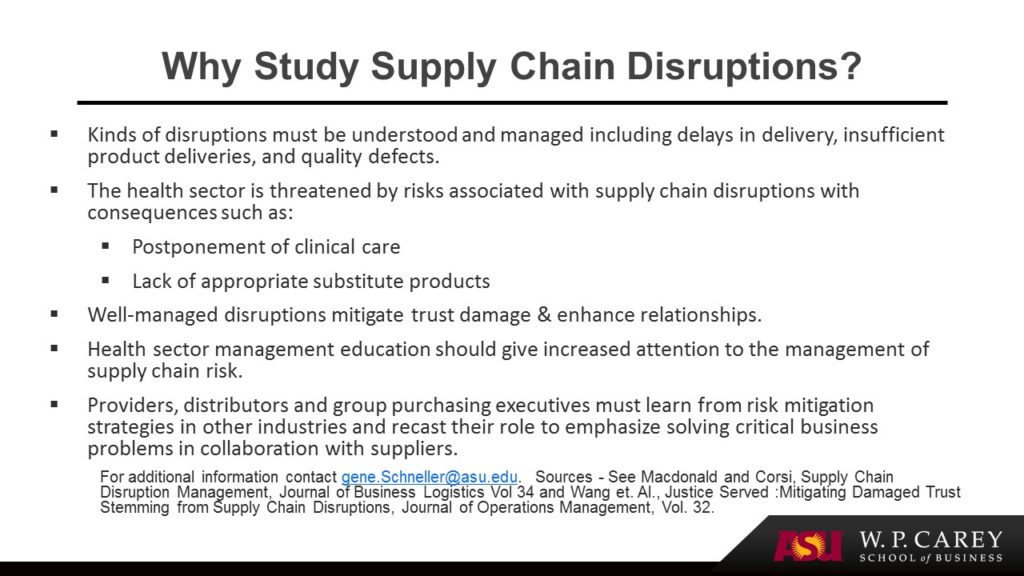
Links: Slide

Submitted: August 20, 2016; Accepted after review: October 30, 2016

Cite as: Eugene Schneller. 2017. Strategies for Dealing with Supply Chain Disruptions. Health Management Policy and Innovation, Volume 2, Issue 1.

|

Introduction

Supply chain disruptions in healthcare such as recalls and shortages of pharmaceutical and medical/surgical products commonly harm clinical quality, regulatory compliance, and patient safety (see Figure 1). Even with sound risk management practices, severe disruptions can arise unexpectedly. Healthcare professionals need to establish flexible processes to identify and manage supply chain disruptions once they occur. This article summarizes recent research on managing supply chain disruptions.

Supply chain disruptions move through four phases: (1) the disruption event, (2) discovery of the event, (3) recovery from the disruption, and (4) redesign of the supply system. Although each phase requires thoughtful attention, the most critical factor in managing disruptions is often discovery speed. Following supplier-induced disruptions, suppliers benefit from using procedural justice strategies that restore buyers’ trust in their abilities.
 

Studies

Study 1: Managing supply chain disruptions

Study context: This study examined 34 supply chain disruptions from 17 firms, each of which experienced a well-managed supply chain disruption and a disruption that could have been managed better (MacDonald & Corsi, 2013).

Findings: Supply chain disruptions such as product recalls and quality failures are particularly challenging to address. Such internal disruptions commonly take substantial time to discover, face slow recovery times after discovery, and require large buyer-supplier recovery teams that are difficult to manage. Disruptions that are slow to discover incur particularly large financial costs. Firms that actively monitor supply chain activities are best able to discover problems early and then determine the disruption’s root causes. Early identification and diagnosis then facilitate smooth recovery.

Study 2: Mitigating damaged trust resulting from disruptions

Study context: This study examined 604 supplier-induced disruption incidents from Chinese manufacturers, including delivery delays, delivery shortages, and major quality defects. The researchers used organizational justice theory to examine how approaches suppliers used to resolve the disruptions affected buyers’ trust in the buyer-supplier relationships and, in turn, whether the relationships continued (Wang, Craighead, and Li, 2014).

Findings: Buyers were most likely to maintain relationships with suppliers that actively involved themselves in managing recovery from the disruption. Supplier strategies that focused on maintaining a buyer’s trust in the supplier’s ability (procedural justice) were most successful in limiting damage to trust. By contrast, simply encouraging buyers to support the suppliers (conserve supplier benevolence) did not help maintain a relationship.

Summary

Supply chain disruptions can spill down the value chain far beyond the initial problems. Both parties in a buyer-supplier relationship need active processes for identifying problems quickly, diagnosing the causes of the disruptions, and addressing the root causes. In doing so, suppliers need to focus on maintaining buyers’ confidence in their capabilities and their ability to avoid future problems.


REFERENCES

Macdonald, J. R., & Corsi, T. M. 2013. Supply Chain Disruption Management: Severe Events, Recovery, and Performance. Journal of Business Logistics, 34(4), pages 270–288.

Wang, Q., Craighead, C. W., & Li, J. J. 2014. Justice served: Mitigating damaged trust stemming from supply chain disruptions. Journal of Operations Management, 32(6), pages 374–386.


The Health Sector Supply Chain Research Consortium

The Health Sector Supply Chain Research Consortium (HSRC) is an Industry Advisory Group within CAPS Research.  CAPS Research is jointly sponsored by member companies, the W. P. Carey School of Business at Arizona State University, and the Institute for Supply Management®(ISM®). HRC was founded in 2004 to bring together health sector organizations and academic researchers to conduct research on topics related to the strategic management of the health care supply chain. HSRC embodies:

  • Research– We engage in cutting-edge research led by scholars from universities across the globe.  We also monitor monitoring health care supply chain trends and engage in benchmarking.
  • Thought Leadership –We function as a boiler room for new ideas to drive excellence and innovation in the health care supply chain.
  • Collaboration– Our research is developed through collaboration with member organizations representing multiple stakeholders across the health care supply chain.
  • Industry Guidance– HSRC research is responsive to industry needs and provides guidance and opportunity to raise the standard of management and policy practice surrounding the health care supply chain.

For more information, visit: http://www.capsresearch.org/health-sector-advisory-group/ or https://wpcarey.asu.edu/research/health-supply-chain

Contact: gene.schneller@asu.edu or (602) 320-1512


Consolidated Services Centers Can Improve the Health Care Supply Chain

From the Health Sector Supply Chain Research Consortium (Eugene Schneller, Director), CAPS Research & Arizona State University, W. P. Carey School of Business

Contact: Eugene Schneller, gene.schneller@asu.edu

Eugene Schneller is an experienced academic leader, researcher, and administrator with extensive experience at the university, college, and departmental levels. As Associate Dean of the College of Business at Arizona State University (ASU), he was responsible for operations of one of the largest colleges of business in the United States.

Abstract

What is the message?

  • Consolidated service centers (CSCs) can help simplify hospital supply chains by reducing suppliers, contracts, and staffing requirements. In doing so, CSCs act as system integrators that achieve greater cross-functional coordination of hospital supply relationships.

What is the evidence?

  • A study of three consolidated service centers (CSCs) used complexity theory to seek common themes and strategies that CSCs use to provide effective supply chain services for hospitals. Information for the studies included documents, field visits, and interviews with CSCs and their customers (Abdulsalam, Gopalakrishnan, & Schneller, 2015).

Links: Slide01 | Slide02

Submitted: August 20, 2016; Accepted after review: October 30, 2016

Cite as: Eugene Schneller. 2017. Consolidated Services Centers Can Improve The Health Care Supply Chain. Health Management Policy and Innovation, Volume 2, Issue 1.

Introduction

Throughout North America and beyond, consolidated service centers (CSCs) are emerging as important actors in the health sector supply chain. CSCs seek to reduce supply chain complexity. National distributors, group purchasing organizations (GPOs), and other health sector supply chain intermediaries are integrating features of CSCs as they attempt to deliver higher levels of service to their customers. As the health sector increasingly engages with this supply chain model, it is important to understand how CSCs manage complexity.

CSCs help simplify complex supply chains


The study highlights three conclusions about the complexity of the supply chain landscape.

First, the three CSCs in the study created measurable reductions in supply chain complexity and staffing.

  • Medical/surgical suppliers: Reduced by 10% to 20%
  • Medical/surgical direct contracts (non GPO): Reduced by 10% to 90%
  • FTEs at the hospital: Reduced by 3 to 15 FTEs
  • FTEs needed at CSC to service the hospital: Additional 1 to 8 FTEs (net reduction: 2 to 7 FTEs)

Second, the CSCs created supply chain benefits by reducing components in the system and managing inter-relatedness.

  • Fewer components: CSCs reduce the number of components in the hospital supply chain by facilitating supply base reduction initiatives.
  • Managing inter-relatedness: CSCs address inter-relatedness in the hospital supply chain by disintermediation and resource consolidation.

Third, three characteristics of the CSCs helped them smooth the hospital supply chain landscape.

  • Customer selectivity: The CSCs in the study were cautious about adding customers, preferring to grow through increased volume with existing customers.
  • Contract compliance: Over 80% of hospital supply spend was through the CSCs, compared to traditional hospital supply routes that incurred 50% to 70% of spend through direct contracts.
  • Reporting realignment: Hospital supply directors changed their reporting relationships to a matrix structure that included reporting to CSC leadership.

Discussion

To date, hospital supply chain functions have achieved lower uptake of shared service strategies compared to functions such as finance, IT, and HR (Deloitte, 2013). The emerging self-distribution strategy in health care, including CSCs, is beginning to reverse this delay. By aggregating supply chain components under one locus of control, the CSC can achieve wider “arcs of integration” with suppliers and customers (Frohlich & Westbrook, 2001).

The study has limits based on examining only three CSCs. Nonetheless, this article highlights the potential for CSCs to lead cross-functional coordination that integrates purchasing, logistics, and operations. In doing so, CSCs can both reduce cost and improve reliability in the health care supply chain.

References

Abdulsalam, Y., Gopalakrishnan, M., Maltz, A., Schneller, E. 2015. The Emergence of Consolidated Service Centers in Health Care. Journal of Business Logistics 36, 321–334.

Deloitte. 2013. 2013 Global Shared Services—Survey Results. Deloitte Development LLC.

Frohlich, M.T., Westbrook, R., 2001. Arcs of integration: An international study of supply chain strategies. Journal of Operations Management 19, 185–200.


Health Sector Supply Chain Research Consortium

The Health Sector Supply Chain Research Consortium (HSRC) is an Industry Advisory Group within CAPS Research.  CAPS Research is jointly sponsored by member companies, the W. P. Carey School of Business at Arizona State University, and the Institute for Supply Management®(ISM®). HRC was founded in 2004 to bring together health sector organizations and academic researchers to conduct research on topics related to the strategic management of the health care supply chain. HSRC embodies:

  • Research– We engage in cutting-edge research led by scholars from universities across the globe.  We also monitor monitoring health care supply chain trends and engage in benchmarking.
  • Thought Leadership –We function as a boiler room for new ideas to drive excellence and innovation in the health care supply chain.
  • Collaboration– Our research is developed through collaboration with member organizations representing multiple stakeholders across the health care supply chain.
  • Industry Guidance– HSRC research is responsive to industry needs and provides guidance and opportunity to raise the standard of management and policy practice surrounding the health care supply chain.

For more information, visit: http://www.capsresearch.org/health-sector-advisory-group/ or https://wpcarey.asu.edu/research/health-supply-chain

Contact: gene.schneller@asu.edu or (602) 320-1512

Two Secretaries: Lessons and Insights for U.S. Health Care

Steven Ullmann, University of Miami School of Business Administration

Contact: Steven G. Ullmann, sullmann@bus.miami.edu

Steve Ullmann is Professor and Chair, Department of Health Sector Management and Policy and Director of the Center for Health Sector Management and Policy at the University of Miami School of Business Administration. Dr. Ullmann holds secondary appointments in the Department of Economics as well as in the Departments of Epidemiology & Public Health and Family Medicine & Community Health in the University of Miami Miller School of Medicine, specializing in the areas of health care management and health care economics.

Abstract

What is the message?

Discussion with two former Secretaries of Health and Human Services, Donna Shalala and Kathleen Sebelius, offers insights for changes in U.S. health care going forward.

What is the evidence?

The insights draw on thirteen years of experience of the two former Secretaries of Health and Human Services.

Cite as: Steven G. Ullman. 2017. Two secretaries: Lessons and insights for U.S. health care. Health Management Policy and Innovation, Volume 2, Issue 1.

Introduction

What happens when two former Secretaries of Health and Human Services come together for a one-on-one discussion relating to the Patient Protection and Affordable Care Act and potential adjustments/alternatives to the Act?  Former Secretaries Donna Shalala (1993-2001) and Kathleen Sebelius (2009-2014) led this discussion at the University of Miami’s Center for Health Sector Management and Policy’s annual conference, The Business of Health Care, on March 4th with this year’s theme being “Post-Election.”

The Secretaries had significant insights given their own experiences—Secretary Shalala’s attempt during her tenure, together with President and Mrs. Clinton, to pass “Hillary Care,” and Secretary Sebelius’ experiences with the political ups and downs associated with the passage, rollout, and seven-year experience of the Patient Protection and Affordable Care Act (PPACA) under President Obama’s administration. With their experiences, they were able to provide an understanding of what works and what does not in these complex processes and were able to provide words of advice and warning relating to future plans and proposals.

With the conference being held a week before the unsuccessful first attempt to pass the American Health Care Act by the House, the timing of their thoughts was that much more important,  as well as very much in agreement.

Lessons from the Past

In any health care methodology proposed, timing is an issue.  Delay is not good from the Secretaries’ perspectives.  It is important to begin quickly to craft policy.  Congressional buy-in, however, and the creation of a supportive coalition are also important.

This was a lesson learned from the success of former President Lyndon Johnson in successfully negotiating with Congress to pass the Medicare and Medicaid Acts in 1965, the only true forms of national health insurance in the United States prior to the passage of the Patient Protection and Affordable Care Act nearly fifty years later.

When Medicare and Medicaid were first passed, the focus was on coverage. Cost issues were the focus later on. The Secretaries suggested that the same must be true with current and future policies; first coverage, then costs.

The Secretaries strongly suggested that the President should stay out of the details of the plan or, as was stated, “the President needs to stay out of the Health Care weeds”.  This was the methodology followed by former President Obama in introducing the PPACA.  The President indicated nine overriding principles and then allowed Congress to develop the project details.

Here are the nine principles:

  • Reduce long-term growth of health care costs for businesses and government
  • Protect families from bankruptcy or debt because of health care costs
  • Guarantee choice of doctors and health plans
  • Invest in prevention and wellness
  • Improve patient safety and quality care
  • Assure affordable coverage for all Americans
  • Maintain coverage when you change or lose your job
  • End barriers to coverage for people with pre-existing conditions
  • The plan must put the country on a clear path to cover ALL Americans

Clear communication of the principles and significant aspects of a health plan is critical. The administration needs to immediately provide clear explanation of the plan and its benefits to the public and the message must be clear, something that had not necessarily been accomplished by previous administrations or the current one.

For example, clear communication should allow the public to understand that in health care, a free market does not work on its own.  Health care has strong public good components.  Without clear explanation, misconceptions quickly arise and once those misconceptions are perceived as the truth, the misperceptions are very difficult to undo. There have been many miscommunications relating to the current law as well as various other proposals that have been forthcoming.

Looking Forward

Secretaries Shalala and Sebelius discussed some of the details of alternative plans that have been under discussion.  One of the alternative concepts, forwarded by members of Congress, has been to retract the portion of the Affordable Care Act that requires insurance companies to provide insurance to those with preexisting conditions and/or to allow insurance premiums to reflect experiential ratings rather than community ratings.

The legislation that had been proposed was not passed, but may be proposed anew. It would allow for a higher premium for those with preexisting conditions but also would create high-risk pools at the state level for those with preexisting conditions.  Regarding high-risk pools, the Secretaries indicated that they historically do not work well.  In the past, 37 states ran out of such funds.  In turn, people who were covered in high-risk pool plans ran out of coverage.

The Medicaid expansion program has also been a focus of Repeal and Replace/Repeal and Reform plans.  The former Secretaries indicated that 72 million individuals are currently on Medicaid and that one-half of births take place with funding through the Medicaid program.  Further, funding for long-term health care is a heavy (and to become a heavier) burden placed on the Medicaid system due to the aging population.

Secretaries Sebelius and Shalala indicated that Medicaid federal block grants to states, as was proposed by the current legislature and the administration, would have caused a significant drop in benefits within states.  With Medicaid being a relatively low payer to providers to begin with, provider reimbursement would have been subject to further lowering of rates.  This would have potentially compromised care to the poor.

Further, proposals have come forth to set caps per person that the Federal government would pay for Medicaid. This simply shifts the cost of care to other payers.  Discussion by the Secretaries relating to the problems associated with funding long-term care for the elderly indicated that long-term care reimbursement should come under Medicare, not Medicaid, and that governors would welcome returning this portion of Medicaid funding and funding obligations to the federal government.

Regarding Health Savings Accounts, the concept is potentially positive if there is an appropriate health care plan that underlies it.  The Secretaries used the analogy of the acquisition of a Medicare supplement plan without having an underlying base Medicare plan.  If one were to access a Health Savings Account for care in a tier four Neonatal Intensive Care Unit or for neurosurgery, the funds in the Health Savings Account would be depleted quickly, and the Health Savings Account would have been pretty close to useless.

Regarding cross-state availability and marketing of health insurance plans, the Secretaries indicated that seven states already allow for cross-state availability of insurance.  There have been no takers among insurers.  The reason is that it is the network of providers and hospitals that is important.  Furthermore, consumer protection regulations differ from state to state.  Thus, this option is easier said than done.

Finally, the Secretaries discussed the total lack of electronic interoperability, in that Electronic Health Record Systems do not talk to each other.  This has become a significant issue regarding the lack of continuity of care resulting in higher cost and lower quality.

The discussion with the two former Secretaries of Health and Human Services provided a rare and insightful afternoon.  As we move forward, we face an important period in health care cost, funding, quality, and access.

Donna Shalala and Kathleen Sebelius discuss the Patient Protection and Affordable Care Act