HMPI

Revitalizing Employee Network and Ensuring Workforce Stability

Angela Botiba, DivineMercy Bakare, and Erika Schlosser, Carlson School of Management, School of Public Health, Medical School, University of Minnesota

Contact: botib001@umn.edu

Abstract

What is the message? Amidst a global shortfall in healthcare workers, compounded by the COVID-19 pandemic and civil unrest, GoodHealth, a community hospital, grapples with significant staffing shortages, workplace safety concerns, and financial constraints. These challenges resonate beyond GoodHealth, but are reflective of broader issues confronting healthcare organizations. This report underscores the urgent imperative for GoodHealth to implement immediate to long-term strategies to mitigate workforce shortages and cultivate a sustainable healthcare workforce. Our proposed recommendations recognize the distinct challenges faced by nursing and patient support staff, addressing their specific pain points. Additionally, we aim to develop recommendations that encompass both monetary and non-monetary needs, ensuring a comprehensive approach to workforce management.

What is the evidence? GoodHealth, like many hospitals nationwide, has historically employed broad strategies without specifically targeting the unique needs of different groups of workers. To inform our recommendations, we consulted national and international experts specializing in the economics of the healthcare workforce, organization of healthcare services, and quality of healthcare, alongside leaders of labor unions. This helped us understand past trends and identify innovative, widely implemented approaches.

Acknowledgements: The authors extend their heartfelt gratitude to their faculty advisors Drs. Michael Finch and Stephen Parente whose collaboration, dedication, and expertise were integral to the completion and success of the team at the 2024 BAHM Global Case Competition.

Special appreciation is also extended to the Medical Industry Leadership Institute (including staff, executives in residence, and alumni) at the Carlson School of Management; the faculty members at the School of Public Health; as well as the invaluable input from state, national, and international experts. Their collective contributions have enriched the depth and nuance of the team’s analysis and recommendations.

Disclosures: The authors have no conflicts of interest to disclose.

Disclaimer: The analysis presented in this paper is based on our interpretation of publicly available information and data. The authors would like to clarify that the majority of the data utilized in this analysis was sourced from publicly accessible sources, and not from internal information provided by the organization under study. While the authors have made efforts to ensure the accuracy and reliability of the information presented, they cannot guarantee its completeness or absolute accuracy.

Background

Healthcare workers are essential in the functioning of health systems, which face a significant shortfall in the healthcare workforce. The World Health Organization (WHO) projects a deficit of 10 million health workers by 2030 in low- and middle-income countries, while industrialized nations grapple with workforce shortages [1]. The critical role of labor expenses cannot be overstated, as highlighted by the challenges revealed by the nationwide labor shortage; hospitals like GoodHealth have had to lean heavily on contract labor, which has resulted in a staggering 258% increase in total contract labor expense between 2019 and 2022 [2]. More than that, in recent industry reports, the pressing issue of healthcare workforce shortages and employee turnover continues to grab attention. A 2023 Guidehouse report underscored the implications of worker turnover that, beyond mere financial costs, lead to adverse effects on workers’ well-being and patient care outcomes [3].

GoodHealth, a community hospital in a Midwest city, and similar healthcare organizations have used supplemental staffing from outside agencies to mitigate shortages, but the financial strain associated with such measures, coupled with concerns about compromised quality of care, has led them to reassess this approach. The COVID-19 pandemic created further challenges, with workforce protection and occupational hazards emerging as significant concerns. Increased workloads, workplace violence, and burnout are exacerbating the staffing crisis. This report delves into GoodHealth’s challenges, focusing on nurses and patient support staff, and provides insights and recommendations essential for the hospital’s ability to meet community healthcare needs within its financial constraints.

Current Context of the Healthcare Workforce at GoodHealth

In the face of unprecedented challenges, GoodHealth, a county-owned public healthcare organization in a bustling Midwest downtown, confronts significant hurdles in recruiting and retaining healthcare professionals. Over the years, GoodHealth has benefited from its strong engagement with the community, treating patients with complex needs and the uninsured to building relationships with community leaders to address health inequities; this has led to a strong sense of purpose and commitment among staff more likely to stay and contribute during challenging times. However, the confluence of the COVID-19 pandemic, events surrounding racial justice, and a fiercely competitive job market have amplified the difficulties in staffing the organization adequately. Particularly acute is the scarcity of nursing staff and patient support staff such as medical assistants and nurse aides who assist with tasks such as scheduling appointments, taking vital signs, and monitoring patients, with the organization contending with 520 open positions as of Fall 2023. When considering the critical needs of GoodHealth, it’s essential to understand the distinct motivations and pain points of nursing and patient support staff. Nurses, facing a high risk of leaving the bedside for other organizations offering flexibility, prioritize feeling valued, respected, and supported by their employer. In contrast, patient support staff, at risk of leaving the healthcare industry entirely, seek career advancement opportunities, which may be found outside of healthcare [4]. Recognizing these differences is crucial for tailoring strategies to effectively recruit and retain these vital healthcare professionals.

GoodHealth’s operational landscape is characterized by its role as a 400-bed community hospital, serving as both an academic medical center and a Level 1 Trauma Center. As a standard bearer of the healthcare model, GoodHealth embodies the challenges faced by 84% of U.S. hospitals in the community hospital category [5], meaning it is non-federally funded and provides services to the local population. GoodHealth’s added capacity as a county hospital provides its employees with a state-specific retirement plan. Financially, the organization grapples with substantial reliance on Medicare and Medicaid for patient revenue, compounded by high operating expenses and pension obligations. Despite holding a Disproportionate Share Hospital status for additional funding, GoodHealth’s operating expenses have consistently outpaced its operating revenues since 2019 [6]. The organization also experienced, between 2020 and 2022, a 123% increase in premium and contract labor costs to help fill gaps left by persisting labor shortages, thus contributing to overall increased labor expenses. Within this context, shortages in nursing and patient support staff pose significant challenges for the organization. Factors contributing to the scarcity of healthcare workers include increasing safety concerns, both psychological and physical, associated with healthcare roles. High levels of stress, burnout, and exposure to infectious diseases contribute to the challenging nature of these professions, deterring potential workers and exacerbating existing shortages.

Prior Strategies

GoodHealth has employed various strategies to tackle labor challenges, including reducing reliance on temporary staff and travel nursing by utilizing technology like ShiftMed for streamlined hiring [7]. Despite investing over $225 million in outpatient clinics to attract downtown workers, parking issues hinder recruitment. Homegrown initiatives like the five-week nursing assistant training and Health Care Assistant (HCA) program have seen success but have yet to address shortages fully. The HR team collaborates with marketing to enhance recruitment efforts, and retention initiatives include emotional and financial support, onsite childcare, and assistance with student loans. However, adopting temporary fixes without addressing core issues proves unsustainable. A paradigm shift is needed in workload management and workplace culture to foster a resilient healthcare workforce.

Potential Threats

While GoodHealth has implemented innovative strategies to bolster recruitment, retention, and productivity, workforce gaps persist due to many internal and external challenges. Internally, pandemic-related disruptions and healthcare worker burnout have strained the availability and well-being of HCWs. Additionally, financial losses and internal conflicts, such as a lack of transparency and inadequate response to violence against healthcare workers, have further exacerbated staffing shortages. While this is not a unique scenario for hospitals, GoodHealth nurses reported in 2021 an increased level of violence against nurses attributed to understaffing (200% increase in a single unit), which has led to concerns about patient safety and outcomes  [8]. Financially, the organization contends with rising expenses related to salaries, benefits, and contract labor costs, exacerbated by a patient population largely reliant on government payers and uninsured individuals. This reliance leads to high charity care and bad debt write-offs. Operationally, staffing challenges prompt compensation, safety, and retention concerns, leading to increased union activity and a trend of employees leaving the healthcare industry for better opportunities.

Presence of Unions

The presence of unions at GoodHealth introduces a complex and challenging dynamic that reverberates across various facets of the organization, notably impacting recruitment, retention, and staff utilization. With six active unions and 60% of the workforce unionized and operating under distinct contracts and requirements, the workforce at GoodHealth is subject to a set of intricacies that extend throughout the organization.For its healthcare delivery workforce, GoodHealth has a rich history of unionization efforts with the State Nurses Association and AFSCME playing crucial roles in championing the rights of frontline workers. In 2005, over 1,000 Registered Nurses employed at GoodHealth chose to be represented by the State Nurses Association; this was one of the largest union-organizing victories in recent years [9]. All nurses are still unionized. AFSCME represents over 1,000 medical assistants, pharmacy techs, nurse-licensed practicals, and other job titles at GoodHealth [10].

In addition to affecting organizational dynamics, unions at GoodHealth introduce obstacles due to increased union activity, exacerbating tensions between employees and leaders. As the organization faces financial strains, proposed budgetary cuts to employee health benefits have sparked dissatisfaction among employees, leading to a vote of “no confidence” in the CEO and subsequent executive resignations [11]. Previous instances of employee dissatisfaction, such as picketing over staffing levels and retention concerns, further underscore the challenges in achieving cohesion between employees and executive leadership.

Recommendations

Our recommendations for GoodHealth are structured on strategies aimed at increasing the retention of current employees, recruiting new employees to fill in the current gap, and creating a sustainable pipeline of workers. The goal of these strategies is to market GoodHealth as a desirable employer in the state and to ensure that GoodHealth attracts and retains full-time employees and eventually eliminates the need for high-premium contract labor.

Community hospitals like GoodHealth often face significant challenges influenced by the county board’s oversight, budget constraints, resource allocation, and union dynamics. The county board’s decisions regarding funding allocation and policy directives can significantly impact the hospital’s ability to implement workforce strategies, particularly when faced with limited financial resources. Budget constraints further exacerbate these challenges, often forcing hospitals to prioritize essential services over workforce development initiatives. Additionally, navigating union dynamics presents a complex landscape, as unions may support and resist changes depending on their perceived impact on workers’ interests and collective bargaining rights. Balancing the competing demands of stakeholders while effectively allocating resources becomes crucial in addressing workforce challenges and ensuring the delivery of high-quality patient care at GoodHealth.

Short-Term Recommendations

Due to the state of the healthcare shortage at GoodHealth, it is paramount that some strategies be urgently employed to curb the bleeding and retain the current staff. We have created four short-term recommendations to help increase the staffing levels at GoodHealth. These include encouraging leadership engagement with the workforce, creating an employee harm index, constructing a wellness champion program, and implementing differential pay. These short-term initiatives will require little to no funding in the first year of implementation.

Leadership Engagement

There is a history of mistrust of leadership at GoodHealth between employees and executive leaders. Nurses have expressed distrust in the CEO’s decisions, particularly those affecting patients and driving caregivers away from the bedside [12]. We recommend increasing leadership engagement with the healthcare workforce to address this issue. Accessibility and transparency should be at the forefront of GoodHealth’s leaders. To communicate this, we recommend that leaders conduct walkabouts/rounds and host monthly calls to create meaningful connections and understand the needs of their healthcare workers. Along with the walkabout, we recommend a monthly town hall or a standing virtual meeting for leaders to communicate organizational changes and for healthcare workers to voice their concerns. Trust is a cornerstone of transparency. Encouraging a two-way conversation between the leaders of GoodHealth and the healthcare workers will promote trust, responsiveness, and shared responsibility.

Employee Harm Index

Violence against healthcare workers is a pressing issue leading to physical and emotional harm. This phenomenon has contributed, in part, to the departure of healthcare workers from the field. Recognizing the urgency of this issue, we recommend that GoodHealth create an Employee Harm Index (EHI). This platform will provide a mechanism for healthcare workers to report incidents of physical and verbal violence against them. The EHI will serve as a real-time tracking system and be analyzed every month to provide insight into the frequency, nature, and location of violence against healthcare workers. Information from the EHI will be used to quickly implement targeted interventions and measures to ensure the safety of the healthcare workers. The EHI will empower healthcare workers and represent a proactive approach to tackling workplace violence and preventing harm before it escalates.

Wellness Champion

The current healthcare worker shortage is both a result of and a contributor to burnout. Nurses and patient support staff often face heavy workloads, long hours, and regularly witness traumatic events and may experience secondary trauma or compassion fatigue when dealing with patients’ critical situations. Thus organizations like GoodHealth must implement wellness initiatives that address these issues. The Wellness Champion initiative aims to acknowledge the challenges related to burnout and foster a culture of well-being in the hospital. Healthcare workers will nominate their colleagues as Wellness Champions, individuals who will serve as point persons to assess mental well-being. These individuals will communicate wellness initiatives, motivate and encourage their colleagues to participate in wellness programs, and plan events to improve mental well-being.

The needs of healthcare workers are evolving, and no one understands this better than a colleague. To ensure the program’s feasibility, an annual discretionary budget of $100,000 will be reserved for any projects that need funding. The Emergency Department will be the first department to undergo this initiative. The program’s efficacy will be evaluated over three months, and based on the data collected and initial feedback, the program will be expanded to other departments at GoodHealth. Wellness Champion initiatives have been employed at various institutions since 2000 and have been shown to reduce healthcare costs and increase employee productivity [13].

Differential Pay

At GoodHealth, healthcare workers are currently working understaffed shifts with inadequate support leading to an increased workload. The increased workload is a major contributor to the burnout many healthcare providers feel and may be a factor in the large number of workers looking to leave the industry. To help with the retention efforts of employees at GoodHealth, we recommend the implementation of short-term differential pay for staff working understaffed shifts. This strategy acknowledges the current situation and compensates healthcare providers for the additional workload [14]. It also signals that GoodHealth is committed to rectifying the issue. The increased wages will further incentivize the institution to work harder to ensure that healthcare workers don’t continue working understaffed shifts, as it will affect operating expenses. The decision to increase compensation will depend on various factors, including improvements to the organization’s financial health (e.g. phasing out costly contract labor), and continued subsidies provided by the County.

Union Impacts

While the recommendations above strive to increase healthcare worker retention at GoodHealth, the unions will have to be active in the initiation. Most local unions have established or are actively working on incorporating differential pay in their contracts, and thus, the differential pay discussed above will only apply to non-unionized workers. The unions will favorably receive the implementation of the EHI and wellness champion initiative as it is designed to improve workplace safety and reduce violence against healthcare workers. GoodHealth must collaborate with the unions representing their healthcare workforce to ensure these initiatives are genuinely in the best interest of their employees. The success of these initiatives relies on the unions’ buy-in, which can help refine and promote them with the healthcare workers.

Mid-Term Recommendations

Ever since the pandemic, employees have been increasingly looking for more ways to bring flexibility into their work. There are three different flexible staffing structures that we recommend GoodHealth implement to address these flexibility requests, especially for those in nursing and support roles. These recommendations include the Baylor Shift, staffing at “top-of-license” and creating an apprenticeship.

Implementation of Baylor Shift

The first flexible structure is called “The Baylor Shift”. This staffing structure was created by Baylor University Medical Center in the 1980s to help with weekend staffing shortages and improve the work-life balance of employees [15]. The objective of this structure is to allow nurses to take two 12-hour weekend shifts a week, instead of the standard 36-hours per week nursing schedule, and still be considered full-time employees while receiving full compensation and benefits. The Baylor Shift would allow for a significant increase in flexibility for nurses. This would help GoodHealth fill specifically difficult shifts such as the weekend shift.

The implementation of this program would consist of three different phases. The first phase would involve the creation of the program, understanding the specifics of this organization, along with the recruitment of employees into the program. With the launch of a new program, one of the first and most important parts is to educate the population about the new opportunity.

Staffing at “Top-of-License” and Education

The next staffing structure recommendation we have is to staff employees in “top-of-license” roles. Staffing clinicians in “top-of-license” roles is a strategic approach that maximizes the utilization of healthcare professionals’ skills and expertise [16]. This model involves assigning tasks and responsibilities to clinicians that align with their highest level of education, training, and qualifications. By ensuring that clinicians focus on activities that uniquely require their advanced medical knowledge, decision-making abilities, and clinical expertise, healthcare organizations can optimize efficiency and enhance patient care. Staffing clinicians in “top-of-license” roles not only allows healthcare providers to operate at their full potential but also contributes to a more collaborative and integrated healthcare delivery system. The refinements of the program should continue over the next year to ensure that it is a suitable and sustainable action for the organization.

The adoption of a “top-of-license” staffing approach emerges as a strategic initiative for GoodHealth to maximize the skills of healthcare professionals while optimizing patient care. This model recognizes the diverse expertise within the healthcare team, fostering collaboration and a balanced distribution of responsibilities. When employees are practicing at their “top-of-license”, productivity and staff satisfaction increase, and providers end up having more time to spend with their patients [17].

Apprenticeship Program

The last structure implementation would be the creation of an apprenticeship program with local universities. As the seasons change, so do the needs of the employees. For example, when summertime comes around, kids will typically go on school break and the needs of some employees will change. In addition, during the summer months, many employees want to use their hard-earned benefits to enjoy time off. Our proposed solution would offer increased flexibility to those whose needs have changed during specific times of the year, especially targeting the summer months. We would look to partner with local universities close to GoodHealth’s campus to utilize the current students and create a more flexible schedule for employees. This partnership would target students who are interested in pursuing a career in the healthcare field or are already in a health professions program such as nursing.

Union Impacts

With all of the staffing structure recommendations discussed above, it is imperative to also discuss the impact that unions may have on these recommendations. After discussions with GoodHealth’s HR team, it became clear that unions have a significant impact on the ability to change staffing structure and utilization. For these recommendations to work, GoodHealth needs to create strong relationships with union representatives and be sure to include them in the creation of these programs. Allowing each union to have a voice in the creation and implementation of these programs is essential to the success they produce. The support from unions is especially important in the adjustment of staffing structures and needs to be highly considered when implementing new staffing programs.

Long-Term Recommendations

Our final set of recommendations has a long-term range and is focused primarily – not exclusively – on building the talent pipeline of the workforce of the future. These recommendations address career mobility, collaboration, and management of workload through cross-functional collaboration and the injection of flexibility into how care can be delivered.

Recruiting Universal Workers

Our first recommendation to build up the talent pipeline is to recruit and prepare universal workers for a career at GoodHealth. By adopting a universal healthcare worker strategy, GoodHealth can tap into a pool of unusual profiles of workers and introduce them to a hospital setting. The state GoodHealth is located in is home to a large population of foreign-born workers who primarily work in home health or long-term care facilities. These workers are primarily compensated through Medicaid. As an illustration in Washington State, personal care aides are mandated to undergo 75 hours of entry-level training along with 12 hours of ongoing education. This training closely aligns with the training prerequisites set at the federal level for certified nursing assistants and home health aides [18]. This would require establishing clear training standards based on competencies to prepare individuals for roles as “universal workers” across various care settings.

Implementation of Interdisciplinary Teams

The implementation of interdisciplinary teams has emerged as a transformative approach, bridging diverse fields to provide holistic and patient-centered care [19]. This innovative program leverages the collective expertise of professionals from various disciplines, such as physicians, nurses, social workers, and therapists, to collaboratively address complex healthcare challenges. Through seamless communication and shared decision-making, these interdisciplinary teams foster a comprehensive understanding of patients’ needs, considering both medical and non-medical factors [20]. This synergistic approach not only enhances the quality of care but also promotes efficiency in diagnosis, treatment, and long-term management.

Career Lattice Pathways

The next long-term recommendation for GoodHealth is to encourage workers to identify their desired career goals and provide assistance to them in helping meet them. This recommendation encourages a flexible and dynamic approach to career progression, allowing and encouraging employees to navigate diverse paths within the organization [21]. This recommendation would require a meeting and discussion with the union leaders to help create a program that is suitable for the employees and their contracts. It also requires GoodHealth to encourage regular career conversations between employees and supervisors looking to identify individual strengths, interests, and aspirations. In addition to providing career counseling and encouragement, GoodHealth should provide resources such as training programs, mentorship opportunities, and skill-building initiatives to support employees in acquiring the necessary competencies for their chosen career lattice paths.

Virtual Clinical Platforms

The last recommendation for GoodHealth involves the implementation of virtual clinical platforms to introduce flexibility into the roles of nurses, allied health professionals, and patient support staff. This initiative aims to leverage technology to create virtual environments where healthcare professionals can conduct certain clinical and administrative tasks remotely, allowing for a more flexible work arrangement. By utilizing virtual clinical platforms, GoodHealth can address challenges related to scheduling constraints and flexibility in work hours [22]. The implementation will require enlisting a consulting firm like Deloitte or Accenture that focuses on technological implementation to help the organization evaluate current workflows and identify the best platform to fit GoodHealth’s workflow.

Union Impacts

The impact of unions on the recommended strategies for building GoodHealth’s talent pipeline would likely be multifaceted. The recruitment of universal workers might find support from unions, especially if they perceive it as a means to expand employment opportunities for their members. The unions could play a pivotal role in identifying core competencies and collaborating with health organizations to ensure their members are adequately prepared for roles in hospitals. The implementation of interdisciplinary teams might also receive backing from unions, as it aligns with the ethos of promoting worker collaboration and inclusivity.

Financial Analysis

For more details, please refer to Table 1.

Cost Savings

The basis of our financial analysis to generate additional funds to allocate to our proposed solutions lies in phasing out contract labor and savings generated from increased retention rates.

Transition away from Contract Labor

The potential for significant cost savings lies at the heart of our proposal to phase out contract labor at GoodHealth. Two distinct approaches were employed to estimate the annual savings resulting from this initiative.

Approach 1: Using job openings/vacancies percentage

Analyzing the vacancy rate further substantiates the potential savings. We determined that in 2022, 22% of GoodHealth’s nurse workforce comprised contract nurses, totaling approximately 396 travel and temporary nurses. Travel nurse’s contracts can span anywhere from 2 to 26 weeks, depending on factors such as the travel nursing agency and facility requirements [23].

As of January 4, 2024, with 520 job openings, 24% of which were in nursing (125 positions), the projected cost of filling these positions with travel nurses was approximately $22.5 million. Conversely, using registered nurses (RNs) for the same positions would result in an estimated cost of $10.5 million. Assuming an RN FTE fills every opening, our anticipated savings is approximately $11 million. It’s important to note that these figures represent a conservative estimate, and segmenting the data by nurse pay and department could potentially yield even more significant savings. The total cost savings, therefore, range from a conservative $11 million to a more optimistic $39 million.

Approach 2: Eliminating 50% of travel nurse/temporary healthcare worker

In 2022, the annual premium and contract labor expenditure reached $71.2 million. By conservative estimates, eliminating just half of this cost by reducing travel nurses and temporary healthcare workers would yield savings of approximately $35.6 million.

Retention Savings

The average hospital turnover cost for nursing staff is between $28K and $51K, and $25-30K for frontline support staff [24]. GoodHealth currently has a retention rate of 87% across the organization; GoodHealth currently tracks retention rates globally across care settings and roles. The total number of all nurses is 1,762 671 for patient support staff at a turnover rate of 13%. Applying the top of the range, we estimated turnover costs of $11.7 million for nursing staff and $2.6 million for patient support staff for a total turnover of $14.3 million, our total turnover costs at an 87% retention rate.

If we calculate the turnover costs at 7% (93% retention rate) using the same logic, we have total turnover costs of $7.7 million. The differential is $6.6 million in turnover savings from higher retention rates.

Estimated Costs of Implementation

Short-Term Recommendations

All short-term recommendations, except for the leadership engagement initiative, involve associated costs. As leaders are expected to maintain accessibility without additional funds allocated, this initiative remains cost-free. We recommend a 12% increase in the annual rate for nurses ($40/hour) and support staff ($17/hour) to retain workers during understaffed shifts. Starting in 2025, a yearly budget of $100,000 will be allocated for the wellness program. Implementing a primary Employee Harm Index in 2024 will be followed by a standardized platform with an estimated cost of approximately $15,000.

Mid-Term Recommendations

For the Baylor shift initiative, we assume that employees who prefer this shift pattern will fill 20% of current nurse role openings. The average salary for a Baylor shift nurse is $113,000 [25]. A 10% hourly pay raise is proposed for nurses and patient support staff working weekend shifts. Additionally, we suggest an hourly pay of $20 for 30 students per 8-hour shift over 12 weeks for the Apprenticeship initiative. These mid-term expenses are proposed to be incurred starting in 2025.

Long-Term Recommendations

Long-term recommendations aim to establish a sustainable workforce pipeline at GoodHealth. Onboarding costs an average of $1400 per employee, with an additional $500 for certifications or education materials. With 50 employees in mind, we propose a budget accordingly. The Career Lattice initiative suggests transitioning 1.5% of nurses and patient support staff into new roles yearly, with a 20% salary increase. Expanding a virtual clinical platform across 30 departments in 2029 is estimated to cost $200,000. Based on GoodHealth’s 2022 financial report and benchmark values, these projections anticipate substantial cost savings of $47-105 million alongside an investment of $26 million over a 6-year plan. However, inherent limitations exist, including potential workforce fluctuations and economic shifts. GoodHealth’s leadership should remain vigilant and periodically reassess financial projections to ensure alignment with evolving dynamics.

Conclusion

Our workforce recommendations for GoodHealth form a comprehensive strategy to revitalize employee networks and ensure Healthcare workforce stability at GoodHealth by tackling immediate staffing challenges while building a robust and enduring workforce. The approach, spanning short-, mid-, and long-term initiatives, emphasizes collaborative efforts with unions and employees, ensuring alignment with organizational goals and prioritizing employee well-being. The financial analysis supports the viability of the proposed initiatives, projecting significant returns on investment for GoodHealth. Estimated cost savings, ranging from $47 million to $105 million, are carefully calculated based on phased implementation and critical assumptions. As GoodHealth adopts these recommendations, the following steps involve collaborative efforts with unions and employees. Open communication, regular feedback, and inclusive decision-making will be crucial in navigating implementation.GoodHealth is poised to redefine healthcare workforce management for a sustainable and thriving future by setting benchmarks in talent management, cost efficiency, and employee well-being.


Table 1. Financial Analysis (Values in Thousands)


Endnotes

[1] World Health Organization. Health workforce. https://www.who.int/health-topics/health-workforce#tab=tab_1. n.d.

[2] Syntellis and The American Hospital Association. 2022. https://www.syntellis.com/sites/default/files/2023-03/AHA%20Q2_Feb%202023.pdf

[3] Guidehouse. Prioritizing Well-Being in the Healthcare Workforce. 2023. https://guidehouse.com/insights/healthcare/2023/prioritizing-well-being-in-healthcare?utm_source=bambu&utm_medium=social&utm_campaign=advocacy&blaid=4718445

[4] AMN. 2023 AMN Healthcare Survey of Registered Nurses. https://www.amnhealthcare.com/amn-insights/nursing/surveys/2023/. May 2023.

[5] American Hospital Association. Fast Facts on U.S. Hospitals. https://www.aha.org/statistics/fast-facts-us-hospitals. 2024.

[6] Hennepin Healthcare System, Inc. Financial Report. https://www.hennepinhealthcare.org/wp-content/uploads/2023/05/Hennepin-Healthcare-System_22-FS_Final.pdf. December 2022.

[7] Gooch K. Health Systems Create Alternatives to Contract Workers. Becker’s Hospital Review. 2023 Sep 13.

[8] Minnesota Nurses Association (MNA). 2022. https://mnnurses.org/hennepin-healthcare-nurses-report-rising-violence-against-nurses-and-patients-cite-under-staffing-unresponsive-management-as-barriers-in-new-survey/

[9] Workday Magazine. 2005.

https://workdaymagazine.org/hcmc-nurses-organize-with-mna/

[10] AFSCME. N.d. https://www.afscme2474.org/about-2474

[11] Nelson T, Krueger A. Hennepin Healthcare Nurses Picket Outside Minneapolis Hospital. MPR News. 2022 Aug 22.

[12] Minnesota Nurses Association (MNA). Hennepin Healthcare leaders resign under pressure by nurses to hold CEO accountable to workers and patients. 2024. https://mnnurses.org/hennepin-healthcare-leaders-resign-under-pressure-by-nurses-to-hold-ceo-accountable-to-workers-and-patients/

[13] Broyles D. What Employers Should Know About Shift Differential Pay. Complete Payroll Solutions. https://www.completepayrollsolutions.com/blog/shift-differential-pay. 2022 Jun 23.

[14] Weinberg A. Ensure Practice Staff Works to the Top of Their License. Physicians Practice. 2016 Apr 28.

[15] Stone R. Bryant N. Feeling Valued Because They Are Valued. LeadingAge LTSS Center @ UMass Boston. 2021 Jul.

[16] Health Carousel Nursing & Allied Health. How Long Can a Travel Nurse Stay in One Place. n.d.

[17] Stone R. Bryant N. Feeling Valued Because They Are Valued. LeadingAge LTSS Center @ UMass Boston. 2021 Jul.

[18] Salary.com. Job Posting for Nurse Weekend Warrior/Baylor Program at Edenbrook Edina. 2023 Dec 26.

[19] Rosen MA, DiazGranados D, Dietz AS, Benishek LE, Thompson D, Pronovost PJ, Weaver, SJ. Teamwork in healthcare: Key Discoveries Enabling Safer, High-quality Care. The American Psychologist. 2019 Feb 4. 73(4), 433–450.

[20] Bendowska A, Baum E. The Significance of Cooperation in Interdisciplinary Health Care Teams as Perceived by Polish Medical Students. Int J Environ Res Public Health. 2023 Jan 5;20(2):954.

[21] Society for Human Resource Management. Developing Employee Career Paths and Ladders. n.d.

[22] Abernethy A, Adams L, Barrett M, Bechtel C, Brennan P, Butte A, et al. The Promise of Digital Health: Then, Now, and the Future. NAM Perspect. 2022 Jun 27. 2022:10.31478/202206e.

[23] Salary.com. Job Posting for Nurse Weekend Warrior/Baylor Program at Edenbrook Edina. 2023 Dec 26.

[24] Snyder K, Bottorff C. Key HR Statistics and Trends in 2024. Forbes Advisor. 2023 May 17.

[25] Ryzhkov A. How Much Does It Cost to Start Virtual Care? FinModelsLab. 2023 Aug 19.
 

What’s Exciting about Consumer Medical Price Transparency?

Stephen T. Parente, University of Minnesota, Carlson School of Management

Contact: paren010@umn.edu

Abstract

What is the message? Despite federal medical price transparency rules, U.S. consumers continue to face challenges in determining costs for medical services. Consumer-friendly price transparency software applications remain largely elusive. Could big tech provide much-needed solutions?

What is the evidence? The author outlines a use case to compile disparate data into an actionable platform to deliver digital services to consumers.

Timeline: Submitted: March 31, 2024; accepted after review April 3, 2024.

Cite as: Stephen T. Parente. 2024. What’s Exciting about Consumer Medical Price Transparency?. Health Management, Policy and Innovation (www.HMPI.org), Volume 9, Issue 1.

Economists teach that robust markets require high-quality products, consumers willing to buy, and price information for the service or technology being purchased. And yet, because healthcare pricing can be opaque and confusing, a prospective U.S. healthcare consumer will likely encounter frustration when trying to find out the price of an MRI. They might search online, only to be met with a lack of transparent pricing information. Calling healthcare providers may lead to long hold times and vague answers, or maybe remarks like, “it depends on how we provide the service,” adding to the frustration. Ultimately, the consumer experience highlights the systemic issues within the U.S. healthcare system, where pricing transparency remains a significant challenge.

Consumer medical price transparency has been a concept for over 100 years. It’s just never been called that. Before the age of private health insurance, almost all of U.S. healthcare was cash-based (like many healthcare markets around the world, and like cosmetic surgery markets in the United States); consumers were concerned about medical care prices. Beginning with the Great Depression of the 1930s, private health insurance entered the market throughout the United States and began to insulate consumers from direct payment for medical care. Today, with the high cost of insurance and models like high-deductible health plans, there is new interest in price transparency, driven by the current and previous presidential administrations. This new effort has the potential to finally give consumers prices and choices at the point of sale in a way not seen in American healthcare since the 1920s, when the probability of entering a hospital for an inpatient stay and exiting alive was a coin-toss.

In 2019, the Trump administration began to pursue two separate courses for price transparency through Executive Order [1]. The first effort was a federal rule that required all hospitals to list prices for shoppable services for specific Current Procedural Terminology (CPT®) and diagnosis-related group (DRG) codes. This hospital price transparency rule has received the most notice in academic literature and public policy discussions. The second Trump administration effort was to create a private insurer requirement to disclose on a monthly basis the allowed charges (i.e., provider payment plus patient cost-sharing) for all providers’ CPT codes. In other words, each health plan is now required to post their previously confidential prices actually paid to hospitals, not the hospital charges billed to the plan. Using these data, we can now see the actual prices, and variation in prices, across health plans for each hospital.

To make these data accessible, the federal requirement mandated that insurers must publicly post machine-readable files [2]. The goal from the beginning was that in structuring data this way, software application developers would be able to harness the disclosed records and transform them into consumer-friendly price transparency applications. Although the Biden administration revised or terminated many Trump administration executive orders, the price transparency rules were left unaffected. In fact, the Biden administration embraced and fully executed them. As of July 2022, the insurer price transparency rule went into effect, and after that, almost every major US health insurer has disclosed their negotiated prices every month [3].

We have now had some time with these new rules to assess whether the price transparency strategy has succeeded as envisioned. Nearly two years since the requirement went into effect, what innovations have the data generated? Researchers have begun publishing their analyses of this data trove (see for example: https://hmpi.org/2023/12/10/price-variability-of-heart-transplant-and-ventricular-assist-procedures-across-the-united-states/). But the intent of this effort was to drive the data to consumers. While a handful of firms use the data to give consumers access, little of it has become the ultimate consumer shopping tool originally envisioned. Imagine the potential of medical price transparency for consumers with an experience similar to what they get shopping on Amazon or any other easy-to-use web-based interface largely platformed on a smartphone. Are we there yet? Sadly, the answer at this point is no.

But there is hope on the horizon, or at least an opportunity to argue that there are glimmers of hope. In 2023, I published a paper estimating the cost savings from transparency tools applied to the 70 shoppable services that CMS specified for consumer medical care shopping. [4] I assumed cost savings of approximately 40% or so associated with cash-based pricing for these medical services, based on earlier estimates by Laffer and VanHorn [5].  For insured patients, several scenarios were modelled, with variations based on different assumptions. The highest estimate was $80.1 billion in savings to the U.S. healthcare system, while the most modest was $17.6 billion in savings. These are annual savings estimates, with expectations that they will increase as medical care inflation increases. However, these estimates require consumer technology on the scale of Amazon, Apple, or Google entering this market and making these prices available to consumers for shopping.

Rationale For Entry by Big Tech

While these tech giants have yet to emerge in this market, the opportunity is ripe for them to do so. Here are three reasons why:

The first is that the insurer files were structured entirely for big tech. Right now, the average entrepreneur who wants to engage in this market needs to be able to download hundreds of terabits of data every month. As noted in an early data blog column [6], the amount of data currently being released monthly by private insurers, uncompressed, runs into the petabyte range, dwarfing the Library of Congress, the LibGen catalog, the full English Wikipedia, and the entire HD Netflix Catalog — combined. The average entrepreneur working in this space must procure data storage space from cloud providers if they do not have the data stored on their own servers. A 2022 start-up firm downloading these data estimated a data storage cost of $85,000 per month through Amazon Web Services. Large tech platform companies are ideally suited to this task. They have already internalized their storage costs for a task like this. When the Trump administration designed the specifications for price transparency, the federal rule was written with the assumption that large-scale tech platforms could machine-read the data (based on a JSON file structure) and summarize it quickly. Thus, big tech firms can do precisely with these files what they excel at: downloading the data quickly, stripping out the necessary information, and putting the data together into consumer-usable applications.

The second reason big tech should engage is that they have been searching, largely unsuccessfully, for game-changing applications in the healthcare market that makes up 18% of U.S. GDP. Many who have watched this space for the better part of 25 years, when healthcare e-commerce emerged as a topic back in the late 1990s, know that these tech firms have seen limited successes in the health sector. For example, Amazon has been successful with PillPack and their echocardiogram device. Still, the market in which they operate is limited. On the other hand, their endeavors to acquire primary care practices and develop a medical care market have improved with the combined store front of Amazon Health and primary care clinics (One Medical), telehealth, and online pharmacy [7].  Google Health has tried different efforts in this market but has yet to achieve the potential of what it envisioned or delivering a product/service with the same ubiquity of their search engine. Other tech firms, ranging from Best Buy to Apple and Facebook, have explored this space but also without breakout success. Thus, they’ve essentially left relatively untouched a $4.5 trillion US opportunity for digital transformation. For these firms, there should be an opening to build from these new data to kickstart this market at scale.

The third reason big tech should move into this market is that consumers already trust their platforms. On the transaction side, many millennials and older consumers know that the notion of actually sharing credit card information on the Internet to buy a product was considered risky in 1996, two years after Amazon was birthed as an alternative to Barnes & Noble bookstores. Yet, firms took that risk seriously and, in the end, security and convenience trumped that risk concern for the average consumer. Today, almost all Internet commerce operates on credit card platforms, with reliable websites offering a relative degree of safety, and the consumer’s privacy concerns have diminished. The need for convenience should be one of the primary reasons medical price transparency through tech firms has the most significant potential to shape the market.

On the data side, consumer tech firms have already proven to consumers some degree of data security. Without this assurance, we as a society would not buy a range of digital services, from streaming services to online banking to shipping logistics, that are entirely dependent on daily credit card transactions operating in microseconds. Of course, medical privacy is a significant concern for any consumer. The new shopping tool could reveal confidential medical information – how else could someone shop for the price of a total joint replacement or some more sensitive medical procedure.

Back to the Market

This all comes together with some very novel service concepts for consumers. Outside of the federal transparency rule, the 21st Century Cures Act and subsequent federal regulations included a critical provision that reconfirmed consumer ownership of their medical record data [8]. While most consumers think of their medical records as simply information that medical providers access when they are seen, they should also understand that the documentation that health insurers keep from claims data is, while not comprehensive in terms of medical detail, still quite revealing regarding the timing, pricing, and sources of care.  In fact, in some instances claims data is superior to many very siloed hospitals’ electronic medical record systems!

The 21st-century Cures Act permits the consumer to ask for their medical record data and their health insurance data from United Healthcare, Aetna, Humana, or any other major health insurer. Now imagine if a big tech firm representing that consumer has consent to access their insurer data and their medical records [9]. The tech firm could then use a combination of medical price data from the insurers and abstraction of their claims records to examine the consumer’s previous medical care preferences and care pattern. With this information, the firm can predict future health needs and provide real shopping options. It could help consumers shop for future primary or secondary prevention services, or for medical procedures. It could also highlight that given their utilization pattern, a given insurer has the best prices in their local market.

Integrating health data will require technology firms to obtain adequate and clear patient consent and abide by strict data privacy protocols. Once the insurers provide their data, the claims data will effectively provide a longitudinal record locator to find additional clinical data from the medical providers that rendered services and were paid by that insurer.

The insurer data trail must be maintained for between five and 10 years, regardless of whether that person has left that health plan. Why is this information valuable? A person’s medical data might be spread across disparate health systems; for example, imagine a snowbird living between Minnesota and Phoenix. While both healthcare systems may use the electronic health record software from Epic, the largest platform in the United States, they may need to have those systems connect and share data. Because the customer has a health benefit with insurance claims being paid to both providers in Phoenix and Minneapolis, they can see all those transactions and effectively reach out to those medical providers for additional data. Now, this may seem like an odd way to get one’s medical data, but the digital data ecosystem for a patient is vastly complex and not always interconnected. The best mechanism to see a timeline of a person’s prior medical history is the very clunky yet highly efficient health insurance claims data trail of the consumer’s journey.

Transforming Healthcare

We have just outlined a pretty compelling use case to bring together disparate data into an actionable platform to deliver digital services to consumers. While the personal health record is an ideal architecture for service delivery, it has never achieved its promise in the U.S. A price transparency tool on smartphone should provide the right catalyst for consumer engagement since most of us now care about healthcare prices. Why would big tech care? Because they’ve tried in so many different ways to get the consumer to hand-enter their data or scan their data and largely failed. If as an alternative big tech can get consumers’ permission to extract the data that is already in electronic form, they would automatically create the continual data feed sought by either Apple or the Google health platforms. That, combined with a robust shopping experience, would enable the medical price transparency revolution that folks are so eagerly waiting for.

Will this transformation be easy? Not likely, based on a recent survey data from Vanderbilt University: 78% of Americans surveyed expect prices to vary less than twice the price [10]. Most consumers need to realize that there could be a sixfold variation for the same medical procedure in the same geographic area and potentially the same hospital system [11]. This lack of consumer awareness is a primary stumbling block to getting consumers to see the value of medical price shopping tools. As already discussed, consumers with high-deductible health plans are concerned about paying for care before that deductible has been met and keeping costs low, so they would benefit from such technology. Furthermore, for millennials and most likely Gen Z, who are the true digital natives in this space, the potential for pinpoint-click-and-buy-and-reserve medical care might evident far sooner. What I have found in 20 years of qualitative consumer-driven health plan research is that when folks finally have a high-deductible health plan, either by choice or for security reasons, they frequently go through several stages of grief. Finally, they end with acceptance and, even more importantly, empowerment regarding medical care choice and cost.

The year 2025 is right around the corner. When I was in government, that is the year I forecasted up to $80.1 billion in savings from medical care price transparency. That estimate seems a bit premature, unfortunately. However, the opportunity is still ripe for the taking. A handful of startup firms are beginning to realize how to harvest this data efficiently and, more likely than not, will come forward with different plans to either license technology to big tech to go to the next level.

My hope is that the entrepreneurial spirit that drove the Trump and Biden administrations’ federal rules on price transparency will persist. With the new insurer price disclosure information, the necessary conditions for market change have been met with petabytes of data. It is still an open question of whether we will ultimately see consumer tools that enable full medical price transparency and opportunities for consumers to own their medical data and take control of their medical lives. Realization by consumer tech of the enormous financial potential from harnessing these new price transparency data will be one sufficient condition to make it so.


References

  1. Executive Office of the President. Improving price and quality transparency in American healthcare to put patients first. 2019. Accessed August 28, 2022. https://www.federalregister.gov/documents/2019/06/27/2019-13945/improving-price-and-quality-transparency-in-american-healthcare-to-put-patients-first.
  2. CMS-Transparency-in-Coverage- CMS-9915-F. Center for medicare and medicaid services. Created October 27, 2020. Accessed August 28, 2022. https://www.cms.gov/CCIIO/Resources/Regulations-and-Guidance/Downloads/CMS-Transparency-in-Coverage-9915F.pdf
  3. Health-Insurance Providers Begin Publishing Prices for Medical Care. WSJ. July 1, 2022, https://www.wsj.com/articles/health-insurance-providers-begin-publishing-prices-for-medical-care-11656685249
  4. Stephen T Parente. Estimating the Impact of New Health Price Transparency Policies. Inquiry. 2023 Jan-Dec;60:469580231155988.
  5. Lawrence Van Horn, Arthur Laffer, Robert L. Metcalf. 2019. The Transformative Potential for Price Transparency in Healthcare: Benefits for Consumers and Providers. Health Management Policy and Innovation, Volume 4, Issue 3.
  6. Alec Stein. A trillion prices. https://www.dolthub.com/blog/2022-09-02-a-trillion-prices/
  7. Changes at Amazon-owned health services cause alarm among patients, employees, Washington Post, Feb 28, 2024, https://www.washingtonpost.com/technology/2024/02/28/amazon-health-one-medical/
  8. Individuals’ Right under HIPAA to Access their Health Information 45 CFR § 164.524, HHS, https://www.hhs.gov/hipaa/for-professionals/privacy/guidance/access/index.html
  9. Stephen T Parente and Charles E Phelps. Reimagining Patient Data Access for Researchers. Value Health. 2023 Sep;26(9):1329-1333. doi: 10.1016/j.jval.2023.06.012. Epub 2023 Jul 3. PMID: 37406962.
  10. Lawrence Van Horn. Primary Research: Understanding healthcare consumerism: Attitudes, beliefs, and tradeoffs. Presentation at National Health Policy Conference, April 4, 2022, Crystal City, VA. https://tinyurl.com/VanHorn-NHPC-APR2022 Accessed April 3, 2024.
  11. John Xuefeng Jiang, Martin A Makary MA, Ge Bai. Commercial negotiated prices for CMS-specified shoppable surgery services in U.S. hospitals. Int J Surg. 2021 Nov; 95:106107.

A Review on the Role of Prior Authorization in Healthcare and Future Directions for Reform

Austin J. Allen, UNC Kenan-Flagler Business School, UNC School of Medicine, and Markus Saba, UNC Kenan-Flagler Business School, UNC Center for the Business of Healthcare

Contact: Markus_Saba@Kenan-Flagler.UNC.edu

Abstract

What is the message? Prior authorization has evolved from a method of controlling cost into a complex system that payors utilize to manage and regulate care. This has become an emotionally charged headline fueled by accounts of payors negatively impacting clinical care outcomes. This article provides a comprehensive, high-level overview about the status and future direction of prior authorization and concludes with a cautionary note that, in attempts to streamline prior authorization, close collaboration between all stakeholders is required to avoid inadvertently increasing the burden on healthcare providers and patients.

What is the evidence? A review of prior authorization in U.S. healthcare, accomplished via a combination of primary interviews with industry and government stakeholders alongside secondary literature review of both academic journals and news media.

Timeline: Submitted: January 17, 2023; accepted after review March 28, 2024.

Cite as: Austin Allen, Markus Saba. 2024. A Review on the Role of Prior Authorization in Healthcare and Future Directions for Reform. Health Management, Policy and Innovation (www.HMPI.org), Volume 9, Issue 1.

Introduction

Prior authorization. This has become a healthcare buzzword in the setting of emotionally charged headlines about patients not receiving care, proposed legislative changes, and a myriad of responses from health insurers, providers, and patients.

Before diving into this issue, it is critical to answer the question “What is prior authorization?” In the simplest terms, prior authorization is a mechanism utilized by payors which requires approval from the payor before a healthcare service is rendered in order to obtain reimbursement for the service. The purpose of prior authorization is widely accepted to be preventing overutilization of healthcare services as a means of controlling cost. While the general purpose of prior authorization is a matter that most stakeholders can agree with, the logistics and application of prior authorization have evolved into an extremely complicated system. The administrative burden of prior authorization for healthcare providers alone was estimated to cost between $23 and $31 billion annually1 in 2009 for outpatient physicians. Legal battles have also emerged, challenging whether insurers are utilizing prior authorization to protect their own economic interests above the interests of the patients they have contracted to provide healthcare insurance.2,3

One important distinction to make with prior authorization is the difference in process / motivation for pharmaceuticals versus services (ex: surgical procedures). For pharmaceuticals, payors may introduce step-tiered therapy to direct patients towards lower cost or higher discount medications as the first line of therapy. In most scenarios, healthcare providers bear the burden of coordinating this administrative process with no financial incentive, as their payment is tied to medical decision making, not which medication is prescribed. In the setting of prior authorization for services like a surgical procedure, prior authorization exists to ensure all appropriate lower risk/lower cost measures have been exhausted. Financial incentives with services are aligned with the healthcare provider directly involved, as the provider requesting authorization stands to receive payment if the prior authorization is approved and services are provided.

In the setting of ongoing changes with prior authorization, the goal of this article is to synthesize the current landscape of prior authorization. In this review article, included is a summary of the stereotyped perspectives stakeholders commonly have about prior authorization, evidence examining the impact of prior authorization, ongoing legislative initiatives, and additional recommendations that could improve the prior authorization process for all stakeholders.

Stereotyped Perspectives

Payors: It is important to note that in the setting of the U.S. economy with the world’s largest healthcare expenditure, payors are one of the few stakeholders directly incentivized to reduce total healthcare cost. Healthy patients who don’t utilize services are a financial benefit for payors.

At the simplest level, payors utilize prior authorization to decrease the cost of healthcare by preventing use of unnecessary services. Rather than reimbursing any and every service rendered, prior authorization can be used as a rationing mechanism to ensure that the services utilized by patients are appropriately indicated. Indeed, most payors publish guidelines regarding which services are eligible for reimbursement, as well as the requirements for obtaining reimbursement. However, it is important to note that while guidelines are published, they may be inconsistent from insurer to insurer, and are difficult to locate online.4

Another important role of prior authorization for payors is directing patients to lower cost or higher margin services in a step-tiered manner. For example, patients with back pain may be required to undergo less invasive therapy like physical therapy before undergoing surgery.  While the goal may be reducing overall utilization of services, step-tiered therapy becomes even more complicated, but potentially more lucrative, for managing pharmaceutical prescriptions. Payors may direct patients to lower-cost medication classes as a primary treatment modality before authorizing more expensive (and novel) treatment mechanisms. Similarly, patients may be directed to lower-cost or higher margin medications within the same class of drugs, based on which medication the payor has negotiated the best rate. Ultimately, payors are incentivized to steer patients towards the medication that achieves the best outcome at the most cost-effective price.

Pharmaceuticals: Pharmaceutical companies have a mixed relationship with prior authorization. On one hand, with a financial incentive to sell as many medications as possible at the highest margins, barriers like prior authorization theoretically detract from maximum prescriptions and profit. However, even though prior authorization may decrease net market availability, strategically negotiated relationships through pharmacy benefit managers (PBMs) may result in prior authorizations steering an increasing client share to a company’s drug product over competitors, albeit at a lower negotiated rate than list price.

Adding an additional layer of complexity to a pharmaceutical company’s view on prior authorization is that in some therapeutic areas, profit can be maximized by altogether avoiding the prior authorization process. For example, demand for a medication (ex: GLP-1 agonists like Ozempic for weight loss) may be high enough with direct pay that there is little incentive to enter into lower negotiated list prices that require a prior authorization process. Alternatively, the incidence of a disease may be so low that maximum profit has to be extracted from each patient to offset the research, development and manufacturing costs, thus incentivizing the manufacturer not to enter into a lower negotiated rate with any contractor and ensuring that all patients who access the drug go through an insurance exemption request outside of typical prior authorization mechanisms. Ideally, pharmaceutical companies view prior authorization as a barrier and would prefer to have a free market without restrictions.  As a result, pharmaceutical companies try to work within the existing system of PBM negotiations and prior authorization in order to maximize revenue and profits. This is particularly true in highly competitive markets or once a branded drug loses exclusivity and generic competitors enter the market. In these situations, prior authorization requirements from payors steer patients towards lower cost medications and ultimately drive price competition among pharmaceutical companies.

Providers: Physicians and other healthcare providers typically view prior authorization in a negative lens. For many, prior authorizations are viewed as an encroachment on autonomy that prevents practicing medicine as they would optimally desire.5 Providers also report feeling that guidelines for prior authorization, although published by payors, are inconsistent, difficult to access, and create an unethically difficult process for securing fair reimbursement. Unsurprisingly, an AMA survey reported that most physicians believe prior authorization negatively impacts patient care.6 Objective studies characterizing the burden of prior authorization on clinical workflows and patient care are limited; however, studies have shown that policies from insurance companies are sometimes not aligned with evidence-based medicine practices7, and that there can be significant variation in indications for the same service from payor to payor.4 Even more frustrating for providers, the medical directors at payors who make policy decisions and decide the fate of prior authorization requests allegedly have a higher track record of negligence and lawsuits while in clinical practice.8

Factors like this have been established to be contributors to clinician burnout given that it can feel like stakeholders with no direct patient care contact are dictating how care is provided, with no liability for reimbursement or how delays/denials of payment ultimately hurt patients. Beyond the issue of obtaining prior authorization, some providers have also highlighted other strategies that payors utilize to deny payment even after prior authorization is obtained successfully, though data showcasing the prevalence of this issue has not yet been published.9

It makes sense that physicians and other providers would like to have more control over these variables in patient care with less rigorous prior authorization processes. However, it deserves mentioning that although providers spend more time training to participate in the healthcare value chain than any other stakeholder, there has traditionally been an incentive to render as much care as possible under fee-for-service or volume-based reimbursement models. Indeed, some physicians have spoken out about how some rationing of resources is necessary to control cost, and other evidence points toward even the best trained physicians not being able to judge high yield care decisions.10  Furthermore, it is often difficult to access pricing information when making clinical decisions, which limits the ability to make cost-effective decisions, even if this is a salient concern providers are trying to address.

Hospitals / Care Facilities: Hospitals and healthcare facilities typically view prior authorization from a similar lens as providers. Prior authorization represents an obstacle to payment, and for a business model built on payment for services rendered, it is easy to see why prior authorization is frustrating. A professional with over four years of experience in the reimbursement department of a major corporate hospital system echoed these frustrations about difficulties in the prior authorization process.11 However, complaints focused more on the logistics of managing prior authorization and tracking reimbursement, not a principal problem with prior authorization itself. While some of the challenges may be attributed to internal processes which could be improved, a vast majority of the frustrations were due to objective complaints about the process of obtaining prior authorization from payors. Another practice administrator also reported similar sentiments, describing significant variation in the modality by which payors require prior authorization requests to be submitted, having no way to track prior authorization requests without submitting a payment request and having it denied, and trying to comply with strict technical criteria for when and where a service could be rendered if payment was to be provided after successful prior authorization. Long term care facilities brought the issue of prior authorization to a headline recently with reports about automated systems of prior authorization denial.12,13 All of these variables combine to create a dynamic where hospitals and care facilities stereotypically view the prior authorization process negatively.

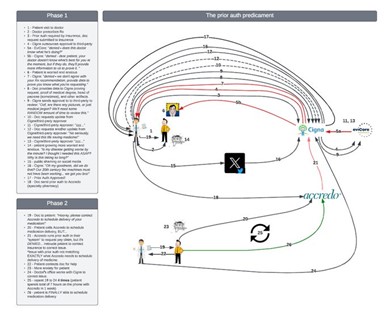
Patients: It is important to note that patients are the only other stakeholder, beyond payors, directly incentivized to reduce the cost of healthcare. The literature has provided evidence of this phenomena, where costs of care decreased by 11.8% – 13.8% when patients switched to a high-deductible plan.14 In cases where prior authorization protects patients from low-value care, patients may ultimately be appreciative of the role that prior authorization plays; however, it is difficult to convey this information. In cases where patients are unaware of prior authorization, or where it has no impact on their treatment regimen and timing, patients are likely indifferent to the prior authorization process. However, in cases where prior authorization results in delays in care, frustration typically abounds. This is easy to understand, given that patients almost always pay monthly premiums to a service they perceive does not provide the value it is supposed to deliver. Online reports from patients about the frustration with prior authorization are common, and a graphic showcasing a somewhat comedic, but not unrealistic, prior authorization process diagram highlights the complexity involved in modern day prior authorization (Figure 1).

Ultimately, failed prior authorization does not preclude a patient from obtaining services given that they could pay cash at the list price for anything insurance denies; however, the high cost of healthcare often makes this an unrealistic option. Debate is ongoing whether payors should inherit some legal responsibility for denied/delayed care given that premiums are paid specifically to be able to access care.15

Figure 1: Patient’s diagram showcasing their experience trying to navigate the prior authorization process to obtain a prescription. Replicated from the Twitter account of Dr. Mark Lewis.

Fact Check and Areas for Future Research

It is easy to understand the sometimes subjective and emotional arguments that stakeholders present for why prior authorization is viewed favorably, or unfavorably, from their perspective. However, to try to understand how prior authorization is truly impacting the field, objective data is needed. Summarized below are questions which aim to highlight the influence of prior authorization on healthcare, data that was uncovered during the course of this review to answer those questions, and areas for future academic study that would help to better characterize how current prior authorization processes impact healthcare delivery.

What percentage of prior authorizations are ultimately approved? 2021 Medicare Advantage prior authorization decisions were the only publicly available source located for analysis.16 In this report, 33.2 million out of 35.2 million (94%) of claims were approved on the first submission. Of the 2.0 million (6%) claims that were either partially or fully denied, only 212,000 (11%) were appealed. However, 173,000 of 212,000 (82%) appeals were successful. Thus, the net approval rate was ~ 33.5 million out of 35.2 million, meaning that 95.2% of prior authorization claims were ultimately approved.16 If so many claims are approved, it is easy to wonder if some of these prior authorizations are not necessary. However, details on the types of prior authorization requests that are approved and denied, as well as reasons for denial, are lacking. Furthermore, data characterizing prior authorization outcomes for commercial insurers was not located during this review. Detailed research to better demonstrate prior authorization outcomes would be beneficial to begin showcasing whether net savings from prior authorization offset the administrative expense of prior authorization management.

What percent of services require prior authorization? Each plan has different rules about which services require prior authorization, which may even vary on a regional level for things as simple as HIV pre-exposure prophylaxis.17 In the sample of Medicare Advantage claims highlighted above, the number of prior authorization requests ranged from 0.3 million to 2.9 million per firm.16 This heterogeneity makes it challenging to characterize how many services require utilization of prior authorization versus how many services can be provided and reimbursed without prior authorization.

Although the exact proportion of services requiring prior authorization is difficult to quantify, one trend that has been reported is an increase in the number of services requiring prior authorization over time. Specifically, Medicare Part D prior authorization was required for ~24% of covered medications in 2019, up from only 8% of medications in 2007.18 This estimate about the number of medications requiring prior authorization is in line with estimates that in 2017, 25% of Medicare Part B claims would be subject to prior authorization requirements if serviced by a private insurer.19 While the precise number of claims requiring prior authorization is still only an estimate, prior authorization processes impact a notable portion of total healthcare expenditure. Future work characterizing the burden of prior authorization in different areas of healthcare (ex: medications vs procedures vs rehabilitation fees) would be beneficial.

Does prior authorization save the system money? The standard argument for prior authorization is that it saves insurers money.7 This is particularly true for step-tiered therapies where payors are able to direct patients to medications with better negotiated rates. However, a study examining mandatory referral to a physiatrist prior to spine surgery found that this change in the prior authorization process resulted in delays in surgery, increased net cost of care, and did not decrease the long-term incidence of spine surgery.20 Examples like this where prior authorization requirements increase the cost of care may be limited; however, if the initial intervention in a step-therapy is unsuccessful and was attempted only because of insurance requirements, net cost of care is potentially increased. The potential for increased cost with any prior authorization requirements should be carefully considered and not just assumed to be a net savings.

How much does the administrative burden of prior authorization cost annually? Providers and other stakeholders frequently complain about the burden of managing prior authorization requests. It is true that administrative tasks and expenses are a part of any business process. However, the exact degree to which prior authorization requests burden providers has been studied in only a limited fashion. A 2009 study estimated that outpatient physician practices spent between $23 billion and $31 billion a year on interactions with health insurance firms.1 Each physician may generate 45 prior authorizations per week, though this number may vary significantly by specialty and practice setting.6

Another study characterizing the burden of prior authorization requests in outpatient superficial vascular surgical procedures noted that most prior authorization denials were the result of improper documentation to meet payor standards. While the initial reaction to this may be that the provider should develop improved standards of documentation, this does not portray the full scenario. Cost-analysis revealed that the physician group spent over $110,000 on administrative expenses related to prior authorization during the study year, whereas the prior authorization denials were estimated to save payors less than $60,000. It is important to note that these cost estimates are only for a select subset of procedures and do not appear to reflect the total administrative cost for the practice.21

While studies characterizing the distribution of burden in navigating prior authorization are limited, this issue deserves particular attention. Each payor’s plan may only have one prior authorization process, but each healthcare provider typically serves patients with numerous different insurance plans. Because of this, the burden on the healthcare provider to navigate prior authorization processes is significantly greater than burden on a payor. Reform is needed to ensure equitable distribution of administrative burden across all stakeholders. Additional study should be directed at better quantifying the current administrative burden for providers and practice administrators versus payors in managing prior authorization requests.

How long does it take for providers to submit a prior authorization request? And how long does it take for a payor to make a prior authorization decision? Another potential point of disparity between providers and payors in administrative burden is the time required to submit and review a prior authorization request. Studies have cited prior authorization requests taking an average of 9.5 minutes / submission in urology22 to a median of 12 minutes / request in dermatology.23 Conversely, claim reviews have been reported to be as low as 1.2 seconds/review for insurers.3 While the disparity in time reported in these studies may overestimate the difference in time burden, there does appear to be evidence that on average, providers and their colleagues spend more time working on prior authorization requests than payors spend reviewing them. This is not inherently wrong; however, in cases of inappropriate denial, any perceived disparity in effort invested into the process may add to frustration. Additional research to better highlight the time required to manage prior authorization requests in relation to the total scope of business would be beneficial.

Who makes prior authorization determinations? The process payors utilize to make prior authorization review is not abundantly transparent and seems to vary on a case by case basis. NaviHealth, a product previously utilized by both Humana and UnitedHealth, utilized an AI algorithm (“nH Predict”) to determine whether patients qualified for long-term care after a hospitalization. A class action lawsuit is now underway against both companies for inappropriately denying care. Similarly, a class action lawsuit against Cigna is ongoing for its utilization of a tool dubbed “PXDX” which reportedly allowed for bulk denial of prior authorization requests without review. 2,3 Media reports have also described that a higher share of physicians participating in prior authorization review allegedly have worse track records in clinical care.8 Frustration also abounds when providers trained in a different specialty deny care. While reports of these stories are widespread, the objective study of how reviews occur has not been established and deserves further investigation.

How are prior authorization decisions communicated? There does not appear to be a uniform method for communicating prior authorization decisions. We uncovered less insight into the process of prior authorization for pharmaceuticals and step-tiered therapy. However, a professional with over four years of reimbursement experience reported frustration with the communication process for prior authorization decisions for surgical procedures. Frequently, the team member requesting prior authorization worked in close collaboration with the clinical care member. The person responsible for obtaining reimbursement was in a completely different department. This resulted in difficulty communicating the prior authorization approval; however, even when this communication occurred successfully, there were times when a denied prior authorization was only uncovered after submitting a claim for reimbursement. The reason for denial was not always included in this communication.11 Although the precise methods of communicating prior authorization decisions have not been uncovered, better transparency in tracking prior authorization decisions, and the rationale for denials, would seem to be beneficial.

Steps for Reform

Prior authorization is a topic that often solicits an emotional reaction. While some argue that a complete overhaul of the American system is needed, the goal of this review was to better understand the current landscape of prior authorization and elucidate realistic action steps that could be implemented to improve the experience for all stakeholders.

  1. Encourage collaborative work between healthcare stakeholders, including insurance companies and physicians. Legislative mandates can be passed to try and encourage positive change; however, change is typically more effective if direct stakeholders can be encouraged to “do the right thing” and make changes that are in everyone’s best interest without legal battles.15
  2. Develop a uniform electronic prior authorization process so that requests can be managed with less administrative burden. Under the current system, the variety of methodologies for managing prior authorization requests is extremely challenging. Some electronic prior authorization platforms are available, but not widely utilized in clinical practice.24 As a transition occurs to electronic authorization requests, it is important that the system doesn’t switch from every company having their own unique prior authorization paper form to their own unique prior authorization portal.25 To realize the full potential synergy and impact of an exclusively electronic prior authorization request system, centralized and common tracking requirements need to be established. While implementing a uniform electronic system may seem like a challenge, the pharmaceutical industry already made this transition from paper scripts into electronic prescriptions that are compatible across many different electronic medical records and pharmacies. This precedent should help drive change to develop a compatible and centralized methodology for tracking prior authorization requests. Data from other industries also supports that uniform information exchange processes improve efficiency.26
  3. While there are certainly examples of providers who abuse the system, the vast majority are judicious about providing care in line with established standards. Gold cards would serve as a method for payors to reward providers with a demonstrated track record of appropriate clinical decisions. For those providers with a gold card, the prior authorization process could be excluded or significantly more streamlined. Periodic review of cases after obtaining gold card status would ensure that providers don’t go unchecked. This option is particularly attractive because it incentivizes collaboration between two of the stakeholders who currently have with the highest amount of tension and has been endorsed by the AMA.27
  4. Many governing bodies in medicine invest considerable time into determining treatment algorithms based on the most up-to-date research studies. These care pathways are designed to maximize patient outcomes in a cost-effective manner. However, research studies have shown significant heterogeneity in coverage policies between different payors. Even worse, care policies are not easily accessible (or accessible at all) for some plans. For example, in a research study examining the criteria required to obtain a cervical MRI, only 66% of plans had publicly available clinical guidelines, and many of these guidelines did not follow American College of Radiology clinical appropriateness criteria.4 The full extent of discrepancy between payor guidelines and societal evidence-based recommendations has not been explored; however, this is a concerning trend. Developing a more consistent set of publicly available guidelines for care coverage would help to streamline prior authorization for many cases. For the limited set of cases that don’t fit neatly into guidelines, there should be more ample resources to go through a legitimate prior authorization process and consider unique reasons for why a different care pathway may make sense for that individual patient.

 Ongoing Legislative / Government Initiatives

There are a variety of ongoing legislative initiatives designed to improve the process of prior authorization for all stakeholders. Some of these align with the recommendations presented above, while others represent different approaches for improving prior authorization processes. Summarized below are a few of the current national legislative initiatives, and one of North Carolina’s legislative initiatives. Similar state-level initiatives are ongoing in over 30 additional states.28

  1. Centers for Medicare & Medicaid Services (CMS) Rule CMS-0057-F: Passed in January 2024, this mandate will require impacted healthcare plans (Medicare Advantage, state Medicaid and Children’s Health Insurance Program Fee for Service, and some plans on the Federally Facilitated Exchanges) to transition to more expedient prior authorization reviews (< 72 hours) and electronically streamline the prior authorization process, along with more transparent information about prior authorization requirements (excluding drugs). Compliance with this requirement will not be fully mandated until January 1, 2027.29, 30
  2. HR 4968: Getting Over Lengthy Delays in Care as Required by Doctors (GOLD CARD) Act of 2023:31 Qualified physicians with a record of at least 90% approval rates in the prior year would be exempt from some prior authorization requirements in Medicare Advantage plans.
  3. HR 5213, Reducing Medically Unnecessary Delays in Care Act:32 Clinical criteria for which services are (or are not) covered by Medicare Advantage plans must be developed in collaboration with a qualifying physician who has an active medical practice in the specialty.
  4. 652, Safe Step Act33 and HR 2630, Safe Step Act:34 Step-therapy protocols exist to guide patients toward lower cost or higher margin services in the initial treatment steps. Payors would have to establish exemption processes for their step-therapy processes to allow for more rapid approval of services under several specified clinical conditions.
  5. NC HB 649:35,36, 37 This bill includes a variety of additional stipulations that would reshape the process of prior authorization in North Carolina, highlighted by key features summarized below:
    • Clinical review based on nationally recognized medical standards.
    • Flexible to allow for deviations from the standard care pathways when justified on an individual basis.
    • Prior authorization denials only from physicians in that specialty.
    • Patient must be notified if medical necessity is questioned by the payor.
    • Payor must maintain a complete list of services where prior authorization is required.
    • Shorter timeframe for prior authorization decisions, ranging from 60 minutes for emergency services to 48 hours for non-urgent services.

Conclusion

Prior authorization was initially developed as a check and balance to control cost. The evolution of healthcare business has morphed prior authorization into a complicated system that payors utilize for a variety of purposes, including steering patients towards lower cost and higher margin treatment options. While payors argue that all of this is undertaken with the goal of providing the highest quality care at the lowest possible price, other stakeholders such as providers, administrators, and patients report frustration that the barriers to navigating prior authorization processes serve as an unethical barrier to timely care and appropriate reimbursement. Anecdotal reports of frustrating care denials are abundant; however, limited studies have provided an objective assessment about the prevalence and impact such denials have on patient care. Regardless, most evidence suggests that the current process of obtaining and tracking prior authorizations has become inefficient.

Increasing frustration has prompted significant legislative scrutiny of the prior authorization process. Work is underway to refine the prior authorization process with new rules and regulations. A roadmap showcasing specific legislative initiatives and other improvement strategies is highlighted in this report, including recommendations for streamlined electronic prior authorization processes, gold card policies rewarding providers with an established track record of appropriate clinical decisions, and more standardized guidelines on indications for which care will and won’t be covered. Government interventions sound promising; however, without careful consideration during the implementation process, additional downstream consequences may occur. Ultimately, we believe improvement in prior authorization requires improved data characterizing the burden of current processes, increased transparency about how prior authorization decisions are made, and close collaboration between all stakeholders so that additional burdens are not inadvertently placed on healthcare providers and patients in an attempt to streamline the prior authorization process.


References

  1. Casalino LP, Nicholson S, Gans DN, et al. What does it cost physician practices to interact with health insurance plans? Health Aff Proj Hope. 2009;28(4):w533-543. doi:10.1377/hlthaff.28.4.w533
  2. Minemyer P. Cigna hit with class action alleging it used an algorithm to reject claims. Fierce Healthcare. Published July 25, 2023. Accessed December 19, 2023. https://www.fiercehealthcare.com/payers/cigna-hit-class-action-alleging-it-used-algorithm-reject-claims
  3. Cigna Sued Over Alleged Automated Patient Claims Denials. Accessed December 4, 2023. https://news.bloomberglaw.com/health-law-and-business/cigna-sued-over-alleged-automated-patient-claims-denials
  4. Berman D, Holtzman A, Sharfman Z, Tindel N. Comparison of Clinical Guidelines for Authorization of MRI in the Evaluation of Neck Pain and Cervical Radiculopathy in the United States. JAAOS – J Am Acad Orthop Surg. 2023;31(2):64. doi:10.5435/JAAOS-D-22-00517
  5. Schwartz B. Post | LinkedIn. LinkedIn. Accessed November 27, 2023. https://www.linkedin.com/posts/ben-schwartz-md_health-healthcare-medicine-activity-7071638000006254594-vQwY/?utm_source=share&utm_medium=member_desktop
  6. American Medical Assocation. AMA Prior Authorization (PA) Physician Survey.; 2022. https://www.ama-assn.org/system/files/prior-authorization-survey.pdf
  7. Sharma SP, Russo A, Deering T, Fisher J, Lakkireddy D. Prior Authorization: Problems and Solutions. JACC Clin Electrophysiol. 2020;6(6):747-750. doi:10.1016/j.jacep.2020.04.022
  8. Burke PR David Armstrong,Doris. Doctors With Histories of Big Malpractice Settlements Now Work for Insurers. ProPublica. Published December 15, 2023. Accessed December 19, 2023. https://www.propublica.org/article/malpractice-settlements-doctors-working-for-insurance-companies
  9. Tumialan L, Camarata P. ‎It’s Not Brain Surgery – The AANS Practice and Business Management Podcast – Presented by the AANS on Apple Podcasts. Accessed October 25, 2023. https://podcasts.apple.com/us/podcast/denial-of-payment-after-successful-prior/id1628126631?i=1000626049047
  10. Episode 164: Scarcity in Neurosurgery. Accessed December 4, 2023. https://soundcloud.com/user-838542034/episode-164-scarcity-in-neurosurgery
  11. Miller J. Perspective on Prior Authorization from Experienced Professional with Over 4 Years Experience in the Reimbursement Department. Published online November 20, 2023.
  12. Pierson B, Pierson B. Lawsuit claims UnitedHealth AI wrongfully denies elderly extended care. Reuters. https://www.reuters.com/legal/lawsuit-claims-unitedhealth-ai-wrongfully-denies-elderly-extended-care-2023-11-14/. Published November 14, 2023. Accessed December 19, 2023.
  13. Ross BH Casey. UnitedHealth discontinues a controversial brand amid scrutiny of algorithmic care denials. STAT. Published October 23, 2023. Accessed December 19, 2023. https://www.statnews.com/2023/10/23/unitedhealth-optum-navihealth-rebranding-algorithm/
  14. Brot-Goldberg ZC, Chandra A, Handel BR, Kolstad JT. What does a Deductible Do? The Impact of Cost-Sharing on Health Care Prices, Quantities, and Spending Dynamics*. Q J Econ. 2017;132(3):1261-1318. doi:10.1093/qje/qjx013
  15. Burgin J. NC Legislative Perspective on Prior Authorization. Published online December 4, 2023.
  16. Biniek JF, Published NS. Over 35 Million Prior Authorization Requests Were Submitted to Medicare Advantage Plans in 2021. KFF. Published February 2, 2023. Accessed December 4, 2023. https://www.kff.org/medicare/issue-brief/over-35-million-prior-authorization-requests-were-submitted-to-medicare-advantage-plans-in-2021/
  17. Regional Disparities in Qualified Health Plans’ Prior Authorization Requirements for HIV Pre-exposure Prophylaxis in the United States – PMC. Accessed December 19, 2023. https://www.ncbi.nlm.nih.gov/pmc/articles/PMC7272119/
  18. Resneck JS Jr. Refocusing Medication Prior Authorization on Its Intended Purpose. JAMA. 2020;323(8):703-704. doi:10.1001/jama.2019.21428
  19. Schwartz AL, Brennan TA, Verbrugge DJ, Newhouse JP. Measuring the Scope of Prior Authorization Policies: Applying Private Insurer Rules to Medicare Part B. JAMA Health Forum. 2021;2(5):e210859. doi:10.1001/jamahealthforum.2021.0859
  20. Goodman RM, Powell CC, Park P. The Impact of Commercial Health Plan Prior Authorization Programs on the Utilization of Services for Low Back Pain. Spine. 2016;41(9):810-815. doi:10.1097/BRS.0000000000001329
  21. Lee V, Berland T, Jacobowitz G, et al. Prior authorization as a utilization management tool for elective superficial venous procedures results in high administrative cost and low efficacy in reducing utilization. J Vasc Surg Venous Lymphat Disord. 2020;8(3):383-389.e1. doi:10.1016/j.jvsv.2019.10.016
  22. Madhusoodanan V, Ramos L, Zucker IJ, Sathe A, Ramasamy R. Is Time Spent on Prior Authorizations Associated With Approval? J Nurse Pract JNP. 2023;19(2):104479. doi:10.1016/j.nurpra.2022.10.008
  23. Carlisle RP, Flint ND, Hopkins ZH, Eliason MJ, Duffin KC, Secrest AM. Administrative Burden and Costs of Prior Authorizations in a Dermatology Department. JAMA Dermatol. 2020;156(10):1074-1078. doi:10.1001/jamadermatol.2020.1852
  24. Bhattacharjee S, Murcko AC, Fair MK, Warholak TL. Medication prior authorization from the providers perspective: A prospective observational study. Res Soc Adm Pharm. 2019;15(9):1138-1144. doi:10.1016/j.sapharm.2018.09.019
  25. Forys A. Review of Prior Authorization. Published online November 27, 2023.
  26. Cutler DM. Reducing Administrative Costs in U.S. Health Care.
  27. House bill advances “gold card” model on prior authorization. American Medical Association. Published August 30, 2023. Accessed December 20, 2023. https://www.ama-assn.org/practice-management/prior-authorization/house-bill-advances-gold-card-model-prior-authorization
  28. Bills in 30 states show momentum to fix prior authorization. American Medical Association. Published May 10, 2023. Accessed December 19, 2023. https://www.ama-assn.org/practice-management/prior-authorization/bills-30-states-show-momentum-fix-prior-authorization
  29. $15 billion win for physicians on prior authorization. American Medical Association. Published January 18, 2024. Accessed February 25, 2024. https://www.ama-assn.org/practice-management/prior-authorization/15-billion-win-physicians-prior-authorization
  30. CMS Interoperability and Prior Authorization Final Rule CMS-0057-F | CMS. Accessed February 25, 2024. https://www.cms.gov/newsroom/fact-sheets/cms-interoperability-and-prior-authorization-final-rule-cms-0057-f
  31. Rep. Burgess MC [R T 26. H.R.4968 – 118th Congress (2023-2024): GOLD CARD Act of 2023. Published July 28, 2023. Accessed December 4, 2023. https://www.congress.gov/bill/118th-congress/house-bill/4968
  32. Rep. Green ME [R T 7. H.R.5213 – 118th Congress (2023-2024): Reducing Medically Unnecessary Delays in Care Act of 2023. Published August 15, 2023. Accessed December 4, 2023. https://www.congress.gov/bill/118th-congress/house-bill/5213
  33. Sen. Murkowski L [R A. S.652 – 118th Congress (2023-2024): Safe Step Act. Published March 2, 2023. Accessed December 4, 2023. https://www.congress.gov/bill/118th-congress/senate-bill/652
  34. Rep. Wenstrup BR [R O 2. H.R.2630 – 118th Congress (2023-2024): Safe Step Act. Published April 13, 2023. Accessed December 4, 2023. https://www.congress.gov/bill/118th-congress/house-bill/2630
  35. Aldridge R. NCMS Aided HB 649 Passes House Health Committee, Prior Authorization Bill Now heads to Rules Committee. North Carolina Medical Society. Published April 25, 2023. Accessed December 4, 2023. https://ncmedsoc.org/ncms-aided-hb-649-passes-house-health-committee-prior-authorization-bill-now-heads-to-rules-committee/
  36. House Bill 649 (2023-2024 Session) – North Carolina General Assembly. Accessed December 4, 2023. https://www.ncleg.gov/BillLookUp/2023/H0649
  37. Ledger C. Her health insurer delayed her MRI – as the cancer spread. North Carolina Health News. Published May 8, 2023. Accessed December 4, 2023. http://www.northcarolinahealthnews.org/2023/05/08/health-insurance-prior-authorization-bill/


Florida Wants to Import Low-Cost Prescription Drugs from Canada. Will Its Plan Work?

Paul Grootendorst, Leslie Dan Faculty of Pharmacy, University of Toronto

Contact: paul.grootendorst@gmail.com

Abstract

What is the message? The U.S. Food and Drug Administration recently approved the petition by Florida Governor Ron DeSantis to import drugs from Canada. The plan, however, is unlikely to succeed.

What is the evidence? Canada has no interest in jeopardizing its ability to maintain the low cost of prescription medications and to prevent potential drug shortages. Manufacturers are also unlikely to allow drugs earmarked for Canada to be diverted to the United States if these reimported products displace sales that would have been made at higher U.S. prices.

Timeline: Submitted: February 21, 2024; accepted after review February 22, 2024.

Cite as: Paul Grootendorst. 2023. Florida Wants to Import Low-Cost Prescription Drugs from Canada. Will Its Plan Work? Health Management, Policy and Innovation (www.HMPI.org), Volume 9, Issue 1.

Acknowledgements: I thank Kevin Schulman for helpful comments. All errors are mine.

The Florida state government recently obtained approval by the U.S. Food and Drug Administration to import low-cost prescription drugs in bulk from Canada. In this article, I describe Florida’s importation plan, review the reasons that drug prices are lower in Canada and assess the prospects that Florida’s plan will succeed from the Canadian perspective.

Florida Governor Ron DeSantis has since 2019 petitioned the U.S. federal government for the right to import drugs from Canada.  The U.S. FDA has recently acquiesced. [1]  Other state governments are also hoping to import drugs from Canada.[2]  Governor DeSantis proposes to initially import drugs from several therapeutic classes for use by beneficiaries of several state-funded drug plans, namely those administered by the Agency for Persons with Disabilities, Department of Children and Families, Department of Corrections, and Department of Health.  The program will eventually expand to procure prescription drugs for use by state Medicaid beneficiaries.  The state government expects to save $183 million per year once the program is fully implemented.[3].

One can understand Florida’s motivation: list prices for patented drugs in the United States are multiples of those paid in Canada. Canada’s Patented Medicine Prices Review Board (PMPRB) has reported on the relative U.S.-Canadian list prices for patented drugs since 1988.  The data, illustrated below, indicate that U.S. prices have increased markedly since 2010.  In 2021, U.S. list prices were about 3.5 times Canadian prices.

Figure 1. Weighted average US to Canadian patented drug list price ratios, by year, 1988-2021

Note: these are the Canadian sales weighted averages of ratios of U.S. to Canadian pre-rebate prices of patented drugs.  Ratios are multiplied by 100.  Prices are reported by patentees selling products in both Canadian and U.S. markets.  U.S. prices converted into Canadian dollars using market exchange rates.  Data source: Patented Medicine Prices Review Board Annual Reports.[4]


The Florida state government obtains discounts off these list prices. By law (OBRA 1990), the rebate on drugs used by Medicaid beneficiaries is 23.1% of the Average Manufacturer Price (AMP) or the difference between the AMP and “best price,” whichever is greater.[5]  In exchange for these statutory rebates, Medicaid covers all the manufacturer’s FDA-approved drugs.

The AMP is defined as the average price paid to drug manufacturers by wholesalers for medications sold through retail pharmacies.[1]  The “best price” is defined as the lowest available price to any wholesaler, retailer, or provider, excluding the prices negotiated by certain government programs such as the health program for veterans.[5]  Under the 340B program, manufacturers are required to provide discounts to “covered entities,” but the sales of these products are not subject to Medicaid rebates nor to inclusion in the best price calculation.[6]  State-funded drug plans can also negotiate additional discounts off these statutory price discounts.[5] Even after these discounts, however, state Medicaid programs evidently pay more than Canadian list prices. In 2017, Medicaid paid 45% of U.S. prescription drug list prices; [5] in 2022, Canadian drug plans and hospitals paid about 28% (pre-rebate) of U.S. list prices.[7]  This likely explains why the Florida state government wants to import drugs from Canada.

Why are drug list prices lower in Canada?  One possible reason is that incomes are lower in Canada. Another reason is Canada’s use of price regulation. Canada’s PMPRB, a federal government agency, uses both internal and external reference pricing to limit the introductory list prices of patented drugs. New drugs that the PMPRB deems to be therapeutically innovative can be priced no higher than the median of the prices charged in various comparator countries. Until recently, the comparison countries were the ”PMPRB7”: France, Germany, Italy, Sweden, Switzerland, the United Kingdom, and the U.S.  Because many new drugs were launched in just Canada and the U.S., U.S. prices became the effective price ceiling.[8]  To lower the price ceiling, in July 2022 the PMPRB changed the comparison countries to the ”PMPRB11”: Australia, Belgium, France, Germany, Italy, Japan, the Netherlands, Norway, Spain, Sweden, and the United Kingdom. The PMPRB11 removes two high price countries, the U.S. and Switzerland, and adds six countries with relatively low prices: Australia, Belgium, Japan, the Netherlands, Norway, and Spain. [9]

Public drug plans in Canada also engage in price negotiation. These federal, provincial, and territorial plans have created two agencies, one of which provides evidence on cost effectiveness of new drugs at their list prices.[10]  Using this evidence, the public plans separately identify drugs that meet unmet needs and that could be cost effective at lower prices. They then rely on another agency that negotiates over the size of confidential discounts off manufacturers list prices. [11]  The exact discounts are unknown, but they are said to be in the order of 25% of list prices.[12]  Governments are willing to walk away if a deal cannot be reached, particularly for drugs which provide small therapeutic value. [13]

Private, typically employer-sponsored, drug plans, which cover about 40% of outpatient prescription drug costs, have historically paid list prices and had minimal formulary restrictions. But during the last decade, they have increasingly also used cost-effectiveness analyses to set maximum reimbursement prices. As with the public plans, the private plans negotiate over the size of the confidential rebate. But because they do not tend to use “take it or leave it” offers, and because each private plan negotiates over a small book of business, the discounts are said to be much smaller than those obtained by the public plans.[12]

Other industrialized countries pay list prices that are even lower than in Canada. For example, list prices paid in Australia, France and the United Kingdom were, respectively, 70%, 73% and 84% of list prices paid in Canada in 2022.[7] One possible reason is that these countries operate national public drug plans, so that they are the single largest purchaser of prescription drugs in the country. Canada’s public drug plans, by contrast, tend to cover those without employer-provided drug coverage, such as seniors, and those with very low incomes.  These public plans collectively reimburse only about half of non-hospital prescription drug sales.

In summary, Canadian drug list prices – while high internationally – are much lower than U.S. list prices. This is likely because of income differences, Canada’s federal price regulation and possibly because until recently private plans paid prices close to list price so that charging U.S. prices would price them out of the market. State Medicaid plans obtain statutory price discounts off list prices and can negotiate additional discounts, but evidently net prices remain higher than Canadian list prices. One possible reason for this difference is that state Medicaid programs are mandated to include drugs on their formularies in return for the statutory rebate. In addition, Medicaid is organized at the state level, and each state Medicaid plan accounts for only a small share of the total prescription drug market. Collectively, the Medicaid plans spent $92 billion (before rebates) in 2022; [14] this is only 22% of the $429 billion spent on retail prescription drugs (again, before rebates) in the U.S. in 2022. [15]

What are the prospects for Florida’s drug importation plan? From the Canadian perspective, the proposal appears to be dead in the water. Canada works hard to maintain the low cost of prescription medications to help control the costs of health care in Canada. As a matter of policy, Canada has no interest in jeopardizing its current advantage in prescription drug pricing to support the U.S. market. The Canadian government, and the Canadian pharmaceutical industry, have taken several steps to support its domestic market in the face of programs like the Florida reimportation scheme.

Drug distributors and wholesalers in Canada are federally licensed. [16] Federal regulations in place since 2020 ban the export of pharmaceuticals outside the country if there are “reasonable grounds to believe that doing so could cause or worsen a drug shortage.” [17]  So distributors are only able to legally export surplus drugs – i.e. drugs with large inventories, well in excess of domestic demand.  It appears that few drugs currently meet this requirement.

Further, almost all Canadian brand drug manufacturers are multinationals that sell in both the U.S. and Canadian markets. These manufacturers charge higher prices in the U.S. because of the structure of the U.S. market. It seems unlikely that manufacturers will allow drugs intended for sale in Canada to be diverted to the U.S. if these reimported products displace sales that would have been made at higher U.S. prices. Thus, manufacturers carefully manage sales to distributors within Canada to ensure that there are not excess inventories available for reimportation to the U.S.

Canadian drug manufacturers have additional ways of preventing diversion by requiring domestic wholesale distributors and pharmacies to refrain from selling drugs to non-domestic customers. Manufacturers added these provisions to their sales contracts with distributors in response to the creation of online pharmacies in the province of Manitoba that were selling drugs to U.S. customers in the early 2000s.[18]

The only conceivable scenario in which multinational manufacturers would agree to reimportation is if the reimported drugs were to be used by Floridians who would be unwilling to pay prevailing U.S. prices. Presumably U.S. manufacturers already have ways of lowering prices to such groups if it is in their commercial interest. This likely explains why the U.S. brand drug manufacturer industry association, the Pharmaceutical Research and Manufacturers of America (PhRMA), has also opposed Florida’s drug import plans.[1] [18]

From north of the border, our assessment is that Florida’s plan is unlikely to succeed.  If Florida or other U.S. purchasers want lower drug prices, they will have to address the  structural issues in the way that drug prices are set in the U.S.

Notes

[1] There is nothing more confusing than how list prices for drugs are reported in the U.S. Wholesale Acquisition Costs (WAC) are meant to be the list prices of drugs before rebates and discounts, while Average Manufacturer Price (AMP) is the price after wholesaler discounts such as cash and volume discounts. Medicare separately considers Average Sales Price (ASP) as the actual price in the market for hospital outpatient reimbursement. The Federal Supply Scale (FSS) price is the government price to purchase drugs for programs such as the Department of Defense and the Department of Veterans Affairs.

References

  1. What to Know About the FDA’s Recent Decision to Allow Florida to Import Prescription Drugs from Canada | KFF. [cited 20 Feb 2024]. Available: https://www.kff.org/policy-watch/what-to-know-about-the-fdas-recent-decision-to-allow-florida-to-import-prescription-drugs-from-canada/#
  2. Castronuovo C. States Eye Drug Imports From Canada After Florida Approval. In: Bloomberg Law [Internet]. 2024 [cited 24 Feb 2024]. Available: https://news.bloomberglaw.com/health-law-and-business/states-eye-drug-imports-from-canada-after-florida-wins-approval
  3. Florida Becomes First in the Nation to Have Canadian Drug Importation Program Approved by FDA. [cited 20 Feb 2024]. Available: https://www.flgov.com/2024/01/05/florida-becomes-first-in-the-nation-to-have-canadian-drug-importation-program-approved-by-fda/
  4. Patented Medicine Prices Review Board. Annual Reports – Canada.ca. [cited 20 Feb 2024]. Available: https://www.canada.ca/en/patented-medicine-prices-review/services/annual-reports.html
  5. Understanding the Medicaid Prescription Drug Rebate Program | KFF. [cited 20 Feb 2024]. Available: https://www.kff.org/medicaid/issue-brief/understanding-the-medicaid-prescription-drug-rebate-program/
  6. Medicaid and CHIP Payment and Access Commission. The 340B Drug Pricing Program and Medicaid Drug Rebate Program: How They Interact. [cited 22 Feb 2024]. Available: https://www.macpac.gov/publication/the-340b-drug-pricing-program-and-medicaid-drug-rebate-program-how-they-interact/
  7. Patented Medicine Prices Review Board. Annual Report 2022 – Canada.ca. [cited 24 Feb 2024]. Available: https://www.canada.ca/en/patented-medicine-prices-review/services/annual-reports/annual-report-2022.html
  8. Parliamentary Budget Officer. Canadian patented drug prices: Gauging the change in reference countries. [cited 24 Feb 2024]. Available: https://www.pbo-dpb.ca/en/publications/RP-2223-008-S–canadian-patented-drug-prices-gauging-change-in-reference-countries–prix-canadiens-medicaments-brevetes-mesurer-importance-modification-dans-pays-reference
  9. Patented Medicine Prices Review Board Annual Report 2022 – Canada.ca. [cited 20 Feb 2024]. Available: https://www.canada.ca/en/patented-medicine-prices-review/services/annual-reports/annual-report-2022.html
  10. Canadian Agency for Drugs and Technologies in Health. [cited 24 Feb 2024]. Available: https://www.cadth.ca/
  11. pan-Canadian Pharmaceutical Alliance. [cited 5 Nov 2023]. Available: https://www.pcpacanada.ca
  12. Canada.  Office of the Parliamentary Budget Officer. Cost Estimate of a Single-payer Universal Drug Plan. Ottawa; 2023. Available: https://distribution-a617274656661637473.pbo-dpb.ca/c4201c5cc0c9a162ff5f127e98992b64f3547048bf187de65bca2b399f3b9320
  13. Kyle M, Williams H. Is American Health Care Uniquely Inefficient? Evidence from Prescription Drugs. American Economic Review. 2017;107: 486–90. doi:10.1257/AER.P20171086
  14. Recent Trends in Medicaid Outpatient Prescription Drug Utilization and Spending | KFF. [cited 20 Feb 2024]. Available: https://www.kff.org/medicaid/issue-brief/recent-trends-in-medicaid-outpatient-prescription-drug-utilization-and-spending/#
  15. The Use of Medicines in the U.S. 2023 – IQVIA. [cited 20 Feb 2024]. Available: https://www.iqvia.com/insights/the-iqvia-institute/reports-and-publications/reports/the-use-of-medicines-in-the-us-2023
  16. Establishment Licences – Canada.ca. [cited 20 Feb 2024]. Available: https://www.canada.ca/en/health-canada/services/drugs-health-products/compliance-enforcement/establishment-licences.html
  17. Guide to distributing drugs intended for the Canadian market for consumption or use outside Canada (GUI-0145) – Canada.ca. [cited 20 Feb 2024]. Available: https://www.canada.ca/en/public-health/services/publications/drugs-health-products/guide-distributing-canadian-market-consumption-outside-canada.html 
  18. Whitwham B. Dispute over Canada’s online pharmacies heating up. CMAJ: Canadian Medical Association Journal. 2003;168: 759. Available: /pmc/articles/PMC154941/


Word from the HMPI Editor

As described in this issue, we are undergoing two major transitions in healthcare: a demographic transition and a technology transition. On the demographic side, aging populations will put enormous strain on health are systems by increasing demand at a time when we might become supply constrained in terms of personnel. One major healthcare system in the United States is touting its ability to maintain its provider level despite the rapid pace of retirements as a competitive advantage.

It’s no secret that technology is moving forward at an amazing pace. One of my colleagues at Stanford, Fei-Fei Li, has just written a memoir about the evolution of AI (The Worlds I See). She describes Geoffrey Hinton’s first successful use of a neural network for computer vision research in 2012, little more than a decade ago. It’s important to reflect on how early we are in the use of this technology. One great metaphor I have heard is that we’re back at the dawn of electricity – we’ve invented the copper wire, but not yet the light bulb, and so we’re constantly getting shocked as we explore use cases and applications. The withdrawal of Cruise from San Francisco and the recall of Tesla Autopilot are examples of this process of discovery in real time. Thus, the appropriate concern about safety in healthcare applications – applications that are, frankly, being developed with teams that have far fewer resources than these well-funded efforts.

But AI is a technology. In the Clayton Christensen world, to have true cost and quality improvements in a market, we need technology innovation and business model innovation. For all of the excitement of AI, we’re ignoring the business model and business process challenges. Building from the work of Gerry Anderson and Ge Bai at Johns Hopkins, my coauthors and I recently described how dysfunctional the healthcare market has become in terms of complexity (https://jamanetwork.com/journals/jama/fullarticle/2812255).

We are going to have to wake up to this unfortunate reality if we are going to realize the full potential of this technology as a solution to our demographic and work force challenges. Dissecting and solving the business process challenge is a great role to play for all of us studying healthcare management and healthcare systems.

Kevin Schulman, MD, MBA
BAHM President & HMPI Editor-in-Chief
Professor of Medicine, Stanford University


Regi’s “Innovating in Health Care” Case Corner

Case: Pear Therapeutics’ Failure: Paying the Trailblazer Tax (Case: SM-369; date: 08/22/23; length: 19 pages)

Authors: James Tai, Ethan Goh, Margaret Wenzlau, Shikha Avancha, and Professor Kevin Schulman, MD, MBA, Stanford Graduate School of Business

Background

Digital therapeutics (DTX) offers the promise of using digital technology to benefit patients. The concept is to build from existing science and clinical strategies to create algorithms to support improve patient outcomes. In contrast with consumer applications, DTX algorithms are meant to carry a clinical label, and be subject to FDA review as medical devices (potentially including clinical trials to support the labeled indications).

One of the most interesting companies developing the DTx concept was Pear Therapeutics. At one time Pear was a digital health unicorn valued at over $1 billion. It pushed for the first mover advantage in the DTx space by aggressively expanding its R&D portfolio. Unfortunately, the reimbursement for the DTx market was slow to develop, and Pear’s aggressive investment in research and marketing outmatched market acceptance of their products, leading to Pear’s bankruptcy in 2023. This case asks the question of whether this is the end of the DTx concept, or just the “Trailblazer’s Tax” leaving interest in the space for new entrants.

The case reviews the development of the DTx Concept, and the regulatory and reimbursement challenges for this class of technologies.

Download the case. For inquiries, contact Kevin Schulman kevin.schulman@stanford.edu


Word from the HMPI Editors

We’re excited to publish this special issue of HMPI focusing on the topic of pharmaceutical costs and benefits. The Inflation Reduction Act of 2022 provides a new pathway for direct negotiation of drug prices by the Medicare program. This is a change from the Medicare Modernization Act of 2003, which prohibited direct negotiation of drug prices by the government. Despite the rhetoric surrounding this law, the program itself is modest, with a small number of products subject to negotiations in 2024, with no changes to actual prices for these prices until 2026. The program will continue to add new products to the negotiation program each year.

There are significant questions about the program – will it really impact prices for consumers or is the benefit most likely to accrue to taxpayers (who pay 75% of the costs of Medicare Parts B and D)? Will the program impact innovation in terms of investment in new products or product categories? The industry appears to respond to financial incentives. For example, the portfolio of products under development leans heavily towards oncology, in part due to price inelasticity in this part of the market (and in part due to the advances in medical science in this field). Finally, will this effort have any carry-over to the private market? One can imagine that it might force prices upwards as manufacturers attempt to recoup lost revenue that was promised to investors. As Mark Pauly, our guest editor says, we’ll have to wait and see.

One interesting question not addressed in this issue is the mechanics of price negotiation. How should we negotiate these prices. First, we have to ask the question of whether price negotiation is based on gross price, Wholesale Acquisition Cost, or net price, or the amount actually received by the manufacturer. For Part D drugs, the difference between gross and net is explained by rebates and other potential transactions between pharmaceutical firms and Pharmacy Benefit Managers. For Part B drugs, the issue is the required price discounts of the 340B program, now impacting over 54,000 covered entity sites. Once this is determined, how could the government justify it’s price: economic analysis (like cost-effectiveness analysis), reference pricing to prices in other markets, competitive bidding, or maybe just a required discount based on number of years the product has been in the market. It will be a real challenge to develop an approach that can withstand public scrutiny and potential further court challenges.

We’re grateful to Mark Pauly and the authors of the papers in this special issue for helping to bring their perspectives to this fascinating topic.

Kevin Schulman, MD, MBA
Editor-in-Chief, Health Management, Policy and Innovation (HMPI)
President, Business School Alliance for Health Management (BAHM)
Professor of Medicine, Stanford University

Efficiency, Consumer Welfare, and Market Equilibrium in Private Insurance Coverage of Patented Drugs

H.E. Frech, III, University of California, Santa Barbara; Mark Pauly, The Wharton School, University of Pennsylvania; William S. Comanor, UCLA Fielding School of Public Health; and Joseph R. Martinez, Jr. The Wharton School and Perelman School of Medicine, University of Pennsylvania

Contact:pauly@wharton.upenn.edu 

Abstract

What is the message? Pharmaceutical prices are set through interactions among drug companies, the sellers, and health insurers. This study offers a series of models demonstrating the impact of monopoly prices on insurance coverage and the consumer.

What is the evidence? An analysis of patented drugs with no close substitutes sold by monopoly drug firms to competitive private insurance plans and the effects of insurance-induced price effects on subsequent changes in co-insurance rates.

Timeline: Submitted:  June 10, 2023; accepted after review Sept. 1, 2023.

Cite as: H.E. Frech, Mark Pauly, William S. Comanor, Joseph Martinez. 2023. Consumer Welfare, and Market Equilibrium in Private Insurance Coverage of Patented Drugs. Health Management, Policy and Innovation (www.HMPI.org), Volume 8, Issue 2.

Background and Insured Patient Demand

Private sector insurers are under intense pressure to restrain premium growth in both individual and group markets, especially with regard to pharmaceutical spending. Such growth is largely driven by the diffusion of costly new products, especially by novel brand-name, patent-protected prescription drugs, and by increases in the prices of products or services where there is little competition. Historically, U.S. insurers, public and private, have taken a passive role with regard to the prices or quantities of effective branded drugs with no close clinical substitutes. (They might use formularies tiered with copays and reference prices for products for which there were alternative clinical choices (Cremer and Lozachmeur), but that is not the case to be considered here.) Once approved by the FDA, insurers would generally pay for whatever drugs physicians and patients agreed to order at whatever price the drug firm charged. Historically, drug insurance policies often included uniform coinsurance or other forms of cost sharing that applied to all prescription drugs, so consumers were partially exposed to high prices and deterred from higher quantities of covered drugs. This exposure is heightened in modern health insurance, where most policies include drug coinsurance, and few drugs are excluded from coverage.

In this paper, we present a set of models of simultaneous determination and market equilibrium for drug firm price and insurance coverage for “exclusive” branded drugs, those with no close clinical substitutes (new molecular entities or biological products). Such breakthrough drugs constitute a substantial share of the growth in drug spending. Insurers also find their prices difficult to modify even when the insurer has a large market share (Lakdawalla and Yin, 2015). We will explore simple monopoly pricing by the drug firm that insurers are assumed to take as given, but with insurer choice of cost sharing (given the price set by the monopolist) as a way of increasing the welfare of risk-averse consumers. The drug firm is assumed to set the simple monopoly price given demand and a constant (zero) marginal cost of production and distribution.[1] After developing this benchmark model, we will comment on the impact of moving to alternative pricing models for drugs when insurers take a less passive approach with regard to drug price and quantity.

To focus attention on payment mechanisms, we present a benchmark model in which we assume that drug insurance markets are approximately competitive, with no single insurer having a large enough market share among insurance buyers in that location to motivate face-to-face bargaining with any drug firm. Some insurers are national firms (that own pharmacy benefit managers) but they typically tailor their plans to the demands of local employment-based groups. This assumption allows us to avoid the often-intractable problem of modeling bargaining equilibria in a drug monopoly-insurance monopsony setting.

Our approach will differ from most other commentary on drug pricing and its relationship to insurance (Berndt, McGuire, and Newhouse, 2011; Danzon and Pauly, 2002) by going beyond discussion of what insurance buyers might do when a new drug is introduced at some (high) price.  We ask how the seller’s price responds to the insurance they choose. We then take the next step and ask how the coverage chosen may change in response to the new price and trace out the independent adjustment process to an equilibrium in seller price and insurance coverage. To our knowledge, modelling the steps of subsequent insurance firm and buyer responses to the insurance-induced increase in branded drug prices along a linear demand curve is a novel contribution, as is the specification of an equilibrium in which the market price and the market level of insurance are mutually consistent.

More specifically, we will deal with the challenging case in which drug firms set prices of branded products based in part on insurance coverage design, while insurers seek to offer cost-sharing designs that patient-consumers will prefer, given the consumers’ financial risk associate with a given drug firm price and illness-affected quantity demanded at that price. We focus on a major paradox in the simple monopoly model which has not been recognized: when coverage and price are endogenous, market equilibrium outcomes may leave representative risk-averse consumers worse off or no better off with than without insurance. Alternatively, market equilibrium may not exist.

Modelling

Initial Assumptions

Our focus is on a hypothetical market of competitive profit-maximizing private insurers who can offer varying cost-sharing levels for different drugs  and who can refuse to cover a product at all (100% cost sharing), Following a long line of literature, we simplify insurance by treating all cost sharing as a coinsurance percent or proportion (Zeckhauser, 1970; Feldstein, 1973; Feldman and Dowd, 1991).[2] The insurance product is demanded to treat an uncertain illness of potentially varying severity, and risk-averse consumers may demand insurance to cover the financial cost of the drug when they use it. We assume a linear demand curve both because it is a simple way of illustrating consumers’ surplus diagrammatically and because the property of high elasticity and high prices and low elasticity at low prices seems most realistic when quantity demanded is bounded by zero and use by all persons with an illness. Insurance demanders, who might be individuals or homogenous groups of individuals, can then choose which combination of coverage and associated premium they most prefer, prior to knowing whether they will get the illness and how severe it will be.

The drug to be covered is sold by a profit-maximizing firm, which has market power because it has a patent on an exclusive drug. In order to characterize a demand curve facing these firms, it must be the case that different potential buyers attach different values to a given product once illness has occurred because it yields different amounts of increased expected health [quality-adjusted life years (QALYs] depending on illness severity. If all persons with the illness a drug treats expect to gain the same number of QALYs from treatment, and have the same monetary value per QALY added, the seller would face a horizontal demand curve and either sell none of the product or sell it to all those with the illness, depending on where it set the price (Pauly, Comanor, Frech, and Martinez, 2021). In what follows, we assume instead that severity (and marginal benefit) varies after illness strikes but that monetary values of QALYs are the same across buyers of drugs and insurance.

We also assume for simplicity that each individual insured person consumes either zero or one drug treatment (Garber, Jones, and Romer, 2006). This allows us to focus on the extensive margin in describing the demand curve for the product. We use a standard two-state expected utility maximization model with moral hazard. For ease of exposition, we ignore income effects on demand and, in most cases, set marginal cost to zero.

The model

Following Feldman and Dowd (1991), we define the “risk premium” π as the value subtracted from income in the no-illness state that equates an individual consumer’s expected utility with insurance and some coinsurance rate of c to the expected utility without insurance, or:

(1) E[V( X- π- (1 – c) E (PM) – cPM + W(M)] =E [V(X-Pm) + W(m)]

Where the utility function is assumed to be separable into two parts, V and W, X= income, c = coinsurance rate, P =gross price of treatment, M= quantity with this insurance, and m = quantity without insurance. Equation (1) also assumes that the insurance is actuarially fair so that the premium K=E[(1-c)PM].

Then it can be shown (Cf, Feldman and Dowd, 1991) by a second order Taylor series expansion of (1) that π is given by:

(2) π = [[E(P(m-M)]+ [E(W(m)]-EW(M)]/V’] + (Rσ2)/2.

Here the first term in brackets represents the difference in expected spending, the second term  represents the difference in value of care received (difference in utility divided by the marginal utility of income), and the last term represents the value of risk reduction from insurance, where R equals the Arrow Pratt coefficient of risk aversion and σ2 is the variance of out of pocket spending.

The insurance buyer maximizes expected utility by choosing the level of c which maximizes π, the net gain from insurance. Risk arises in this setting because illness is uncertain, its severity conditional on its occurrence is uncertain, and therefore the out-of-pocket spending by the insured is uncertain. Moral hazard arises when the insurance payment is made conditional on the level of care chosen post-purchase and when the severity of illness (or other determinant of care demand) is then only known by the insured but not by the insurer. One of our primary interests in this paper is in the change in medical care use that is incentivized by insurance and resulting consumer welfare cost, so our discussion will be primarily about the first two terms of expression.

To explore the impacts of variation in coinsurance and resulting changes in monopoly price on the risk premium for the representative consumer, we follow Feldman and Dowd in relying on an analysis of the geometric welfare triangle that shows how consumers’ surplus changes when market-level coverage and price change. We then compare that change with changes in the value of risk reduction from insurance. We differ in that we assume that the drug firm charges the same price to the insured and the uninsured.

Equilibrium and consumers’ surplus without insurance

If there were no insurance (or if insurance could take the form of fixed dollar indemnities conditional on the patient’s state of health and the type of illness), the resulting demand curve for the product, which is also the schedule of marginal health benefits, would (ignoring income effects) be the one which would prevail in a simple monopoly market. The drug firm would then set its profit-maximizing price, and patients would choose whether or not to demand the drug at that price. Note that, at the profit-maximizing price, the demand curve will be elastic: if the price is raised above this price enough, consumers will not buy the drug to such an extent that drug firm revenue will fall. (The drug monopolist can set any price it wants but it cannot sell any quantity it wants.) As usual, at the monopoly price there is welfare loss because of this demand response. Consumers’ surplus would be lower than if the price were competitive.

This scenario of simple monopoly without insurance predicts a price in excess of marginal cost, but one at which those consumers who do choose to buy the product obtain positive consumer surplus, on average, compared to a situation in which the drug was not available. Many pay less than the value of the benefit they expect to get from the drug. In what follows, we assume that the marginal cost of the drug is zero so that profit and revenue maximization coincide. Consumers’ surplus would be maximized if 100% of patients with the illness obtained the drug, but that will not happen in a simple monopoly equilibrium.

Adding insurance with independent adjustment by the drug seller and the buyers of insurance

Because insurer information on the state of a person’s health is imperfect, health insurance cannot take the form of predetermined indemnity payments conditional on the health state. Instead, as noted above, we model insurance coverage as using proportional coinsurance to limit moral hazard, with the choice of treatment quantity, given insurance coverage, to be chosen by a patient-doctor agreement influenced by the level of the out-of-pocket payment. (If the patient knew the health state prior to purchasing insurance but the insurer did not, the situation would be one of adverse selection.) The patient and physician are assumed to observe the health state (illness severity) with full accuracy once an illness has occurred. Given the assumption that each person demands one or zero units of drug treatment, the firm and market demand curve for the product without insurance will track the distribution of health benefits from the drug in a given population. If we assume that these benefits are determined by illness severity—sicker people get more benefit from the drug—the market demand curve is defined by the distribution of illness severities.  There will be some price so high that no consumers, not even the sickest, will choose to buy the drug, and at a near zero price all members of the population with the illness will buy the drug but no one who is not sick will choose it.  The demand curve strikes both price and quantity axes.

We model the choice by risk-averse consumers facing a tradeoff between lower coinsurance (and therefore lower variance of out-of-pocket spending) against greater moral-hazard-caused reduction in consumer surplus. To determine the market equilibrium for insurance coverage and price of this drug, we assume there are numerous insurance purchasers and competing insurers who take the drug seller’s current market price as given, and have no foresight about future drug firm price changes.  This is the standard Nash assumption.

Begin by assuming that the drug firm faces a known linear demand curve for drugs and that the no-insurance simple monopoly price prevails. Insurers offer coverage with the coinsurance rate that is optimal at that price for consumers, given the consumers’ expected marginal benefit curve from the product and given their degree of risk aversion. That would be the level of coinsurance that would maximize the risk premium, given the initial price (the no-insurance price).  Thus, the coinsurance rate is determined by consumer preferences.  The monopoly seller now faces a different demand curve with P replaced by P/c. This is the equilibrium described by Garber, Jones and Romer (2006).

Figure 1 illustrates the standard argument about the effect of coinsurance on market equilibrium quantity and price.  P* is the no-insurance monopoly price.   At this price, 50% of patients with the illness buy the drug. The triangle  A represents the welfare loss from monopoly pricing.  Now suppose that risk-averse consumers choose insurance with the coinsurance c* that maximizes expected utility in equation (2).  The presence of insurance will then cause the demand curve faced by the monopolist to rotate upward as indicated. A profit-maximizing seller will react to the demand curve affected by coinsurance by increasing the price to a new higher profit-maximizing level.   In figure 1, this change is shown by the pivoting of the demand curve around the x-axis intercept (Pauly, 2012) leading to a new monopoly price, P’. At this new monopoly price P’ and the original coinsurance rate c*, the net price settles to the same level as the gross price before insurance.  The quantity with insurance is then the same quantity (50% of patients using the drug) as without insurance.

However, this is not the end of the story. What happens next to the coinsurance rate chosen by the representative risk-averse consumer after the increase in price is ambiguous in theory (Phelps, 1973). The desired level of the coinsurance rate may either rise or fall with increases in the market price.  Roughly speaking, the direction of this change depends on the representative person’s marginal value of risk protection relative to the cost of moral hazard; coinsurance will increase if the former is smaller relative to the latter—and vice versa.

Let us first consider the case where the coinsurance rate increases if P increases. Demanders of insurance may choose this level of coverage because there is a larger marginal welfare loss at a higher price, and that larger welfare loss may more than offset a higher level of financial risk. If coinsurance rises in the market, the drug firm would reduce its price. However, after this increase the user price will again end up at the original gross price. Then coinsurance rises a little again, and the process continues by smaller and smaller steps until it converges to a Nash equilibrium of drug prices and coinsurance.  In that independent adjustment equilibrium (if it exists) the level of coinsurance will be optimal for consumers given the drug price, and the drug price will be profit-maximizing for the drug firm given the coinsurance affected demand curve. Formally, the representative consumer chooses the utility maximizing level of coinsurance, given P, described in equation 2 while the drug firm chooses the level of price, given c, which satisfies the usual MR =MC condition with gross price defined as P/c. More importantly, the net price to consumers in the final equilibrium (as in all other stages) is at the same level as the gross user price before insurance was available, and the equilibrium quantity of the drug purchased by 50% of those at risk.

Figure 2 illustrates. It shows the independent-adjustment (Cournot-Nash) process.  Following the textbook model (Emerson, 2018), there are two best response reaction curves: one for the drug firm (profit maximizing price given coinsurance) and the other for the representative insurance buyer (expected utility maximizing coinsurance rate given price). The path of prices and coverage given some initial starting point value for c is shown, and the process converges to equilibrium at the intersection point E in this example.

The paradox

We now note a major issue: in this equilibrium (if it exists), the user price equals the initial no-insurance price, and so the quantity demanded is the no-insurance quantity (50% of the population covered). This leads to:

Proposition 1: Compared to the no-insurance equilibrium, in the insured Nash equilibrium (if it exists), consumers end up with the same expected quantity of care, (at which 50% of patients with the illness use the drug), and the same expected distribution of out-of-pocket payments.

This positive proposition may appear fairly obvious, though to our knowledge it has not been noted in the literature.  What is less obvious and more paradoxical is the welfare implication:

Welfare Implication 1: In equilibrium consumers are worse off with some insurance than with no insurance.  They experience the same out-of-pocket cost, financial risk, and the same quantity as with no insurance, but pay more in premiums.

Why does insurance fail to provide additional risk protection compared to the risk averse consumer’s situation without insurance?  The reason is because insurance continues to change the demand curve in ways that raise the monopoly price unless and until the consumer cuts back far enough on insurance coverage.  Increasing coinsurance has to catch up with rising prices. In this equilibrium with insurance, the seller now collects in out-of-pocket payments    and insurance benefits a total amount which is (potentially much) more than the no-insurance revenue. This inferior equilibrium is still stable because, at the higher product price, consumers will want the insurance they have.  However, if the government would forbid the sale of insurance, all consumers would be better off.

Nature and existence of equilibrium

Now suppose that the initial level of ideal coinsurance (given P) was less than 0.5. This implies that after coverage is purchased the profit-maximizing price will be greater than 2P. At that price, the quantity will be 50%. However, at that price and quantity, the consumer will be worse off from purchasing the insured drug.  There will not be an equilibrium.  In the next round the drug seller will reduce the price to P, the consumer will again choose c less than 0.5, and the process will repeat.

Hence:

Proposition 2: Equilibrium does not exist if the consumer chooses coinsurance at or below 0.5 or if the consumer reduces desired coinsurance as price increases.

If the consumer responded to the higher monopoly price by choosing a lower coinsurance rate, that choice will lead to even higher prices and premiums which will lead to zero insurance.  At zero insurance price will fall back to the simple monopoly price, and then buyers will demand insurance with coinsurance below 0.5.  Hence the price will move from the simple monopoly price to a price that exceeds the reservation price, and back again—independent-adjustment equilibrium without foresight will not exist.

Adding foresight

It is plausible that the drug monopolist will anticipate future changes in market levels of coinsurance when it changes its price (even if an individual competitive insurer might not anticipate further changes in the drug firm’s price in response only to its own coverage change).  That is, the drug seller may know what levels of coverage for its drug (including no coverage) insurance buyers will choose at a given launch price or subsequent price.  In the case where coinsurance is increasing in P, a drug seller strategy alternative to the independent adjustment process just described may simply be to set the price at what would be the equilibrium of that independent adjustment process. At that price insurance demanders will choose the coinsurance level that is optimal, and the quantity level of 50%. The outcome will be the same as that previously described but will converge immediately.

The more challenging case is when desired coinsurance falls as price increases. The outcome of no insurance and no drug use is clearly inferior to some other option with a particular price P* and some other level of coinsurance. But if that combination is put in place, buyers of competitive insurance will want more generous coverage and insurance firms will see positive prospective profits from offering it.  Prices and coverage will continue to rise to such an extent that no insurance (and no drug purchase at a very high price) is preferable to keeping insurance.  When consumers drop all coverage price will fall but that is also not an equilibrium, so the cycle begins again.

As before, foresight may come to the rescue here.  The drug firm may choose a price at which buyer insurance coverage and quantity demanded at that price still yields consumers surplus.

From passive to active

Might an individual competitive insurer in at the equilibrium coinsurance rate gain by proposing to the drug seller an alternative arrangement with a new insurance product that carries a lower coinsurance rate in return for the drug seller’s promise to charge a lower price?  It is commonly believed that an insurer needs to enroll a large share of the users of a branded drug to negotiate with the drug firm — “to be effect as negotiators in pharmaceutical markets, PBMs need size” (Werble, 2017). Is this necessarily true?   Might this kind of price negotiation prevail even if each insurer has only a small market share and hence no bargaining power?

The answer turns out to be affirmative.  We begin in a Nash equilibrium with a given coinsurance rate c0 and a given gross price P0 with quantity Q0=0.5, at which marginal benefit and user price is c0P0.  This yields drug firm profits of P0(0.5).  Now consider an offer from the insurer to pay a lower gross price P1 but demand a higher quantity Q1 such that drug firm profits are marginally greater than in the Nash equilibrium.  That is, the increase in quantity from 0.5 to the larger quantity patients will demand with a lower gross price and lower coinsurance (DQ) exceeds by a small amount e the fall in profits on the original quantity from the reduction in gross price DP.

(3)  DQ(P1) – DP(0.5) = e.

The insurer agrees to adjust coinsurance so that demand at gross price P1 does indeed equal Q1 at that price. Call this new user price c1P1 (This level of coinsurance would generally be lower than the level on the reaction curve at P1 so it is not a Nash combination.) Hence the user price falls from c0P0 to c1P1.

At this new point the seller has somewhat higher profits.  What is the change in total surplus DCS?  It is the change in payments to the insurer, or e above, plus the increase in expected consumers surplus which is:

(4) DCS = 0.5[c0P0(0.5)]-[(0.5-DQ) c1P1]

The first term in square brackets is the increase in expected consumers surplus if the user price were reduced from the original level c0P0 to zero and quantity increased from 0.5 to 1, and the second term is the shortfall from that amount because user price remains positive at c1P1.

That is, the representative insureds consume a larger quantity of care whose value is positive even after paying off the monopolist; they expect more consumers surplus.  Hence both sellers of the drug and buyers of insurance are better off at this point than they were in Nash equilibrium.  Of course the best deal for insured consumers would be one in which user price was zero (equal to MC) and Q=1 (100% of those who got sick and could benefit from the drug).

We can think of the drug firm’s response to the insurer’s offer as movement along an all- or-nothing supply curve (Friedman, 1976; Herndon, 2002) along which the required quantity is so     large that, at the proposed (lower) per unit price, the seller is just indifferent between accepting the offer and staying at the previous equilibrium (or the chaos of the non-equilibrium case). Effectively, this alternative is identical  to proposing a lump sum amount (unit price times maximum quantity) that extracts almost all supplier surplus from the seller.  This is also a step in the direction of the two part model of Lakdawalla and Sood (2013).

If one thinks of the drug company as suggesting this type of deal as an improvement from the Nash equilibrium (or non-equilibrium), the drug company would get more surplus and the insurer and its members would be indifferent or near indifferent.  It is also possible that insurer and the drug company share the surplus gained by this sort of deal.

Empirical evidence

There is evidence consistent with some of the steps in the adjustment process to independent adjustment equilibrium. There is time series evidence that more generous market-level insurance coverage is associated with higher prices for branded drugs [3]. There are also some examples of drugs with a  high original launch price at which insurers refused to offer or greatly limited the number of patients eligible for coverage (coinsurance of unity), followed by substantial price cuts (which happened with the recently introduced high priced drugs Sovaldi and Aduhelm). Finally, the pattern of price increasing from the launch price supported by generous insurance coverage is common.

However, there has been to our knowledge no documentation of the cyclical pricing-insurance coverage interaction suggested by the model.  Perhaps foresight, r experience or inertia produces convergence to the independent adjustment equilibrium without the intermediate steps. It would be interesting to see whether there are some novel drugs for which insurers take the price as given, versus others where there is negotiation of the type described by the mutual agreement model described above.

Conclusion

In a model in which insureds and insurers take the drug monopolist’s price as given and in which the drug seller takes insurance coverage as given, any Nash noncooperative equilibrium is one in which consumers are no better off with insurance than without. If consumers are sufficiently risk averse there may be no Nash equilibrium.

This paradox would not occur if buyers of insurance or sellers of the drug had foresight and took account of how choices of insurance coverage and drug prices interacted. If buyers are not too risk averse, drug sellers might set their launch prices a little below the equilibrium level, and then consumers would still demand insurance. If buyers are very risk averse, then even the existence of an equilibrium requires a more complex strategy involving a combination of a unit price and a coinsurance rate that gives consumers some advantage over having no insurance. This more complex strategy could also dominate even when consumers are not too risk adverse. If the drug firms take the lead, the outcome can be efficient, but the surplus goes to the drug firms. Consumers can do better if insurers take the lead. Either way, the coinsurance rate may be chosen based on the choice of formulary tier. In the more complex world of bargaining, the surplus can be divided between the drug seller and consumers.

Footnotes

[1] The assumption of constant MC rules out the model developed by Chiu (1997) based on increasing marginal cost of the insured good or service.   The model of Vathinathan (2006) of imperfect (Cournot) competition  is ruled out by the assumption of simple monopoly pricing.

[2] We do not treat the case in which the insured is charged a fixed monetary amount per prescription (called in the US “copayment”) or the case in which the insurance pays a fixed per unit indemnity usually linked to a reference price (confusingly  labeled “copayment” by Cremer and Lozachmeur).

References

Berndt, E, McGuire, T, Newhouse, J. A primer on the economics of prescription pharmaceuticals pricing in insurance markets.  Forum Health Econ. Policy 2011; 14(1): 1-28.

Chiu, HW. Health insurance and the welfare of health consumers. J. Public Econ 1997; 64: 125-133.

Cremer, H, Lozachmeur, J-M. Coinsurance vs copayments: Reimbursement rules for a monopolistic medical product with competitive health insurers. J Health Econ 2022; 84.

Danzon, PM, Pauly, MV. Health insurance and the growth in pharmaceutical expenditures. J. Law Econ 2002; 46 (October): 587-613.

Emerson, PM.  Perfect competition.  Chapter 13 in:  Intermediate microeconomics.   Corvallis, OR:  Oregon State University Open Educational Resources; 2018.

Feldman, R, Dowd, B. 1991. A new estimate of the welfare cost of excess health insurance.  Am Econ Rev 1991; 81: 297-301.

Feldstein, MS. 1973. The welfare loss of excess health insurance. J Polit Econ 1973; 81(2, Part 1) (Mar. – Apr.): 251-280.

Friedman, M.  Price theory. Chicago: Aldine; 1976.

Garber, AM, Jones, C, Romer, P.  Insurance and incentives for medical innovation. Forum Health Econ. Policy 2006; (9)2: 1- 27.

Herndon, JB. Health insurer monopsony power: the all-or-none model. J Health Econ 2002; 21: 197–206

Lakdawalla, D, Sood, N. Health insurance as a two-part pricing contract. J Public Econ 2013; 102(June): 1-12.  https://www.sciencedirect.com/science/article/pii/S0047272713000492

Lakdawalla D, Yin, W.  Insurance leverage and the external effects of Medicare part D.  Rev Econ Stat 2015; 97 (2): 314–331.

Pauly, MV. Insurance and drug spending. In: Danzon, P, Nicolson, S, editors. The Oxford handbook of the economics of the biopharmaceutical industry. Oxford, UK: Oxford University Press; 2012.

Pauly, MV, Comanor, WS, Frech, HE, 3rd, Martinez, JR.  Cost-effectiveness analysis of branded drugs with market demand and insurance.  Value Health 2021; 24(10): 1476-1483.

Phelps, CE. The demand for health insurance: a theoretical and empirical investigation. (Working Paper R-1054-OEO). Santa Monica, CA:  The RAND Corporation; 1973.

Vaithianathan, R.  Health insurance and imperfect competition in the health care market. J Health Econ 2006; 25(6): 1193-1202.

Werble, C. Pharmacy benefit managers. Health policy brief prescription drug pricing number 12. Health Aff. 2017.   https://www.healthaffairs.org/do/10.1377/hpb20171409.000178/.

Zeckhauser, R. Medical insurance: a case study of the tradeoff between risk spreading and appropriate incentives. J Econ Theory 1970; 2(1): 10-26.


[1] The assumption of constant MC rules out the model developed by Chiu (1997) based on increasing marginal cost of the insured good or service.   The model of Vathinathan (2006) of imperfect (Cournot) competition  is ruled out by the assumption of simple monopoly pricing.

[2] We do not treat the case in which the insured is charged a fixed monetary amount per prescription (called in the US “copayment”) or the case in which the insurance pays a fixed per unit indemnity usually linked to a reference price (confusingly  labeled “copayment” by Cremer and Lozachmeur).

Arbitrage Deterrence: A Theory of International Drug Pricing

Stephen Salant, University of Michigan

Contact: ssalant@umich.edu

Abstract

What is the message? Prices of brand-name pharmaceuticals in the United States exceed prices that governments in other countries have negotiated for the same drugs, which in turn exceed their marginal production costs. Meanwhile, drug manufacturers spend millions of dollars warning American consumers that prescription drugs imported from other high-income countries are unsafe. Such safety warnings are unjustified. They deter personal arbitrage and enlarge the differential between drug prices at home and abroad.

What is the evidence? Random sampling of pharmaceuticals imported online from pharmacies registered in other high-income countries confirms their safety. The relatively small fraction of Americans taking advantage of the enormous savings such imports would provide is evidence of the deterrence effect of such safety warnings.

Timeline: Submitted: Submitted: June 10, 2023; accepted after review Sept. 1, 2023.

Cite as: Stephen Salant. 2023. Arbitrage Deterrence: A Theory of International Drug Pricing. Health Management, Policy and Innovation (www.HMPI.org), Volume 8, Issue 2.

Download the PDF

Introduction

Four prominent features of the international pharmaceutical market are widely recognized: (1) Americans pay much more than Europeans and others for the same brand-name drugs; (2) drug prices abroad result from bargaining between drug manufacturers and foreign governments; (3) even the lower foreign prices vastly exceed the marginal costs of production; and (4) drug manufacturers spend millions of dollars warning consumers that imported prescription drugs are unsafe. We discuss each of these stylized facts in turn. The first three require little discussion.

First, the domestic price of specific pharmaceuticals strictly exceeds the foreign price. According to a RAND study (Mulcahy et al. 2021), the average price of brand-name drugs in the United States is approximately 3.5 times the average price of those same drugs abroad. Even when the secret rebates and discounts manufacturers routinely offer their customers are taken into account, domestic prices are considerably higher than their foreign counterparts (House Ways and Means Committee Staff 2019).

Second, other high-income countries negotiate with manufacturers over the prices they charge. As the Council of Economic Advisers (2018) notes, “Most OECD nations employ price controls in an attempt to constrain the cost of novel biopharmaceutical products, e.g. through cost-effectiveness or reference pricing policies.”

Third, even the lower prices in Canada and Western Europe are far higher than the marginal cost of production—sometimes hundreds of times larger. For example, no price in Western Europe for a 12-week course of Sovaldi, one of several drugs to treat the hepatitis C virus (HCV), is below $40,000. And yet “a recent study estimated the cost of production of sofosbuvir [Sovaldi] to be U.S. $68-$136 for a 12-week course of treatment based on the same manufacturing methods used in the large-scale generic production of HIV/AIDS medicines (Hill et al. 2014), and its findings have not been challenged” (Iyengar et al. 2016). Other direct action antiviral (DAA) treatments for HCV (Epclusa, Harvoni, Mavyret, etc.) have similar costs of production (Hill et al. 2014).

The fourth stylized fact requires more discussion. Through their trade organization (the Pharmaceutical Research and Manufacturers of America, or PhRMA) and through “non-profit” organizations such as Partnership for Safe Medicines (PSM) which misleadingly appear to be independent, drug companies have spent millions of dollars warning that imported pharmaceuticals are dangerous because they may be counterfeits. Counterfeit pharmaceuticals are undeniably dangerous. But the actions of the manufacturers and PhRMA, often taken by the “independent” organizations they fund, make clear that consumer protection is a pretext; the real goal of the manufacturers is to protect the lucrative U.S. market from arbitrageurs acquiring the same goods from other high-income countries at a fraction of the price. Raising doubts about the safety of imported drugs follows a plan developed by a PR firm, Edelman, which PhRMA had retained. According to the Wall Street Journal (WSJ 2003), Edelman concluded on the basis of focus groups of people without drug-insurance coverage that safety, not legality, was their central concern when deciding whether to import their prescription drugs to save money. In response, PhRMA paid their “independent” organizations millions of dollars to publicize the dangers of drug importation. For example, according to Bloomberg (2019), PSM received $7.3 million in 2019 alone for this purpose. One such organization was the consulting firm of the former FBI Director Louis Freeh. Freeh reported that imports would “open a new, unregulated pipeline into the United States” despite the fact that none of the 16 states then proposing drug importation plans would have allowed imports from unregulated online pharmacies.1 Another such organization was the National Sheriffs Association. Basing their conclusions on Freeh’s report, sheriffs began appearing in hundreds of ads in the summer of 2019 imploring “the country’s leaders to reject proposals to import cheaper prescription drugs from other countries.” Robocalls in Florida even denounced a proposed state law claiming (without the slightest basis) that it “would legalize importing prescription drugs from China, which has a long  history of producing counterfeit medications. . . ” As the Republican state representative who introduced Florida’s drug importation bill noted, it was “a good, old-fashioned scare campaign. Their real fear is this could have a significant impact on the profit margins of  drug companies.”

In fact, importation from Canada will have only a minor effect on the profitability of the U.S. market since the population of Canada is 11.5% that of the United States. But the combined population of the other high-income countries with tightly regulated prescription drug markets is comparable to our own, and drug imports from them would devastate the drug companies’ most lucrative market. Such imports could be purchased by prescription holders themselves online or, in the rare circumstances when travel is feasible, in person.

Alternatively, prescription drugs could be imported by large commercial enterprises like Amazon, Costco, Sam’s Club, CVS, Walgreens, Rite Aid and sold to holders of prescriptions in person or online. All of these enterprises currently sell in the U.S. online (as well as in person). There is no reason to think importation from regulated outlets licensed in high-income countries are less safe than prescription drugs purchased in the U.S. As Michael Law, holder of the Canada Research Chair in Access to Medicines dryly observed: “People aren’t dying in the streets of Canada from unsafe medications” (Bloomberg 2019). They aren’t dying in the streets of the U.K., France, Germany, Switzerland, Australia, New Zealand, and Japan, either. In reality, the FDA has never reported a death or adverse reaction suffered by any patient in the U.S. who has personally filled his valid prescription online or in person from a pharmacy licensed in another high-income country.

Finally, if drug manufacturers were genuinely concerned about the safety of imports, they would not have sought to eradicate an organization like PharmacyChecker.com, whose mission includes protecting consumers from counterfeit drugs by identifying pharmacies licensed in high-income countries from which they can safely fill their prescriptions at a lower cost.2 Groups like PSM would instead either have financially supported such private certification organizations or would have advocated that their role be taken over by a government agency like the FDA.3 In summary, the fourth stylized fact is that drug manufacturers annually spend millions of dollars blurring the distinction between dangerous counterfeit drugs and safe drugs sold by pharmacies licensed in other high-income countries.4

Every model previously proposed to analyze the international drug market is inconsistent with at least one prominent feature of this market. For instance, Berndt (2002, 2007), Danzon (1997) and others regard the international pharmaceutical market as an example of third-degree price discrimination (Robinson 1933). While this model predicts prices in the two markets will differ, with the lower price exceeding the marginal cost of production, it assumes that prices in the foreign market are set by the monopolist without any negotiation.5 Moreover, these models of price discrimination ignore the massive investments manufacturers make in order to deter arbitrage. Hence, these models violate stylized facts (2) and (4).

Pecorino (2002) was the first to recognize that the foreign price is the result of bargaining. He assumes that a single manufacturer sells in the U.S. market at the monopoly price and in the foreign market at a price determined by the Nash bargaining model. Pecorino considers a regime where there is neither actual nor threatened arbitrage. Hence, there is no linkage between the two markets. The manufacturer always sells at the monopoly price in the U.S. If the foreign government has some bargaining power, the manufacturer sells at a strictly lower, negotiated price in the foreign market; unless the foreign government has all the bargaining power, the negotiated foreign price will exceed the constant marginal cost of production. Thus, Pecorino’s model is consistent with the first three stylized facts. However, it cannot explain stylized fact (4). Why spend millions of dollars to deter imports if there is no threat of imports?

Like Pecorino (2002), Egan and Philipson (2013) envision government bargaining down prices. They emphasize that paying for R&D through drug prices is costly to each country but the innovations that may result benefit all countries. Hence, there is a public goods problem and free-riding limits aggregate spending on R&D: “a small European country has no access-innovation trade-off in its pricing; it will have low reimbursements because it does not affect world returns and sees the same innovations regardless of its reimbursement policy.” Hence, it will bargain the price down close to the marginal cost of production: “the smaller the share of world demand and supply a country makes up,  the less that government will mark up prices above cost to promote innovation.” Egan and Philipson’s theory takes no account of firm behavior. In neglecting firm behavior, they imply that firms will accept any price—as long as it is above their short-run marginal cost.

Egan and Philipson also take no account of arbitrageur behavior. Since the implied price differentials under their theory may be enormous, they presumably assume that arbitrage can never occur regardless of prices. In that case, there should be no spending by firms to raise the cost of consumer arbitrage. Thus, their theory violates stylized facts (3) and (4).

Like Egan and Philipson (2013), the Council of Economic Advisors (2018) discusses a case where the manufacturers and foreign governments negotiate over the foreign price but again there is no threat of arbitrage. Unlike Pecorino (2002), the Council assumes  the foreign government faces \(n \geq 1\) manufacturers and has all the bargaining power; it is as if the government simultaneously proposes a price to these \(n\) manufacturers on a take-it-or-leave basis: “. . . in price negotiations with manufacturers, foreign governments with centralized pricing exploit the fact that once a drug is already produced, the firm is always better off selling at a price above the marginal cost of production and making a profit, regardless of how small, than not selling at all. Thus, the foreign government can insist on a price that covers the marginal production cost—but not the far greater sunk costs from years of research and development—and firms will continue to sell to that country” (CEA 2018, 15; 141 emphasis added).6 The prediction that the foreign price must equal marginal cost conflicts with stylized fact (3). As with Pecorino (2002), this model is also inconsistent with stylized fact (4) since there is no need to spend massively to deter arbitrage when there is no threat of arbitrage.

The situation where there is a single manufacturer and the foreign negotiator has all the bargaining power is a special case of both the Council’s and Pecorino’s models. Both predict a foreign price equal to the marginal cost of production. But imagine what would really happen if producers of drugs to cure hepatitis C sold them for $65,000 per cure (their current price) in the U.S. market and for $140 (marginal cost) in the market of other high-income countries. Since the market of the other high-income countries, taken as a group, is so large, arbitrage into the U.S. would occur on a massive scale. Demand at the $65,000 price would plummet, creating an incentive for the manufacturers to narrow the price differential between the two markets below what these models predict.7

Ganslandt and Maskus (2004) were the first to recognize that pricing to deter arbitrage might be advantageous to a manufacturer. They sketch a model where a single manufacturer with zero marginal cost can sell the same product in the foreign market at a price cap set exogenously and in the home market at a price of its choosing. If the difference between the two prices strictly exceeds an exogenous threshold, arbitrage is “accommodated” and if the price difference is no larger than that threshold, arbitrage is deterred. In their model, the foreign price cap is exogenous, conflicting with stylized fact (2). There is also no spending to scare consumers, a violation of stylized fact (4).

The contribution of the current paper is to provide a tractable model of the international pharmaceutical market for some therapeutic class of drugs (blood thinners, hypertension drugs, hepatitis C direct action antivirals, etc.) consistent with all four prominent characteristics of that market. The model combines the feature of arbitrage deterrence sketched  in Ganslandt and Maskus (2004) with the bargaining model outlined in CEA (2018). In particular, we assume that if the difference between the high U.S. retail price and the low foreign retail price is sufficiently great, massive arbitrage would occur. We maintain all of the other assumptions of the Council. In particular, we continue to assume that a single negotiator bargains with \(n \geq 1\) manufacturers on behalf of all the foreign governments and that it proposes the price it is willing to pay on a take-it-or-leave-it basis. In this way, we show how a single change in assumption alters the prediction of the Council.

It is common to consider the two extremes: either arbitrage is illegal, the markets are unconnected, and the domestic and foreign prices are independent of each other; or arbitrage is legal, the markets are perfectly connected, and the domestic and foreign prices coincide.8 However, there is a neglected intermediate case where importing prescription drugs is illegal, but nonetheless the markets are connected. Banning pharmaceutical imports does not eliminate importation; it merely makes engaging in it more costly. Massive arbitrage would still occur if the price difference were sufficiently great. Our formulation permits consideration not only of the two extremes but also of this intermediate case where the threat of arbitrage leads manufacturers to reject a negotiated foreign price any closer to the marginal cost of production.

In the equilibrium of this intermediate case, the difference in prices that emerges is just small enough to deter massive arbitrage. Only inframarginal buyers with unusually low thresholds would still purchase from foreign pharmacies. Recent empirical findings (Hong et al. 2020) are consistent with this prediction: “The findings suggest that patients are not using prescription purchases outside the U.S. to meet their medication needs.” In particular, according to this study based on 61,238 adults taking prescription medicines, a mere 1.5% of U.S. adults purchasing prescription medications bought them abroad to save money.9 Hence, the pharmaceutical industry’s intensive (and expensive) campaign to scare and confuse potential importers has succeeded. It has deterred the 98.5% of U.S. purchasers from reaping the huge savings available had they filled their prescriptions at the same licensed pharmacies that patients in other high-income countries routinely utilize to treat the same illnesses. A welfare implication of the situation modelled should be emphasized. Policies that benefit U.S. consumers do not do so by stimulating more arbitrage. The benefits arise instead because these policies motivate profit-maximizing manufacturers to lower domestic prices to deter arbitrage.10

It is important to distinguish two kinds of arbitrage that can be triggered if price differences between markets are sufficiently large: (1) personal arbitrage by patients seeking the least expensive cure for their illness and (2) commercial arbitrage by firms that buy and then resell whatever quantity of cures maximizes their profits. While both forms of arbitrage are illegal, personal arbitrage for own use has never been prosecuted. On the other hand, the law against commercial arbitrage is strictly enforced.

That may change. Bills have been proposed to legalize both kinds of arbitrage: “The Safe and Affordable Drugs from Canada Act of 2021” (S. 259), introduced by Senator Klobuchar on February 4, 2021 focuses on personal imports from Canada. It removes the discretion the FDA currently has to intercept personal imports from Canada. It explicitly requires that such imports be allowed if the dispensing pharmacy is licensed in Canada and provides the medication using a valid prescription from a physician licensed in any U.S. State.

“The Affordable and Safe Prescription Drug Importation Act” (S.920), introduced by Senator Sanders on March 23, 2021, is more sweeping. It allows individuals to use a licensed foreign pharmacy in any country to fill a U.S.-issued prescription for personal use (up to a 90-day supply), requires HHS to issue regulations that permit commercial importation from Canada and, at HHS’s discretion after a two year delay, to permit commercial importation from the OECD and other countries. Finally it imposes criminal penalties for online websites that sell counterfeit drugs or dispense drugs without a required prescription. Thus, in future years the importing may be done by Amazon Pharmacy or Costco.11

We proceed as follows. In Section 2, we introduce our model of personal importation, show that it has a unique subgame-perfect equilibrium, and that despite our assumption that the foreign negotiator has all the bargaining power, he is unable to negotiate the price down to the marginal cost of production. In Section 3, we show how the same framework can be used to determine domestic and foreign prices if the threat comes instead from commercial arbitrage. Section 4 concludes the paper.

Personal Arbitrage

Personal arbitrage typically occurs when a patient with a valid U.S. prescription orders online from a pharmacy which may be as close as Canada or as far away as New Zealand. Many foreign pharmacies receiving a prescription from an American patient routinely fill the order with the version of that drug approved in their own country. In countries where pharmacists are required to receive a prescription from a local doctor, the current practice is for the local doctor to review the U.S. prescription and the patient history and write a new prescription (“cosigning”) for the foreign version of the medication. Although importing prescription drugs into the United States for own use is technically illegal, no one has ever been prosecuted for this “crime,” which is victimless.

Although it is less common than online purchasing (Levitt, 2015), some patients have traveled to a foreign country such as Canada or a member of the EU, filled their prescriptions, and returned home.12 Enforcement then seems even more problematic since a patient can always disguise the drug purchased abroad by putting it in empty bottles (either from old prescriptions or over-the-counter medications). Even if the authorities were capable of stopping personal arbitrage, it seems unwise politically to separate a grandmother from the only medication she can afford to treat her cancer.

We hypothesize that if patients with valid prescriptions could save enough money by purchasing from foreign pharmacies instead of from American pharmacies, there would be massive personal arbitrage. We denote the threshold difference in retail prices as \(\Delta\). Like Ganslandt and Maskus (2004), we assume this threshold is exogenous.13

Let \(p^{U}\) denote the price the manufacturers charge wholesalers in the United States and \(p^{N}\) denote the price they charge wholesalers for the same medication abroad. Let \(\tau_{w}>1\) denote the exogenous markup of wholesalers, so that they charge local pharmacies at home and abroad \(\tau_{w} p^{U}\) and \(\tau_{w}p^{N}\), respectively. Let \(\tau \geq \tau_{w}\) denote the exogenous combined markup of wholesalers and retailers at home and abroad, so that the retail prices are, respectively, \(\tau p^{U}\) and \(\tau p^{N}\). We assume that massive personal arbitrage will occur if \(\tau(p^{U}-p^{N})>\Delta\) and none (apart from inframarginal imports) will occur if \(\tau(p^{U}-p^{N})\leq \Delta\).

The U.S. government can lower \(\Delta\) exogenously by scaling down misleading FDA warnings about the riskiness of taking medications routinely dispensed by licensed pharmacies in other high income countries; legalizing personal arbitrage would have similar effects, since it would reassure U.S. consumers about the safety of prescriptions filled at such pharmacies.

We consider \(n \geq 1\) manufacturers, each producing one therapeutically equivalent, branded drug (such as the DAAs to cure hepatitis C, the vaccines to prevent Covid-19, blood thinners, hypertension drugs, etc.) at zero marginal cost and selling them at a market-determined price in the United States and at a negotiated price ceiling in the EU and Canada. The cap is set in the following game between the \(n\) manufacturers and the negotiator. At the time of this bargaining, the R&D cost for developing the drug is a sunk cost.

Description of the Bargaining Game of Perfect Information 

In this subsection, we describe the price negotiations between the agent representing the foreign governments and the \(n\) manufacturers. Since none of the bargaining games in the literature seemed appropriate for our purposes, we constructed a tractable noncooperative  bargaining game.14 The subgame-perfect equilibrium of this game is unique, intuitive, and amenable to graphical comparative-static analysis.15

We envision the following game. A single negotiator specifies a discounted price \(p^{N}\) per cure at which to purchase medication for each of the (exogenous) \(Q^{N}\) sufferers of a specific malady (such as hepatitis C).16 The negotiator proposes this price sequentially to each of the \(n \geq 1\) drug manufacturers. If \(k\) of them accept his proposal, he orders \(Q^{N}/k\) from each of them. Those rejecting the negotiator’s proposal produce and sell only in the unnegotiated (U.S.) market. Those accepting it sell not only in the U.S. market but also in the foreign market. In the next subsection, we deduce the unique subgame-perfect equilibrium of this bargaining game.17

Intuitively, manufacturers benefit if they accept the negotiator’s proposal since each manufacturer can then sell in the foreign market a drug that is costless to produce. On the other hand, every manufacturer also incurs a cost in the U.S. market if any of them accepts the negotiator’s proposal because of actual or potential arbitrage. As a simplification, we assume that if arbitrage were to occur, all \(Q^N\) cures obtained by the foreign negotiator  would flow into the U.S. We relax this assumption at the end of the section.

If \(Q^{N}\) were small relative to the size of the U.S. market, importation would be insignificant and the manufacturers would accommodate arbitrage by playing Cournot using a demand curve shifted inward slightly by the negligible amount \(Q^{N}\). That is, manufacturers would sell in the U.S. market to the vast majority of patients lacking the good fortune to have acquired the \(Q^{N}\) imports. However, since pharmaceuticals would be  imported not only from Canada but from all the other OECD countries, \(Q^{N}\) is large relative to the U.S. market and manufacturers would find arbitrage deterrence more profitable than accommodation.18 Hence, the consequence of any manufacturer accepting the negotiator’s  proposal is a retail price in the U.S. market of at most \(\Delta\) more than the retail price abroad.

Given the extremely low marginal costs of production for most drugs (recall the costs reported in Section 1), we assume that producing additional cures is costless.19 In addition, we assume that the drugs in this therapeutic class are perfect substitutes and therefore sell at the same price. Throughout, we assume that domestic retail demand, denoted \(D(\cdot)\), depends on the retail price \(p=\tau p^{U}\) and satisfies the following conditions: (1) \(D(0)\) is finite, (2) \(pD(p)\) is strictly concave and achieves a maximum at \(p^{*}>\Delta>0\), and (3) there is a unique Cournot equilibrium in the game where the \(n\) manufacturers sell simultaneously in the U.S. market and earn \(p^{Cournot}/\tau=p^{U}\) per cure.

Table 1. Payoffs to manufacturer i

The negotiator approaches each manufacturer in sequence and proposes to pay \(p^{N}\) per cure for \(\frac{Q^{N}}{k}\) cures, where \(k=1, \ldots, n\) is the number of manufacturers that ultimately accept. After the last manufacturer makes his decision, payoffs in the bargaining game are collected. The payoffs result from the subsequent simultaneous sales by the \(n\) manufacturers.

If every manufacturer rejects the negotiator’s proposal, then each of the n manufacturers sells only in the U.S. market and receives an equal share of Cournot retail profits deflated by the markup factor (\(\tau\)). If \(k \geq 1\) manufacturers accept the negotiator’s proposal but \(\tau p^{N}+\Delta > p^{Cournot}\), then each of those accepting the proposal earns \(p^{N}Q^{N}/k\) in the foreign market while those rejecting it earn nothing there. The U.S. retail price is \(p^{Cournot}\), which is insufficient to compensate arbitrageurs given the high cost (\(\tau p^{N}+\Delta\)) of acquiring foreign drugs. No arbitrage occurs. Every manufacturer therefore again earns in the U.S.  market an equal share of Cournot profits deflated by the markup factor (\(\tau\)).

If \(\tau p^{N}+\Delta<p^{Cournot}\) and at least one of manufacturers accepts the negotiator’s proposal (\(k \geq 1\)), then each of the \(k\) manufacturers earns \(p^{N}Q^{N}/k\) in the foreign market while the \(n-k\) others earn nothing in that market. In the U.S. market, however, a price of \(p^{Cournot}\) would attract massive arbitrage. To deter it, limit pricing occurs instead. Each manufacturer sells enough more than its Cournot output in the U.S. market that the U.S. retail price (\(\tau p^{U}\)) drops to \(\tau p^{N}+\Delta\). No manufacturer would unilaterally sell less than \(D(\tau p^{N}+\Delta)/n\), under a weak condition insuring that arbitrage deterrence occurs in equilibrium. Nor would any manufacturer unilaterally sell more than this quantity since,  with every firm producing an output exceeding the Cournot level, selling more would drive the U.S. retail price further away from the revenue-maximizing level. Hence, if any manufacturer accepts the proposal, the retail price in the U.S. market would be \(\tau p^{N}+\Delta\),  but no importing would occur.

In Table 1, we list for any proposed \(p^{N}\) the payoffs manufacturer i would receive in this bargaining game. These payoffs depend not only on his accept-reject decision but on those of the \(n-1\) other manufacturers.

The Unique Subgame-Perfect Equilibrium in the Bargaining Game 

We now consider how each manufacturer in the sequence would respond to any proposed \(p^{N}\). Each manufacturer in the sequence would find himself in one of two situations: either (1) some firm earlier in the sequence had already accepted the negotiator’s proposed price \(p^{N}\) or (2) no previous manufacturer had accepted the proposed price. We work backwards, considering first the optimal choice of the final manufacturer in the sequence.

We consider two cases. In the first case, the proposed price satisfies:

\[p^{N}Q^{N}+\frac{(\tau p^{N}+\Delta)D(\tau p^{N}+\Delta)}{\tau n}>\frac{\pi^{Cournot}}{\tau n}\] (1)

If someone previously had accepted the proposal, the final manufacturer would accept as well. For, even if he rejected the proposal, there would still be \(Q^{N}\) cures that would 338 flood the U.S. market unless arbitrage was deterred. By accepting and selling in the foreign 339 market, he would earn revenue additional to his domestic sales.

If no one had previously accepted, the final manufacturer would strictly prefer to accept. For by being the only manufacturer to accept, he would earn \(p^{N}Q^{N}\) in the foreign market plus \(\frac{(\tau p^{N}+\Delta)D(\tau p^{N}+\Delta)}{\tau n}\) in the domestic market, which according to inequality (9) strictly exceeds \(\pi^{Cournot}/\tau n\), the revenue he would earn if he rejected the negotiator’s proposal. So the final manufacturer would accept such a proposal even if no firm prior to him had accepted it.

Turning now to the optimal decision of the penultimate manufacturer, he would accept the proposal if any previous manufacturer had accepted; for, there would then be the arbitrage threat of the \(Q^{N}\) cures in the foreign market whether he accepted or rejected the proposal, and he would strictly increase his revenue by also selling in the foreign market. If no previous manufacturer had accepted the proposal, the penultimate manufacturer would anticipate that if he rejected it as well, the final manufacturer would nonetheless accept it since that is his best reply in that situation. Thus, the penultimate manufacturer recognizes that there would be \(Q^{N}\) cures in the foreign market to be deterred from flooding the U.S.  market regardless of his decision; he accepts and strictly increases his revenue by \(p^{N}Q^{N}\) / 2 since he would divide the foreign market with the final manufacturer.

Any previous manufacturer would behave in the same way. If someone had previously accepted, he would accept to get some share of the foreign market. If no one had previously accepted and he also rejected, he would anticipate that every subsequent manufacturer would best-reply by accepting the negotiator’s proposal. Hence, he would anticipate that regardless of what he did the \(Q^{N}\) cures would still loom over the U.S. market and that by accepting he would get an additional \(p^{N}Q^{N}/(1+z)\) in revenue, where \(z\) is the number of manufacturers who move after him.

Suppose instead the proposed \(p^{N}\) satisfies the following inequality:

\[p^{N}Q^{N}+\frac{(\tau p^{N}+\Delta)D(\tau p^{N}+\Delta)}{\tau n}<\frac{\pi^{Cournot}}{\tau n}\] (2)

As before, the final manufacturer and every predecessor would accept the proposed price if any previous manufacturer had previously accepted it. Suppose, however, that the final  manufacturer observed that no one had previously accepted the proposed price. If he accepted it, inequality (2) indicates that he would be strictly worse off than if he joined his  predecessors in rejecting the proposal and competed only in the U.S. market; for if none of the \(n\) manufacturers sells in the foreign market, there would be no need to deter arbitrage and he would earn his share of Cournot profits deflated by the markup \(\tau\). Now consider  the penultimate manufacturer. If he observed that no one had previously accepted the negotiator’s proposal, then—anticipating that the final manufacturer would reject it if he  did, he would reject \(p^{N}\) as being too low. Indeed, every prior manufacturer would be in the same position. If he rejected the proposal, every subsequent manufacturer would do so as  well and there would be no threat of imports flooding the U.S. market. The \(n\) firms would each get a share of the Cournot profits in the U.S. market.

\[p^{N}Q^{N}+\frac{(\tau p^{N}+\Delta)D(\tau p^{N}+\Delta)}{\tau n}=\frac{\pi^{Cournot}(n)}{\tau n}\] (3)

Since the foreign negotiator wants to purchase \(Q^{N}\) cures at the lowest price, he would propose a price just above \(\bf{p}^{N}\). In the play of the game, every manufacturer accepts proposal \({\bf p}^{N}\), and each firm receives \(1/n^{th}\) of the additional \(Q^{N}\) sales. The retail price in the U.S. market falls to \(\tau p^{U}=\tau p^{N}+\Delta\), just low enough to deter arbitrage. The \(n\) manufacturers sell \(Q^{N}\) cures in the negotiated market and \(D(\tau {\bf p}^{N}+\Delta)\) in the unnegotiated market.

If \(n=1\), the right-hand side of equation (2.3) is the monopoly profit the firm would receive if it sold only in the U.S. market and the left-hand side is the profit it would receive from selling to wholesalers at price \(p^{N}\) in the foreign market and at price \(p^{N}+\Delta/\tau\) in the U.S. market, the highest price it can charge without triggering arbitrage. The equality of  the two sides indicates that the foreign negotiator drives the foreign price (\(p^{N}\)) down so that the monopolist earns no more profit selling in both markets than it would receive selling only in the U.S. market. If \(n>1\), the payoff on the right-hand side is the profit per  firm every firm would earn if it sold only in the U.S. market. As for the left-hand side, it is what any one firm conjectures it would earn if it broke ranks with the other \(n-1\) firms and accepted the negotiator’s proposal of \(p^{N}\) instead of rejecting it. The equality of the two sides indicates that the foreign negotiator bargains the price down as far as he can; it  would be in the self-interest of each manufacturer to reject his price proposal if it were any lower.20

It is helpful to rearrange equation (3) as follows:

\[(\tau p^{N}+\Delta)D(\tau p^{N}+\Delta)=\pi^{Cournot}(n)-\tau np^{N}Q^{N}\] (4)

The right-hand side is a decreasing linear function of \(p^{N}\) with vertical intercept \(\pi^{\mbox{ Cournot }}(n)\) and slope \(-\tau nQ^{N}<0\). The left-hand side is a strictly concave function with vertical intercept \(\Delta D(\Delta) \geq 0\). Given our assumptions about the function \(D(\cdot)\), domestic total retail  revenue \((\tau p^{N}+\Delta)D(\tau p^{N}+\Delta)\) is strictly increasing at \(p^{N}=0\).

Since Cournot profit is strictly smaller than monopoly profit (for \(n=2,\ldots\)), the vertical intercept of the line is strictly smaller than the peak of the concave profit function. There are two possible cases. In the first case, \(\Delta \leq p^{Cournot}\), the domestic and foreign markets are “connected” and \({\bf p}^{U}={\bf p}^{N}+\Delta/\tau\); in the second case, \(\Delta > p^{Cournot}\), the two markets are “unconnected” and \(p^{N}=0\) (marginal cost) while \({\bf p}^{U}=p^{Cournot}/\tau\). The first case (respectively, the second case) arises if the vertical intercept of the single-peaked function lies below (resp. above) the vertical intercept of the downward-sloping line. In the two cases,

\[{\bf p}^{U}=\min \left({\bf p}^{N}+\Delta/\tau, p^{Cournot}\right/\tau)\]

In the connected case, the horizontal component of the point of intersection is the manufacturer’s foreign price (\({\bf p}^{N}\)), and the vertical component is the total retail revenue in 402 the domestic market. In the unconnected case, the negotiated manufacturer’s price abroad  equals the marginal production cost (assumed, for simplicity, to be zero), and the retail 404 price in the U.S. market is the Cournot price. We depict the determination of \({\bf p}^{N}\) in Figure  (1):

Figure 1. Determination of the foreign price when there is a threat of personal arbitrage.


In deriving the equilibrium, we assumed as a simplification that if the price differential were large enough to make personal arbitrage attractive, all of the \(Q^{N}\) cures sold in the foreign market would be imported into the U.S. We conclude this section by showing that such an extreme assumption is not necessary for arbitrage deterrence to occur in the equilibrium.

Suppose some firm unilaterally deviated from the proposed arbitrage deterrence  equilibrium, by reducing his sales in the domestic market and driving the price up to \(p^{U}>{\bf p}^{N}+\Delta/\tau\). Suppose that as a result, there were only \(\theta Q^{N}\) cures imported for own use, where \(\theta \in (0,1)\). This unilateral deviation would not affect the deviator’s revenue in the foreign market. He would still sell \(Q^{N}/n\) cures at the price \(\tau {\bf p}^{N}:\; \theta Q^{N}/n\) to Americans importing for own use and \((1-\theta)Q^{N}/n\) to foreigners. However, the unilateral deviation would change the deviator’s revenue in the domestic market by:

\[p^{U}\left(D(\tau p^{U})-\frac{n-1}{n}D(\tau {\bf p}^{N}+\Delta)-\theta Q^{N}\right)-\frac{(\tau {\bf p}^{N}+\Delta)}{\tau n}D(\tau {\bf p}^{N}+\Delta)\] (5)

where \(p^{U} \geq {\bf p}^{N}+\Delta/\tau\).

The second term in (5) is the revenue the deviator receives in the equilibrium from sales in the U.S. market. The first term is the revenue the deviator would get from unilaterally reducing his U.S. sales enough to drive the price up to \(p^{U}\). The second factor of the first term is the amount he would have to sell to accomplish this price increase—the aggregate demand in the U.S. minus the sum of personal imports and the sales from the \(n-1\) non-deviators, conjectured to be unchanged.

If the foreign country was small (e.g. Monaco) or θ was small, \(\theta Q^{N}\) would be negligible and (2.5) reduces to zero when \(p^{U}={\bf p}^{N}+\Delta/\tau\). Since in the equilibrium, every firm is selling more than his Cournot output, even a marginal output contraction by the deviator would make his deviation strictly profitable. In this case, no equilibrium with arbitrage deterrence can exist. On the other hand, if \(\theta Q^{N}\) were sufficiently large, the unchanged sales in the U.S. of the \(n-1\) rivals plus the large personal imports (\(\theta Q^{N}\)) of the Americans might virtually satisfy U.S. market demand at \({\bf p}^{N}+\Delta/\tau\). In that case, the deviator’s sales would be meager and his unilateral deviation would be massively unprofitable. Consider any \(Q^{N}\) large enough that when \(\theta=1\), the most profitable deviation results in a strict loss. Since the deviator’s revenue in the domestic market from his most profitable deviation is continuous in \(\theta\), his deviation will also result in a strict loss for any \(\theta \in (\theta^{*},1)\) where \(\theta^{*}\) is the unique root of the maximized value of the expression in (5).21

Commercial Arbitrage

We have postponed discussion of commercial importation until now because (1) the  analysis parallels that of personal arbitrage and (2) the ban on commercial importation is currently strictly enforced.

Since importers must pay a foreign wholesaler as much as local pharmacies pay it, importers must pay the wholesaler \(\tau_{w}p^{N}\) per unit. Assume the exogenous per-unit cost of importing is the same for all importers and denote it \(\Delta^{c}\). Since the ban against commercial importation is currently strictly enforced, \(\Delta^{c}\) is high (\(\Delta^{c}>>\Delta\)). But it will drop precipitously (\(\Delta^{c}<<\Delta\)) if Senator Sanders bill or a similar one becomes law.

There are three types of commercial importers: (1) dispensers like Amazon, CVS, or Costco which sell to U.S. prescription holders; (2) U.S. wholesalers which sell to U.S. pharmacies; and (3) U.S. arbitrageurs which sell to U.S. wholesalers. If the importer is a dispenser, it earns a per-unit profit of \(\tau p^{U}-\tau p^{N}-\Delta^{c}\). If the importer is a U.S. wholesaler, it earns a per-unit profit of \(\tau_{w}p^{U}-\tau_{w} p^{N}-\Delta^{c}\). If the importer is an arbitrageur, it earns a per-unit profit of \(p^{U}-\tau_{w}p^{N}-\Delta^{c}\). Since \(\tau>\tau_{w}>1\), the largest per-unit profit would be earned by the dispensers. Hence, if the dispensers are deterred, so too will the other two  types of commercial importers.

To summarize, commercial importation is deterred if and only if:

\[\tau p^{U}\leq \tau_{w}p^{N}+\Delta^{c}\] (6)

Previously, it was shown that personal importation is deterred if and only if:

\[\tau p^{U} \leq \tau p^{N}+\Delta\] (7)

We also concluded that the retail price in the U.S. will be no higher with an arbitrage threat than without one:

\[\tau p^{U} \leq p^{Cournot}\] (8)

Finally, the foreign negotiator’s offer will be accepted if and only if:

\[np^{N}Q^{N}+p^{U}D(\tau p^{U}) \geq \frac{\pi^{Cournot}}{\tau}\] (9)

The lowest price the foreign negotiator can secure must be acceptable to the firms but without triggering either type of arbitrage.

In Figure 2, the foreign manufacturers’ price is on the horizontal axis and the U.S. manufacturers’ price is on the vertical axis. The personal arbitrage constraint is depicted as a line sloping upward at 45 degrees with a vertical intercept of \(\Delta/\tau\); the commercial arbitrage constraint is depicted as a line sloping upward at a flatter slope (\(\tau_{w}/\tau <1\)) with vertical intercept \(\Delta^{c}/\tau\). No arbitrage occurs if the two manufacturers’ prices (\(p^{N}, p^{U}\)) lie on or below both arbitrage constraints. In addition, the manufacturers’ price in the U.S. cannot  exceed \(p^{Cournot}/\tau\). Hence, \(p^{U}\) must satisfy \(p^{U} \leq \min({p^{Cournot}; p^{N}+\Delta/\tau; \frac{\tau_{w}}{\tau} p^{N}+\Delta^{c}/\tau})\). Finally, the negotiator will restrict his attention to prices that are above the downward-sloping line since only they will be accepted. Such price satisfy inequality (9).

Figure 2. Even though the foreign negotiator has all the bargaining power, he cannot bargain the price down to marginal cost since proposals resulting in commercial or personal arbitrage are unacceptable to the firms.

In Figure 2, the shaded set of manufacturer prices (\(p^{N},p^{U}\)) defined by the intersection of the four inequalities is labeled the “Feasible Set.” In constructing the diagram, we have assumed that commercial arbitrage has been legalized and so \(\Delta^{c}<\Delta\). As a result, the commercial arbitrage boundary lies below the personal arbitrage boundary—the reverse of  what is currently the case. To avoid clutter, the foreign negotiator’s field of indifference curves is not depicted. However, each curve is a vertical line and lines further to the left  are preferred by the foreign negotiator since he prefers to pay less for them \(Q^{N}\) cures that he procures. The optimal choice of \(p^{N}\) occurs at the intersection of the downward-sloping line and the lower of the two upward-sloping lines. Since we have assumed that commercial importation has been legalized, its constraint is the relevant one. Before legalization of commercial arbitrage, the personal arbitrage constraint would have been the relevant one and the best choice of \(p^{N}\) would have been lower and \(p^{U}\) would have been higher.

Any foreign price proposed by the negotiator strictly to the left of the downward-sloping locus would be rejected; any proposed price on it or to its right would be accepted. If the markets are connected, the equilibrium negotiated price is the smallest \(p^{N}\) that (1) deters massive arbitrage but (2) is acceptable to the manufacturers. This occurs where the downward-sloping line intersects the lower upward-sloping line.

Policies that shift the downward-sloping locus against an unchanged upward-sloping locus will result in the manufacturers’ U.S. price and negotiated foreign price changing in the same direction. For example, increases in \(Q^{N}\) will lower both the foreign price and the domestic price.22

Policies that shift the upward-sloping locus against an unchanged downward-sloping locus will result in the U.S. price and the negotiated foreign price changing in opposite directions. For example, lowering \(\min(\Delta, \Delta^{c})\) would raise the manufacturers’ foreign price and lower the manufacturers’ U.S. price.

We can express revenue per firm (denoted \(R\)) in terms of exogenous variables and \(p^{N}\).

\[R=\frac{pQ^{N}}{n}+\frac{p^{U}D(\tau p^{U})}{n}\] (10)

At the optimum, (9) will hold as an equality. Substituting the equality into (10), we  conclude:23

\[R=\frac{\pi^{Cournot}}{n\tau}-\frac{(n-1)}{n}p^{N}Q^{N}\] (11)

If \(\min(\Delta, \Delta^{c})\) decreases and consequently the foreign price increases, equation (11) implies that manufacturer revenue and hence variable profit will decrease.

Conclusion

In this paper, we identified four stylized facts about the international market in branded pharmaceuticals that seem undeniable. We then showed that no model in the literature explains these facts, and we constructed a new model consistent with them.

Central to this explanation is the effect on manufacturer pricing of the threat of massive personal arbitrage. Legislation is being considered which will lower the cost of importing whether for own use or for commercial resale. If enacted into law, this legislation will reduce U.S. drug prices and will lower the variable profits of pharmaceutical manufacturers. As has been emphasized by Egan and Philipson (2013), CEA (2018), Danzon (1997) and others, these profits are used in part to fund the massive fixed cost of drug innovation. The induced decrease in profits may, therefore, reduce innovation. However, the evidence that welfare will decline as a result is ambiguous. Lakadawalla (2018), in his  thorough survey of the empirical work on this issue, concluded: “We have stressed the uncertainty surrounding the normative analysis of innovation investment. The question of whether innovation is too high or too low is a first-order—perhaps the first-order— policy question in the economics of the pharmaceutical industry. Yet, economists have not produced a definitive answer.”

If welfare turns out to decline because of reduced R&D in this industry, subsidizing innovation can restore the rate of innovation to its previous level. To me, asking sick people to finance drug innovation, which is of value not only at home but abroad, is ethically indefensible. The burden falls heaviest on sick Americans since our prices are by far the highest. People currently in good health should shoulder more of the burden. Increased subsidization, financed by general taxes at home and abroad is, in my view, a step in the right direction.

Funding: This research was funded by the Michigan Institute of Teaching and Research (MITRE).   

Acknowledgments: Jim Adams stimulated my interest in this topic, and I am indebted to him for many useful discussions. I also wish to thank Yuan Chen, Yichuan Wang, and Haozhu Wang for their valuable research assistance and Rabah Amir, Andrew Daughety, Gérard Gaudet, Stephen LeRoy, Joshua Linn, Joseph Newhouse, Yesim Orhun, Charles Phelps, Jennifer Reinganum, Anna Schmidt, and Jon Sonstelie for comments on earlier drafts. I am indebted to Gabriel Levitt for clarifying the mechanics of personal arbitrage and for his continuing encouragement. I am particularly grateful to Mingyuan Zhang for his research assistance and to Marius Schwartz for his extensive comments on a previous draft.  

Conflicts of Interest: The author declares no conflict of interest. MITRE had no role in (1) the design of the study, (2) the writing of the manuscript, or (3) the decision to publish the results. 


Footnotes

1 All the quotations in this paragraph are from the investigative report in Bloomberg (2019).

2 For a discussion of the tactics used by “a network of other groups closely aligned with U.S. pharmaceutical companies. . . to drive PharmacyChecker off the Internet” see Stoltz 2019.

3 The FDA could undoubtedly scale up the surveillance and certification function performed by Pharmacy- Checker.com. Bate et al. (NBER 2013) established that drugs purchased from foreign pharmacies certified safe by PharmacyChecker.com are just as safe as drugs purchased from domestic, brick-and-mortar pharmacies. To detect counterfeits, Bate et al. (NBER 2013) used Raman spectrometry (Witkowski 2005), one of the techniques the FDA uses to distinguish bona fide medicine from counterfeits and adulterated pharmaceutical products.

4 Although PhRMA’s annual lobbying expenditures were $63 million in 2015, the most recent full year for which data are available, annual payments to patient advocacy groups was at least 80% higher! While some of these groups advocate for patients suffering from particular diseases, others “effectively supplement the work lobbyists perform, providing patients to testify on Capitol Hill and organizing letter-writing and social media campaigns that are beneficial to pharmaceutical companies. . . Notably, such groups have been silent or slow to complain about high or escalating prices, a prime concern of patients” (Kopp et al. 2018).

5 Malueg and Schwartz (1994) analyze third-degree price discrimination by a monopolist. Their motivation differed from mine since they were motivated by parallel imports to the U.S. from very low income countries.

6 The academic literature (Grossman and Lai 2008, 386 and Figure 1) also predicts that when re-imports are illegal, governments imposing price controls will bargain down to the marginal cost of production under the plausible assumption that these countries are not too sizable compared with the region that innovates.

7 What would happen in this situation? Our model predicts the arbitrage-deterring pair of prices which would emerge in the two markets for Pecorino’s special case of a single manufacturer as well as for the Council’s more general case of multiple manufacturers.

8 Pecorino calls these the “No Reimports Regime” (NR) and the “Reimport Regime,” respectively. These are essentially the same two extremes on which Grossman and Lai (2008) focus in their valuable article on parallel trade.

9 The study goes on to document the socioeconomic and demographic characteristics of these inframarginal buyers. Many of these outliers are desperately poor or lacking in insurance. We assume that they would continue buy abroad even if the price differential marginally narrowed.

10 The Congressional Budget Office (CBO 2004) concluded that policies to reduce the exogenous threshold, such as legalizing arbitrage or reducing misleading safety warnings, would confer little benefit on U.S. consumers. In reaching this conclusion, CBO disregarded potential reductions in domestic drug prices and confined its estimate of benefits to increases in imports from the European Union and Canada. Under this approach, CBO would have disregarded the policy-induced price changes in our model and, since these are accompanied by no changes in pharmaceutical imports, would have erroneously concluded that no policy change affects consumers.

11 The threat of imports from all OECD countries is vastly more important since they have a population which is 35 times that of Canada.

12 In a signed letter to the New York Times, a rheumatologist observed that “a patient could fly first class to Paris, stay at the Ritz, dine at a top Michelin restaurant, buy a one-year supply of Humira [a rheumatoid arthritis drug] at local prices in France, fly back home and finish with enough profit to hire a registered nurse to administer the injection every two weeks” (Hanauer 2019).

13 If the arbitrage threshold is a strictly increasing but kinked function of the spending of the manufacturers and PhRMA, then the associated marginal cost of increasing that threshold will have vertical segments. We assume that any policy interventions leave the threshold unchanged at the same vertical segment. We denote the threshold \(\Delta\). The threshold is endogenized in Salant (2023).

14 The Nash Bargaining Solution, the Kalai-Smorodinsky Solution, Harsanyi’s Utilitarian Solution, Rawls’ Equal Increments Solution, etc. are cooperative; the most attractive noncooperative one (Rubinstein 1982) would limit us to a single manufacturer; generalizations of Rubinstein to \(n \geq 1\) manufacturers have multiple subgame- perfect equilibria (see Suh and Wen and the references therein); and, although the model of Horn and Wolinsky (1988) has \(n\geq 1\) manufacturers, each government negotiator is required to bargain exclusively with one exogenously designated manufacturer and is therefore unsuitable for our application.

15 We conduct an illustrative analysis when discussing Figure 2. For a more systematic comparative-static analysis, see Salant (2021).

16 Kyle et al. (2008) emphasize that in many European countries, regulations leave pharmacies and patients with no incentive to purchase cheaper offerings. Given that they are so insulated from prices, we assume that \(Q^{N}\) is completely insensitive to price.

17 In footnote 20, we show that the same equilibrium arises if the manufacturers respond to the negotiator’s proposal simultaneously instead of sequentially.

18 See the discussion at the end of the section.

19  Ganslandt and Maskus (2004) make the same assumption.

20 To be precise, if the \(n\) manufacturers respond simultaneously instead of sequentially to the negotiator’s proposal, there are two equilibria. There is a degenerate equilibrium where everyone accepts a proposed \(p^{N}\) no matter how low it is. Rejecting the proposal unilaterally does not alter the need for arbitrage deterrence and merely reduces a manufacturer’s own revenue by \(p^{N}Q^{N}/n\). This equilibrium has no counterpart in the subgame-perfect equilibrium of the sequential game. The more plausible equilibrium in the simultaneous- move game is the counterpart of the subgame-perfect equilibrium in the sequential game. It is an equilibrium in the simultaneous-move game for everyone to reject the proposed price \({\bf p}^{N}\) defined implicitly by inequality (2). For, each manufacturer would receive the payoff on the right-hand side of this inequality whereas if one player unilaterally deviated by accepting the proposal, he would receive the profit on the left-hand side. If \(p^{N}\) is reduced, the left-hand side is even smaller while the right-hand side does not change. Hence, rejecting the proposal remains an equilibrium for any proposed price lower than \({\bf p}^{N}\) . If the proposed price instead satisfies inequality (9), however, this unilateral deviation is strictly profitable and rejection is no longer an equilibrium. What is the equilibrium in this case? Any proposed price higher than \({\bf p}^{N}\) will be accepted by the \(n\) manufacturers; for, if any manufacturer unilaterally rejected the proposal, he would lose \(p^{N}Q^{N}/n\) revenue from the foreign market. Hence, to obtain \(Q^{N}\) cures at the lowest price, the negotiator would propose a price marginally above \({\bf p}^{N}\) and every manufacturer would accept the proposal. None of the \(Q^{N}\) sold in the foreign market would be imported back to the U.S.

21 The envelope theorem implies that the maximized value of (5) strictly decreases in \(\theta\); hence the root \(\theta^{*}\) is unique.

22 If (9) holds as an equality, any increase in \(Q^{N}\) would, for a fixed \(p^{N}\) , raise the first term and necessitate a reduction in the second term in order to preserve the equality. This in turn requires lowering \(p^{U}\).

23 The revenue formula we derive holds whichever upward-sloping arbitrage constraint is binding since the derivation does not involve either of these constraints; it relies only on the definition of revenue and the equation for the downward-sloping line. Note that when \(n=1\) and the Cournot oligopoly reduces to a monopoly, (11) reduces to \(\pi^{Cournot}/\tau\).

References

Bate, R., G.Z. Jin, and A. Mathur. 2013. “In Whom We Trust: The Role of Certification Agencies in Online Drug Markets.” NBER Working Paper 17955. Cambridge, MA: National Bureau of Economic Research.

Berndt, E. 2002. “Pharmaceuticals in U.S. Health Care: Determinants of Quantity and Price.” Journal of Economic Perspectives 16 (4): 45-66.

Berndt, E. 2007. “A Primer on the Economics of the Re-importation of Prescription  Drugs.” Managerial and Decision Economics 28: 415-

Bloomberg. 2019. “Sheriffs’ Ads Slammed Drug Imports, and Big Pharma Helped Pay the Tab.”October 23. Accessed at https://www.bloomberg.com/news/features/2019-10-23/big-pharma-helped-fund-sheriffs-ad-blitz-against-drug-imports

CBO (Congressional Budget Office). 2004. “Would Prescription Drug Importation Reduce U.S. Drug Spending? ” Economic and Budget Issue Brief. Washington, DC: CBO.

CEA (Council of Economic Advisers). 2018. “Reforming Biopharmaceutical Pricing at Home and Abroad.” Washington, DC: Government Printing Office.

Danzon, P. 1997. “Price Discrimination for Pharmaceuticals: Welfare Effects in the U.S. and the EU.” International Journal of the Economics of Business 4 (3): 301-321.

Egan, M. and T. Philipson. 2013. “International Health Economics.” NBER Working Paper 19280.

Ganslandt, M. and K. Maskus. 2004. “Parallel Imports and the Pricing of Pharmaceutical Products: Evidence from the European Union.” Journal of Health Economics 23:1035-1057.

Grossman, Gene M., and Edwin L.-C. Lai. 2008. “Parallel Imports and Price Controls.” RAND Journal of Economics 39 (2): 378-402.

Hanauer, L. 2019. “Anger over Drug Prices in the U.S.” New York Times, March 2: A20.

Hill, A., S. Khoo, J. Fortunak, B. Simmons, and N. Ford. 2014. “Minimum Costs for Producing Hepatitis C Direct-Acting Antivirals for Use in Large-Scale Treatment Access Programs in Developing Countries.” Clinical Infectious Diseases 58 (7): 928-936.

Hong Y.R., J.M. Hincapie-Castillo, Z. Xie, R. Segal, and A.G. Mainous. 2020 “Socioeconomic and Demographic Characteristics of U.S. Adults Who Purchase Prescription Drugsfrom Other Countries.” JAMA Network Open, June 24; 3(6): e208968. doi:10.1001/jamanetworkopen.2020.8968: p.1-12.

Horn, H. and A. Wolinsky.  1988.  “Bilateral Monopolies and the Incentives for Merger.” The Rand Journal, Autumn, 19 (3): 409-419.

House Ways and Means Committee. 2019. “A Painful Pill to Swallow: U.S. vs International Prescription Drug Prices.” September.

Iyengar, S., K. Tay-Teo, S. Vogler, P. Beyer, S. Wiktor, K. de Joncheere, and S. Hill. 2016. “Prices, Costs, and Affordability of New Medicines for Hepatitis C in 30 Countries: An Economic Analysis.” PLOS Medicine 13 (5): 1-22.

Kopp, E., S. Lupkin, and E. Lucas. 2018.“Patient Advocacy Groups Take in Millions from Drugmakers. Is there a Payback?”Kaiser Health News. April 6. Accessed at https://khn.org/news/patient-advocacy-groups-take-in-millions-from-drugmakers-is-there-a-payback

Kyle, M., J. Allsbrook., and K. Schulman. 2008. “Does Re-importation Reduce Price Differences for Prescription Drugs? Lessons from the European Union.” Health Services Research 43 (4): 1308-1324.

Lakdawalla, D.. 2018. “Economics of the Pharmaceutical Industry.” Journal of Economic Literature 56 (2): 397-449.

Levitt, G. 2015. “Online Pharmacies, Personal Drug Importation and Public Health: Ill-Considered Enforcement Prevents Access to Safe and Affordable Medication.” Prepared for the Senate Committee on Health, Education, Labor and Pensions and the House Committee on Energy and Commerce.

Malueg, D., and M. Schwartz. 1994. “Parallel Imports, Demand Dispersion, and International Price Discrimination ” Journal of International Economics 37: 167-195.

Mulcahy, A., C. Whaley, M. Tebeka, D. Schwam, N. Edenfield, and A. Becerra-Ornelas. 2021. “International Prescription Drug Price Comparisons: Current Empirical Estimates and Comparisons to Previous Studies.” Rand Research Report RR2956.

Pecorino, P. 2002. “Should the U.S. Allow Prescription Drug Reimports from Canada?” Journal of Health Economics 21: 699-708.

Robinson, J. 1933.“Economics of Imperfect Competition.” London: Macmillan.

Rubinstein, A. 1982. “Perfect Equilibrium in a Bargaining Model.”Econometrica, 50:97-110.

Salant, S. 2021. “Arbitrage Deterrence: A Theory of International Drug Pricing.” RFF Working Paper 21-07.

Salant, S. 2023. “Spending and Pricing by a Monopolist to Deter Arbitrage.” Working Paper.

Shepherd, J. 2018. “Consolidation and Innovation in the Pharmaceutical Industry: The Role of Mergers and Acquisitions in the Current Innovation Ecosystem.” Journal of Health Care Law and Policy 21 (1): article 2.

Stoltz, M. 2019. “Suit Against Pharmacy Groups Uses Antitrust as a Weapon Against Unaccountable Online Censorship. ”Electronic Frontier Foundation. September 3.

Suh, S and Wen Quan. 2003. “Multi-Agent Bilateral Bargaining and the Nash Bargaining Solution” Journal of Mathematical Economics, Elsevier, vol. 42(1), pages 61-73.

Wall Street Journal. 2003. “Drug Companies Cry ‘Danger’ Over Imports.” September  22. Accessed at https://www.wsj.com/articles/SB106418061476794700.

Witkowski, Mark R. 2005. “The Use of Raman Spectroscopy in the Detection of Counterfeit and Adulterated Pharmaceutical Products.” American Pharmaceutical Review 8 (1): 645 56-62.

Word from the Editors

This issue comes to press a few weeks after the debt ceiling debate left the Medicare program out of discussions on the US government’s future fiscal health. This was a critical omission at a time when almost 5,000 baby boomers a day are joining Medicare. The costs of healthcare in the private market, where real employer and employee costs of health insurance have risen from 13% of median family household income in 2000 to 25% in 2021, and the costs of Medicare, which will require $8.8 trillion in taxpayer support between now and 2030, suggest that it will be hard to leave the economics of healthcare out of future discussions.

One potential means of reducing the cost of healthcare is the use of lower-cost providers. Barak Richman and Bob Kaplan describe how services provided by advanced practice nurses can be billed as services provided by physicians, eliminating this potential source of efficiency in the market.

Billing and administrative costs have been identified as one of the single largest opportunities for waste reduction in the healthcare system. A conservative estimate puts that opportunity for savings at $250 billion annually. Kelly McFarlane et. al. suggest that the billing codes assigned to physician services are needlessly complex, proving one potential path forward to address this cost issue.

Alberto Galasso and Hong Luo take an innovative look at liability in the medical device industry, proposing that liability mitigation should be considered as a feature in product development.

Swati DiDonato and Vittavat Termglinchan explore the emerging IOT framework for the care of aging populations. They outline several different dimensions to characterize the development of this technology, including technical, analytic, data architecture, and business architecture questions that must be addressed before this technology can be meaningfully deployed at scale.

Finally, the University of Miami healthcare conference always brings together a great lineup of speakers. This year’s conference was no exception. We’re pleased to include a summary of the conference in this issue of HMPI.

Kevin Schulman, MD, MBA
Acting Editor in Chief, Health Management, Policy and Innovation (HMPI)
President, Business School Alliance for Health Management (BAHM)
Professor of Medicine, Stanford University