
HMPI

How Much Do U.S. Hospitals Spend on Medical Supplies?

Yousef Abdulsalam, PhD, Kuwait University, and Eugene Schneller, PhD, Arizona State University

Contact: Gene Schneller, gene.schneller@asu.edu

Cite as: Abdulsalam, Y., and E.S. Schneller. 2017. Hospital supply expenses: An important ingredient in health services research. Medical Care Research and Review, 1–13, published online, July 24, 2017. http://journals.sagepub.com/doi/10.1177/1077558717719928

Abstract

What will you learn?

This note summarizes a recent published article by Yousef Abdulsalam and Eugene Schneller (2017). Supply expense is a substantial category of hospital costs, particularly for hospitals with complicated case mixes.[1]

What is the evidence?

Statistical study based on recent AHA data.

[1] Article summary prepared by Will Mitchell, University of Toronto.

Submitted: July 24, 2017; accepted after review: August 2, 2017

Cite as: Abdulsalam Y, Schneller ES. Hospital supply expenses: An important ingredient in health services research. Medical Care Research and Review. 2017; 1–13. https://doi.org/10.1177/1077558717719928. Published online July 24, 2017. Health Management Policy and Innovation. 2017; 2(2).

How Much Do U.S. Hospitals Spend on Hospital Supplies?

We know intuitively that hospitals spend a lot of money on supplies. But just how much is “a lot”? A recent publication by Yousef Abdulsalam and Eugene Schneller (2017) set out to answer this question. The results are important.

What Are Hospital Supplies?

The authors focus on tangible supplies, separate from labor and services required to manage supply chains. They use data from the American Hospital Association (AHA) Annual Survey for 2013. The data encompass all tangible expenses for goods and services, including freight, distribution costs, and sales tax. This measure covers all supplies, including medical supplies (about 60% of total supply expenses), plus pharmaceuticals, physician preference items, nonclinical supplies, and other relevant items. The authors also gathered data from supply chain executives at three large health systems to validate the measures, finding a very high correlation between the AHA survey and the hospitals’ internal numbers.

How Much Do Hospitals Spend on Supply Expenses?

The study found that, indeed, supply expenses are substantial, both in magnitude and in share of total costs. In 2013, U.S. hospitals on average spent $3.8 million on supply expenses, with a median of $9.1 million. Supply expenses averaged 15 percent of total hospital expenses, with the middle 50 percent of hospitals ranging from 9 to 19 percent. The average patient admission required $4,470 of supply expenses. These are highly relevant costs.

The numbers ranged substantially by hospital specialty, correlating strongly with the case mix index. Children’s psychiatric and Rehabilitation specialties were at the low end, with 5 percent ($1,095 per admission) and 6 percent shares of total expenses. Surgical and Orthopedic specialties were at the other end, with 36 percent ($17,566 per admission) and 34 percent shares. General medical and surgical, Children’s general and surgery, and Obstetrics and gynecology were in the middle, with 11 to 16 percent shares. For 8 of 11 measured specialties, supply expenses reached at least 10 percent of total expenses. The authors’ full article provides tables with more detail. Again, in almost all cases, the supply expense numbers are substantial.

Why Does This Matter?

Clearly, managing such a large and diverse category of expenses is important for hospitals. Yet supply chains in health care are both complex and fragmented and complex, commonly lagging well behind other industries in how effectively they are managed (Schneller and Smeltzer, 2006; Landry, Beaulieu, and Roy, 2016). The scale of the expenses—and the strong pressure that hospitals face to control costs—underlines the need to seek improvements in managing hospital supply chains. With many hospitals having operating margins in the low single digits (Ellison, 2015), even a 10 percent reduction in hospital supply expense could significantly impact total net revenues.

References

Abdulsalam Y, Schneller ES. Hospital supply expenses: An important ingredient in health services research. Medical Care Research and Review. 2017; 1–13.  https://doi.org/10.1177/1077558717719928.  Published online July 24, 2017.

Ellison A. 200 Hospital benchmarks. Becker’s Hospital Review. http://www.beckershospitalreview.com/lists/200-hospital-benchmarks-2015.html. Published Online September 29, 2015. Accessed Online March 3, 2017.

Landry S, Beaulieu M, Roy J. Strategy deployment in healthcare services: A case study approach. Technological Forecasting & Social Change. 2016; 113(Pt B):429–437. doi:10.1016/j.techfore.2016.09.006

Schneller ES, Smeltzer LR. Strategic Management of the Health Care Supply Chain (1st ed.). San Francisco, CA: Jossey-Bass; 2006.

[1] Article summary prepared by Will Mitchell, University of Toronto.
Strategies for Dealing with Supply Chain Disruptions

Tags: purchasing, supply chain, supply chain disruption

From the Health Sector Supply Chain Research Consortium (Eugene Schneller, Director), CAPS Research & Arizona State University, W. P. Carey School of Business

Contact: Eugene Schneller, gene.schneller@asu.edu

Eugene Schneller is an experienced academic leader, researcher, and administrator with extensive experience at the university, college, and departmental levels. As Associate Dean of the College of Business at Arizona State University (ASU), he was responsible for operations of one of the largest colleges of business in the United States.

Abstract

What is the message?

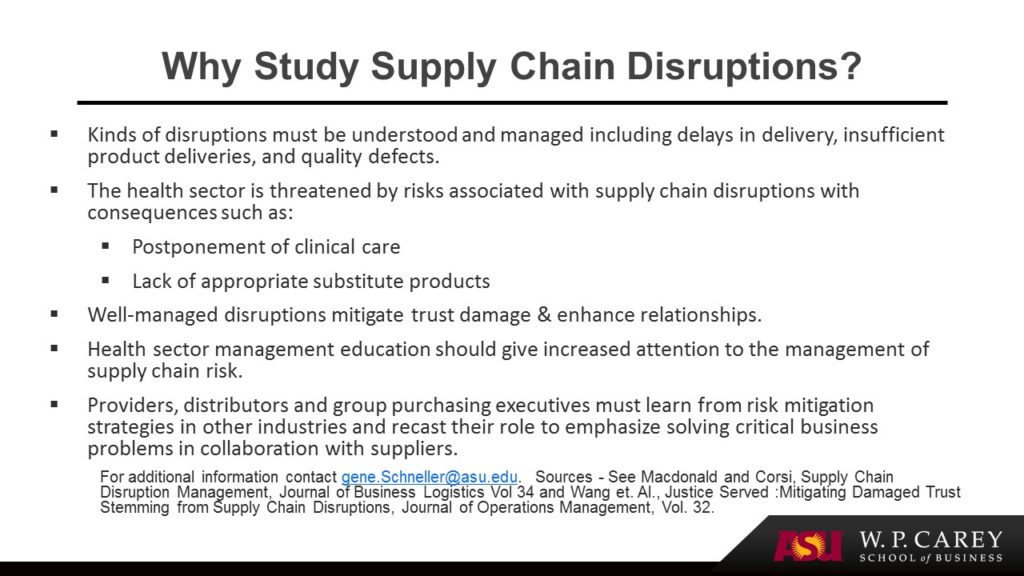
  • Supply chain disruptions are especially threatening in the health sector, where the delayed deliveries and lack of substitute products may mean postponing patient care. The most critical factor in managing supply chain disruptions is discovery speed. In turn, buyers are most likely to maintain relationships with suppliers that actively involve themselves in identifying problems and managing recovery from disruptions, using strategies that focus on maintaining a buyer’s trust in the supplier’s ability.

What is the evidence?

  • Scrutinizing how firms outside the health sector manage disruptions offers important lessons for health sector leaders. Two studies of supply chain disruptions examine the costs of the problems and the effectiveness of different approaches to recovering from the disruptions.

Links: Slide

Submitted: August 20, 2016; Accepted after review: October 30, 2016

Cite as: Eugene Schneller. 2017. Strategies for Dealing with Supply Chain Disruptions. Health Management Policy and Innovation, Volume 2, Issue 1.

|

Introduction

Supply chain disruptions in healthcare such as recalls and shortages of pharmaceutical and medical/surgical products commonly harm clinical quality, regulatory compliance, and patient safety (see Figure 1). Even with sound risk management practices, severe disruptions can arise unexpectedly. Healthcare professionals need to establish flexible processes to identify and manage supply chain disruptions once they occur. This article summarizes recent research on managing supply chain disruptions.

Supply chain disruptions move through four phases: (1) the disruption event, (2) discovery of the event, (3) recovery from the disruption, and (4) redesign of the supply system. Although each phase requires thoughtful attention, the most critical factor in managing disruptions is often discovery speed. Following supplier-induced disruptions, suppliers benefit from using procedural justice strategies that restore buyers’ trust in their abilities.


Studies

Study 1: Managing supply chain disruptions

Study context: This study examined 34 supply chain disruptions from 17 firms, each of which experienced a well-managed supply chain disruption and a disruption that could have been managed better (MacDonald & Corsi, 2013).

Findings: Supply chain disruptions such as product recalls and quality failures are particularly challenging to address. Such internal disruptions commonly take substantial time to discover, face slow recovery times after discovery, and require large buyer-supplier recovery teams that are difficult to manage. Disruptions that are slow to discover incur particularly large financial costs. Firms that actively monitor supply chain activities are best able to discover problems early and then determine the disruption’s root causes. Early identification and diagnosis then facilitate smooth recovery.

Study 2: Mitigating damaged trust resulting from disruptions

Study context: This study examined 604 supplier-induced disruption incidents from Chinese manufacturers, including delivery delays, delivery shortages, and major quality defects. The researchers used organizational justice theory to examine how approaches suppliers used to resolve the disruptions affected buyers’ trust in the buyer-supplier relationships and, in turn, whether the relationships continued (Wang, Craighead, and Li, 2014).

Findings: Buyers were most likely to maintain relationships with suppliers that actively involved themselves in managing recovery from the disruption. Supplier strategies that focused on maintaining a buyer’s trust in the supplier’s ability (procedural justice) were most successful in limiting damage to trust. By contrast, simply encouraging buyers to support the suppliers (conserve supplier benevolence) did not help maintain a relationship.

Summary

Supply chain disruptions can spill down the value chain far beyond the initial problems. Both parties in a buyer-supplier relationship need active processes for identifying problems quickly, diagnosing the causes of the disruptions, and addressing the root causes. In doing so, suppliers need to focus on maintaining buyers’ confidence in their capabilities and their ability to avoid future problems.


REFERENCES

Macdonald, J. R., & Corsi, T. M. 2013. Supply Chain Disruption Management: Severe Events, Recovery, and Performance. Journal of Business Logistics, 34(4), pages 270–288.

Wang, Q., Craighead, C. W., & Li, J. J. 2014. Justice served: Mitigating damaged trust stemming from supply chain disruptions. Journal of Operations Management, 32(6), pages 374–386.


The Health Sector Supply Chain Research Consortium

The Health Sector Supply Chain Research Consortium (HSRC) is an Industry Advisory Group within CAPS Research.  CAPS Research is jointly sponsored by member companies, the W. P. Carey School of Business at Arizona State University, and the Institute for Supply Management®(ISM®). HRC was founded in 2004 to bring together health sector organizations and academic researchers to conduct research on topics related to the strategic management of the health care supply chain. HSRC embodies:

  • Research– We engage in cutting-edge research led by scholars from universities across the globe.  We also monitor monitoring health care supply chain trends and engage in benchmarking.
  • Thought Leadership –We function as a boiler room for new ideas to drive excellence and innovation in the health care supply chain.
  • Collaboration– Our research is developed through collaboration with member organizations representing multiple stakeholders across the health care supply chain.
  • Industry Guidance– HSRC research is responsive to industry needs and provides guidance and opportunity to raise the standard of management and policy practice surrounding the health care supply chain.

For more information, visit: http://www.capsresearch.org/health-sector-advisory-group/ or https://wpcarey.asu.edu/research/health-supply-chain

Contact: gene.schneller@asu.edu or (602) 320-1512


Consolidated Services Centers Can Improve the Health Care Supply Chain

Tags: consolidated service centers. CSC, finance, GPOs, group purchasing organizations, hospital supply chain, hospitals, IT, logistics, operations, purchasing, shared servcices, supply chain

From the Health Sector Supply Chain Research Consortium (Eugene Schneller, Director), CAPS Research & Arizona State University, W. P. Carey School of Business

Contact: Eugene Schneller, gene.schneller@asu.edu

Eugene Schneller is an experienced academic leader, researcher, and administrator with extensive experience at the university, college, and departmental levels. As Associate Dean of the College of Business at Arizona State University (ASU), he was responsible for operations of one of the largest colleges of business in the United States.

Abstract

What is the message?

  • Consolidated service centers (CSCs) can help simplify hospital supply chains by reducing suppliers, contracts, and staffing requirements. In doing so, CSCs act as system integrators that achieve greater cross-functional coordination of hospital supply relationships.

What is the evidence?

  • A study of three consolidated service centers (CSCs) used complexity theory to seek common themes and strategies that CSCs use to provide effective supply chain services for hospitals. Information for the studies included documents, field visits, and interviews with CSCs and their customers (Abdulsalam, Gopalakrishnan, & Schneller, 2015).

Links: Slide01 | Slide02

Submitted: August 20, 2016; Accepted after review: October 30, 2016

Cite as: Eugene Schneller. 2017. Consolidated Services Centers Can Improve The Health Care Supply Chain. Health Management Policy and Innovation, Volume 2, Issue 1.

Introduction

Throughout North America and beyond, consolidated service centers (CSCs) are emerging as important actors in the health sector supply chain. CSCs seek to reduce supply chain complexity. National distributors, group purchasing organizations (GPOs), and other health sector supply chain intermediaries are integrating features of CSCs as they attempt to deliver higher levels of service to their customers. As the health sector increasingly engages with this supply chain model, it is important to understand how CSCs manage complexity.

CSCs help simplify complex supply chains


The study highlights three conclusions about the complexity of the supply chain landscape.

First, the three CSCs in the study created measurable reductions in supply chain complexity and staffing.

  • Medical/surgical suppliers: Reduced by 10% to 20%
  • Medical/surgical direct contracts (non GPO): Reduced by 10% to 90%
  • FTEs at the hospital: Reduced by 3 to 15 FTEs
  • FTEs needed at CSC to service the hospital: Additional 1 to 8 FTEs (net reduction: 2 to 7 FTEs)

Second, the CSCs created supply chain benefits by reducing components in the system and managing inter-relatedness.

  • Fewer components: CSCs reduce the number of components in the hospital supply chain by facilitating supply base reduction initiatives.
  • Managing inter-relatedness: CSCs address inter-relatedness in the hospital supply chain by disintermediation and resource consolidation.

Third, three characteristics of the CSCs helped them smooth the hospital supply chain landscape.

  • Customer selectivity: The CSCs in the study were cautious about adding customers, preferring to grow through increased volume with existing customers.
  • Contract compliance: Over 80% of hospital supply spend was through the CSCs, compared to traditional hospital supply routes that incurred 50% to 70% of spend through direct contracts.
  • Reporting realignment: Hospital supply directors changed their reporting relationships to a matrix structure that included reporting to CSC leadership.

Discussion

To date, hospital supply chain functions have achieved lower uptake of shared service strategies compared to functions such as finance, IT, and HR (Deloitte, 2013). The emerging self-distribution strategy in health care, including CSCs, is beginning to reverse this delay. By aggregating supply chain components under one locus of control, the CSC can achieve wider “arcs of integration” with suppliers and customers (Frohlich & Westbrook, 2001).

The study has limits based on examining only three CSCs. Nonetheless, this article highlights the potential for CSCs to lead cross-functional coordination that integrates purchasing, logistics, and operations. In doing so, CSCs can both reduce cost and improve reliability in the health care supply chain.

References

Abdulsalam, Y., Gopalakrishnan, M., Maltz, A., Schneller, E. 2015. The Emergence of Consolidated Service Centers in Health Care. Journal of Business Logistics 36, 321–334.

Deloitte. 2013. 2013 Global Shared Services—Survey Results. Deloitte Development LLC.

Frohlich, M.T., Westbrook, R., 2001. Arcs of integration: An international study of supply chain strategies. Journal of Operations Management 19, 185–200.


Health Sector Supply Chain Research Consortium

The Health Sector Supply Chain Research Consortium (HSRC) is an Industry Advisory Group within CAPS Research.  CAPS Research is jointly sponsored by member companies, the W. P. Carey School of Business at Arizona State University, and the Institute for Supply Management®(ISM®). HRC was founded in 2004 to bring together health sector organizations and academic researchers to conduct research on topics related to the strategic management of the health care supply chain. HSRC embodies:

  • Research– We engage in cutting-edge research led by scholars from universities across the globe.  We also monitor monitoring health care supply chain trends and engage in benchmarking.
  • Thought Leadership –We function as a boiler room for new ideas to drive excellence and innovation in the health care supply chain.
  • Collaboration– Our research is developed through collaboration with member organizations representing multiple stakeholders across the health care supply chain.
  • Industry Guidance– HSRC research is responsive to industry needs and provides guidance and opportunity to raise the standard of management and policy practice surrounding the health care supply chain.

For more information, visit: http://www.capsresearch.org/health-sector-advisory-group/ or https://wpcarey.asu.edu/research/health-supply-chain

Contact: gene.schneller@asu.edu or (602) 320-1512