HMPI

Controlled But Not Employed: The Clash of Labor Law and the Corporate Practice of Medicine

Hayden Rooke-Ley, American Economic Liberties Project, and Daniel S. Bowling, Georgia State University

Contact: hayden.k.rookeley@gmail.com

Abstract

What is the message? As the corporatization of the medical profession continues, physicians are increasingly turning to labor law to collectively bargain over the terms and conditions of their employment. However, due to state bans on the corporate practice of medicine (CPOM), physicians working for private-equity-backed companies, hospitals, and other corporations are often not directly employed by these corporate entities. Such complex and indirect employment arrangements heighten the salience of labor law doctrines that, at times, allow unionized workers to compel multiple corporate entities to collectively bargain, including those that do not directly employ the workers. As physicians unionize, legal disputes over the application of these doctrines are beginning to surface and may shape the contours of physician unionization and CPOM bans.

What is the evidence? A review and analysis of recent labor law, legislative initiatives, court rulings, legal doctrine, and market developments.

Timeline: Submitted: May 24, 2024; accepted after review May 29, 2024.

Cite as: Hayden Rooke-Ley, Daniel S. Bowling. 2024. Controlled But Not Employed: The Clash of Labor Law and the Corporate Practice of Medicine. Health Management, Policy and Innovation (www.HMPI.org), Volume 9, Issue 2.

Introduction

Physicians are beginning to unionize in response to increasing corporate employment. However, these employment relationships are often indirect and complex, involving numerous corporate entities that jointly exercise control over physicians. In fact, due largely to state bans on the corporate practice of medicine (CPOM), many hospitals and corporate-owned medical practices do not actually employ physicians. Such arrangements raise the salience of two related law labor law doctrines: the “single employer doctrine” and the “joint employer doctrine.” Both doctrines can enable employees to unionize against non-employer entities that nonetheless control their working conditions. As discussed below, the application of these doctrines, which is now beginning to occur, may shape the contours of physician unionization and CPOM enforcement.

The Corporate Practice of Medicine

The current corporate structures of physician employment formed in response to state bans on the corporate practice of medicine (CPOM). Historically, these bans prohibited corporate entities from owning, controlling, or employing physicians.[1] Rising to prominence in the mid-1900s, these laws often originated in state courts through judge-made or “common” law. State legislators followed suit, codifying CPOM bans by prohibiting lay entities from clinical decision-making and requiring for-profit medical practices to be physician-owned.

While states have relaxed CPOM enforcement since the 1970s, the basic structure of these laws is largely still in place: medical practices must be exclusively or majority owned by licensed clinicians, typically physicians. And as corporatization of the medical sector continues, numerous states are now looking to strengthen these laws.[2] Due to this legal ownership landscape, corporations interested in controlling the medical practice have devised a workaround, known as the “PC-MSO,” or “Friendly PC” model (“PC” stands for “professional corporation,” which is a common corporate form of physician-owned medical practices). In these arrangements, a corporate entity, such as a private-equity-backed company, will use the vehicle of a management services organization (MSO) to exercise functional control over a medical practice or a physician staffing company.

While MSOs traditionally assist medical practices with back-office administrative tasks, lay-owned corporations through contracting – can transform the MSO into the controlling entity. For example, the MSO often takes control of all business and administrative elements of the practice, allowing it to require that physicians see more patients, dictate coding and billing procedures, make personnel and scheduling decisions, and control many of their functions of the practice that influence the nature and quality of care delivered. MSOs may also require that physicians sign restrictive contracts such as noncompete agreements, gag clauses, and stock transfer restriction agreements (STRAs), which in effect place the MSO in control of the equity of the physicians.

In the most extreme version, the Friendly PC model, the MSO will install a “friendly” or “captive” physician leader. This physician will be licensed in the state to practice medicine and can therefore satisfy the formal requirements of physician ownership, but in substance, the physician serves as a direct extension of the MSO. This physician, who may not actually practice at the clinic, is often financially compensated by the MSO and even serves on its executive board. The physician may have a direct role in MSO management or receive a minority equity stake in the MSO.

Another scenario of corporate non-employer control implicates hospitals. Many hospital-based physicians work for a corporate staffing company that contracts on behalf of physicians with the hospital. This practice, too, has historical roots in CPOM laws, which barred hospitals from employing physicians. That prohibition continues in some states today, such as Texas and California. The use of physician staffing companies is pervasive even in states that permit direct employment by hospitals. In these arrangements, the hospital, as a party to the contract with the staffing company, exercises varying degrees of control over the employed physicians. Like MSOs in the PC-MSO context, however, the hospital entity is not the formal employer of the physician (nor might be the staffing company using the PC-MSO model).

The upshot of these arrangements is that the corporate entity exercising control of physicians is not actually the legal employer. As physicians are increasingly attempting to unionize under these structures, the fact that the corporation is not the physicians’ employer complicates the application of federal labor law, which is largely predicated upon a direct employer-employee relationship.

The Single Employer and Joint Employer Doctrines

Under the National Labor Relations Act (NLRA), which governs private-sector unions, only “employees” can organize a union, and independent contractors are expressly excluded. The NLRA defines neither employees nor independent contractors, so issues regarding employee eligibility have been the subject of litigation for decades. The NLRA also only references “employers,” which typically involves a single employer. But as corporate ownership structures have become more complex, the National Labor Relations Board (NLRB) has developed two related doctrines that, at times, can broaden the NLRA’s scope to include corporate entities that are not technically employers but functionally operate as such.

The first of these doctrines is the “single employer” doctrine. It applies in situations where there appears to be multiple entities controlling the employees, yet they functionally operate as one enterprise so that “for all purposes, there is in fact only a single employer.”[3] If the entities are deemed a single employer, the NLRA’s protections for collective bargaining apply to it as if it were one employer, rather than multiple separate entities. To determine whether these multiple entities constitute a single employer, the NLRB looks at whether there is interrelation of operations, centralized control of labor relations, common management, and common ownership or financial control.[4] Centralized control over labor relations tends to be the most critical element, and common ownership, while typically necessary, is not dispositive. The single employer doctrine tends to be used in the context of a business subcontracting integral parts of its operations.

A related but distinct principle of labor law is the joint employer doctrine, which has been subject to significant legal disputes in recent years. Historically, courts and the NLRB found joint employment where one or more entities exert “direct and immediate” control over the employment terms of employees seeking unionization. Under this fact-specific inquiry, if a group of employees can show that an entity effectively controls the working conditions of unionizing employees, it will be found to be a joint employer with the direct employer and compelled to comply with the requirements of labor law, such as good-faith collective bargaining.

In 2015, the NLRB relaxed the “direct and immediate” standard for the joint employer doctrine in Browning-Ferris Industries, which held that the putative joint employer need only “share or codetermine” the terms and conditions of employment.[5] The ruling implicated businesses that make heavy use of contractors, staffing companies, and franchisors, and drew vigorous opposition from the Chamber of Commerce and employers such as McDonald’s.[6] The Trump Administration’s pro-business NLRB then issued regulations in 2020 returning the standard to the pre-Browning “direct and immediate” control requirement. Later in 2023, the Biden NLRB issued yet another set of rules discarding the 2020 rules and reimplementing the Browning-Ferris standard, but a U.S. District Court promptly stayed the new rules’ enforcement, a ruling that is now pending appeal.[7] Going forward, the standard will remain subject to much dispute, and it may influence the outcome of joint-employer questions in the context of physician unionization.

Implications for Physicians

Whether physicians can successfully invoke the single and joint employer doctrines will influence the effectiveness of unionization. For example, if physicians unionize against a staffing company but are unable to compel a hospital to collectively bargain, the physicians will be unable to negotiate working conditions dictated by the hospitals. The same is true for physicians employed under a PC-MSO structure: the MSO, if it can avoid the status of employer, would not be compelled to bargain over the working conditions it controls. On the other hand, if physicians can invoke these doctrines, they will not only be able to bargain over all the conditions of their employment; they’ll also be protected from retaliation for unionizing or striking, as labor law would prohibit the hospital, for example, from terminating a contract with a physician staffing company in response to unionization.

These labor law questions could also implicate the enforcement of CPOM bans. In states where CPOM bans prohibit corporate employment of physicians, findings from the NLRB and courts that MSOs or hospitals are essentially functioning as employers could encourage tighter regulation of the PC-MSO model. The specter of such findings could serve to benefit unionizing physicians. As corporate entities using the PC-MSO and Friendly PC models seek to avoid adverse determinations as single or joint employers, physician unions may be able to gain concessions in bargaining in exchange for withholding a challenge on single or joint employment.

With physician unionization and corporate employment accelerating in recent years, these questions are no longer theoretical. For instance, a recent NLRB case considered a physician union challenge to the Friendly PC structure in California. There, the unionized physicians are directly employed by two professional corporations, Family Medicine and Healthcare Partners Medical Group. Those professional corporations are each solely owned by Dr. Derek Chao. Dr. Chao is the “friendly physician” installed by the professional corporation’s MSO, Optum, which is a subsidiary of the insurance conglomerate, UnitedHealth Group. Dr. Chao, in fact, works for Optum as the president of Optum West.

In the dispute before an NLRB regional director, the unionized physicians unsuccessfully argued that Optum should be considered a single employer.[8] The fact record demonstrated that Optum controls management and administration functions, employment of nonclinical staff, training, marketing, employment policies for physicians, and many other forms of control. However, the NLRB regional director found under a single-employer analysis that the entities did not comprise an “integrated enterprise.” The director here appeared to focus on the absence of a common owner of the distinct entities, finding that “the record is devoid of references to the specific entity known as Optum, Inc.” In a footnote, the director concluded that the union would also fail under a joint employer analysis, “based on the dearth of record evidence concerning that entity.”

The case has limited value given the undeveloped fact record and the sparse analysis of the joint employer question. But it is nonetheless relevant that the NLRB regional director found for Optum despite uncontroverted evidence of the Friendly PC model. That is, the fact that the sole owner of the formal employer (the medical practice) is a physician employed and paid by Optum was insufficient to conclude that Optum was a single employer. Future challenges, with more developed fact records, will help clarify how the NLRB interprets PC-MSO arrangements.

Joint employment questions are also bound to arise where physicians treating patients in a hospital setting are employed by corporate staffing companies. Today, one-third of emergency room physicians are employed by private-equity-backed staffing companies, such as Envision and TeamHealth. Hospitalists and other hospital-based physicians, such as anesthesiologists, are also increasingly employees of staffing companies. In California, a pending federal lawsuit is alleging that Envision’s use of the Friendly PC model violates the state’s CPOM ban. In Michigan, physicians at a hospital staffed by TeamHealth have unionized, and they recently went on strike. In all of these arrangements, the degree of control exercised by both the lay MSO and the non-employer hospital may supply grounds for single or joint employment status.

In a recent case of first impression, an NLRB regional director in Seattle found joint employer status to exist between a hospital system, PeaceHealth, and a staffing company, Sound Physicians.[9] The dispute involved a unit of thirty physicians, physician assistants, and nurse practitioners unionizing against Sound. The clinicians argued that while they were formally employed by Sound, the hospitals had direct influence on their terms of employment and were therefore joint employers. Sound argued that any control over terms and conditions of employment by the hospitals was indirect and merely a result of the contract between Sound and PeaceHealth for staffing support. The director, while expressly rejecting the 2023 heightened joint-employer standard, found Sound’s arguments to be unpersuasive. The director concluded that the hospitals exercised sufficient control over wages, benefits, hiring, discharge, and other employment-related issues to be a joint employer. Sound and PeaceHealth have appealed the decision.

Together, these recent cases suggest that more disputes over single and joint employment are forthcoming in the context of physician unionization. The regional decisions by the NLRB are not binding on other regions, though early decisions might have a persuasive effect. How physicians and employers strategically navigate these doctrines will be a development worth watching.

Conclusion

As corporatization of the medical profession continues, physicians are increasingly turning to labor law to collectively bargain over the terms and conditions of their employment. At the same time, state lawmakers and courts may be looking to strengthen CPOM bans that limit or prohibit direct employment of physicians, leading to the PC-MSO and other models of contractually complex employment relationships that will continue to evolve. Together, these factors raise the salience of the single and joint employer doctrines for physician unionization efforts, potentially allowing unionizing physicians to compel multiple corporate entities to comply with labor law rules set forth for employers. How courts and labor boards view these questions will influence the relative power of physicians in the context of unionization–and may influence rejuvenated efforts to enforce CPOM bans.


References

1] Zhu J, Rooke-Ley H, Fuse Brown E. A Doctrine in Name Only — Strengthening Prohibitions against the Corporate Practice of Medicine. N Engl J Med 2023;389:965-96.

[2] Rooke-Ley H, Fuse Brown E. Lesson’s From Oregon’s Attempt to Strengthen the ‘Corporate Practice of Medicine’ Ban. Health Affairs 10.1377/forefront.20240501.954346.

[3] NLRB v. Browning-Ferris Industries of Pennsylvania, Inc., 691 F.2d 1117, 1122 (3d. Cir. 1982).

[4] See Radio Union Local 1264 v. Broadcast Service, 380 U.S. 255, 256 (1965).

[5] Browning-Ferris Industries, 362 NLRB No. 186 (2015).

[6] James van Wagtendonk, Is There an Employer in the House?, 98 Boston L.R. 1105, 1107.

[7] U.S. Chamber of Commerce et al. v. NLRB et al., No. 6:23-cv-00553 (Mar. 8, 2024).

[8] Centers for Family Medicine, GP, and Healthcare Partners Medical Group, PC, Case 23-RC-311869 (2023).

[9] South Sound Inpatient Physicians, PLLC, and PeachHealth 19-RC-338479 (2024).

Steward Health Care: A Cautionary Tale

Wasan M Kumar, Stanford University School of Medicine

Contact: wkumar2@stanford.edu

Abstract

What is the message? The May 2024 bankruptcy of Steward Health Care – the largest physician-owned hospital system in the country and one of the largest U.S. private hospital systems – raises questions about the hospital’s private equity funding, debt-financed business model and the future care of its patients.

What is the evidence? News reports, court documents, and company announcements.

Timeline: Submitted: June 3, 2024; accepted after review June 11, 2024.

Cite as: Wasan M Kumar. 2024. Steward Health Care: A Cautionary Tale. Health Management, Policy and Innovation (www.HMPI.org), Volume 9, Issue 2.

In May 2024, Steward Health Care filed for bankruptcy with nearly $9 billion in liabilities, one of the largest hospital bankruptcies in US history.1 Steward’s financial collapse is closely tied to its private equity funding and debt-financed business model, leaving policymakers with questions about care delivery for the former Steward patients and scrutiny of private equity investment in healthcare.

Steward was launched in 2010 after a private equity firm, Cerberus Capital Management, acquired a failing nonprofit Massachusetts hospital system, Caritas Christi Health Care.2 Ralph de la Torre, a cardiac surgeon with degrees from Harvard Medical School and Massachusetts Institute of Technology, joined Caritas as CEO in 2008 after being recruited from Beth Israel Deaconess Medical Center, and remained as CEO for the new Steward Health Care.3 Steward was intended to show how an injection of private capital and the management model of private equity can be used to improve the management capacity and the services of a safety net healthcare system. At the time, de la Torre was quoted, “We are striving to further improve the quality of care our patients receive, attract talented new physicians, upgrade and expand the infrastructure at our facilities, maintain or grow our staffing levels and undertake additional investments to further improve the quality of care we provide. In Cerberus, we found an investor that shares our vision and commitment.” 2 This marked a substantial private investment in a large hospital system that predominantly delivered care to low-income patients on Medicaid or Medicare. The terms of the transaction were later modified, but finally approved, by the Massachusetts Attorney General.4

Steward grew from the six Caritas Christi hospitals in 2010 to 33 hospitals at bankruptcy in 2024.4

After failing to achieve profitable status or expand outside of Massachusetts, Steward sold its Massachusetts properties to Medical Properties Trust (MPT), a real estate investment trust (REIT), in a $1.25 billion sale-leaseback agreement in 2016.4 In a sale-leaseback agreement, organizations offload properties for a capital infusion, with an agreement to lease the facilities from the new property manager. Steward’s agreement included a 10-year escalator clause leading to annual rent increases, with each individual hospital responsible for rent, insurance, and taxes.

Steward used the funds it raised to make a payment to Cerberus capital, and then to acquire IASIS Healthcare in 2017 and expand to 36 hospitals across 10 states.3,5 In 2018, Steward became an international health system with operations in Malta and Columbia.

In 2020, de la Torre led a buyout of the remaining Cerebus interest in Steward, leaving ownership to a physician group (90%) and MPT (10%).5

As a result of the sale-leaseback agreement, the Steward system, which already failed to attain profitability by 2016, began experiencing increasing operating costs and worsening budgetary pressures given the large and increasing lease payments. Adding to the financial instability, Steward fell behind in its accounts payable to vendors who repossessed medical equipment needed for patient care. This was linked to adverse patient outcomes, including one patient’s death.6

The financial model for Steward remained challenging. In late 2023, Steward delayed lease payments to MPT, so MPT publicly announced efforts to recover its overdue payments and limit its exposure to Steward in January 2024.7  Negotiations to financially restructure Steward were unsuccessful, leading to the bankruptcy filing of Steward and 166 related entities in May 2024.8 In their filings, Steward reported $1.2 billion in secured debt and $8 billion in unsecured debt.8 Steward reported the full potential impact of this bankruptcy when they report that they served “two million patients annually, and employing a workforce of nearly 30,000. Since its inception, Steward has become a national, integrated health care network across 10 states comprised of 31 hospitals and over 400 facility locations (including physician practice offices, ambulatory surgical centres, and diagnostic imaging centres) with over 4,500 primary and specialty care physicians, all committed to serving patients in underinsured and underserved communities.”8

This was a stunning turn of events for Steward, leading to significant questions about the financial engineering underlying all of these transactions. Publicly, politicians were screaming about the two yachts and two jets owned by de la Torre.9 They demanded greater transparency and accountability for Steward’s management.10

Given the implications of the Steward collapse for patients and government-sponsored insurance, federal and state governments have grounds to scrutinize some of the financial tools used to construct Steward, including its REIT financing model. In 2021, REITs owned over $3.5 trillion in assets, with ownership of 3% of all hospitals nationwide.11 Medical institutions are particularly attractive for REITs, as these organizations are often willing to enter longer term sale-leaseback agreements that are negotiated for decades-long leases and have a predictable revenue stream.12 Healthcare organizations have stable cash flows, yet in this instance essential services were put at risk. From the perspective of investors, investing in these organizations can be risky, with Cereberus capital profiting approximately $800 million over 10 years,13 while MPT attributed $693 million in losses in Q1 2024 to Steward.14

The obvious question remains if sale-leaseback agreements even have a place in healthcare, and whether these institutions have the governance structure required to support these transactions. The short-term fiscal benefits of a sale-leaseback agreement could be very lucrative to hospital executives, but they may not support sustained growth of the underlying institutions. From the data currently available, its unclear if the REIT structure itself was at fault, or the escalation terms built into the REIT payments – presumably to help support operational cash-flow in the short term in exchange for higher payments in the future that might only occur by abandoning the safety-net patient base of the organization in the search for patients with more generous commercial insurance. Safeguards could be required in the terms of a sale-leaseback to prevent capital expenditures without an established plan for the hospital system to maintain its new fiscal responsibilities. In addition, the government could regulate sale-leaseback terms in healthcare to prevent hospitals from entering very long-term agreements or unfavorable escalator clauses. Of course, the Steward bankruptcy is also a cautionary tale for the REIT industry which supported an aggressive growth plan by Steward that ultimately failed.

The bankruptcy of Steward Health Care, the largest physician-owned hospital system in the country and one of the largest U.S. private hospital systems, could serve as a wake-up call for further examining the role of private equity in healthcare, especially in the hospital and safety-net markets. Of course, the investment industry will argue that Steward is a case of management greed and failure and should not serve as the condemnation of all of private equity. The inevitable investigations that will follow will shed further light on these questions.

In the immediate term, the crisis leaves lawmakers with several urgent questions to prevent the loss of care continuity for patients served by this hospital system. With Massachusetts often serving as a trailblazer in healthcare policy, the outcome of the Steward Health bankruptcy may set the tone for national health policy on private equity investment in healthcare.


References

  1. Bankrupt Steward Health puts its hospitals up for sale, discloses $9 billion in debt. CNN. https://www.cnn.com/2024/05/07/business/steward-health-puts-hospitals-up-for-sale/index.html. Published May 7, 2024.
  2. Cerberus Capital. Caritas Christi Health Care System to Be Acquired by Cerberus Capital Management, L.P. Cerberus Capital Management; 2010. https://www.cerberus.com/media-center/caritas-christi-health-care-system-to-be-acquired-by-cerberus-capital-management-l-p/
  3. Falla B. Caritas Names Heart Surgeon Ralph de La Torre to Head Hospital System. Marketplace; 2008. https://www.sj-r.com/story/news/2008/04/02/caritas-names-heart-surgeon-ralph/46050078007/
  4. Harrison E, Scalese R. A timeline of Steward Health Care, from founding to financial peril. WBUR. https://www.wbur.org/news/2024/01/31/steward-health-care-timeline
  5. Team of Steward Doctors Acquire Controlling Stake of Steward Health Care.; 2020. https://www.steward.org/newsroom/2020-06-03/team-steward-doctors-acquire-controlling-stake-steward
  6. Bartlett J. Steward’s medical devices were repossessed. Weeks later, a new mother died. Published online January 25, 2024. https://www.bostonglobe.com/2024/01/25/business/steward-health-care-mother-death/
  7. Medical Properties Trust Provides Update on Steward Health Care. Medical Properties Trust; 2024. https://medicalpropertiestrust.gcs-web.com/news-releases/news-release-details/medical-properties-trust-provides-update-steward-health-care
  8. Steward Health Bankruptcy Proceedings, First Day Motions.; 2024. https://restructuring.ra.kroll.com/Steward/Home-DocketInfo?DocAttribute=4776&DocAttrName=FIRSTDAYMOTIONS_Q&MenuID=10608&AttributeName=First%20Day%20Motions%20(motion%2057)
  9. Helms C. Can bankruptcy court “claw back” Steward CEO Ralph de la Torre’s yachts? What to know. The Enterprise. https://www.enterprisenews.com/story/news/healthcare/2024/05/28/steward-ma-steward-health-care-bankruptcy-hospitals-brockton-good-sam-ralph-de-la-torre-yachts/73626198007/. Published May 28, 2024.
  10. Healey M. Governor Healey Demands Financial Transparency and Patient Safety from Steward Health Care. Mass Gov https://www.mass.gov/news/governor-healey-demands-financial-transparency-and-patient-safety-from-steward-health-care#:~:text=Boston%20%E2%80%94%20Governor%20Healey%20is%20today,refused%20to%20submit%20for%20years
  11. Bruch JD, Katz T, Ramesh T, Appelbaum E, Batt R, Tsai TC. Trends in Real Estate Investment Trust Ownership of US Health Care Properties. JAMA Health Forum. 2022;3(5):e221012. doi:1001/jamahealthforum.2022.1012
  12. Pai S. Medical Office Buildings As An Investment. Forbes. https://www.forbes.com/sites/forbesfinancecouncil/2023/08/08/medical-office-buildings-as-an-investment/?sh=45e66df41e96
  13. McDonough J, Hattis P. The State’s Options with Steward on the Brink. Commonwealth Beacon https://commonwealthbeacon.org/opinion/the-states-options-with-steward-on-the-brink/
  14. Vogel S. Steward’s landlord Medical Properties Trust posts $736M loss as hospitals flounder. Healthcare Dive. https://www.healthcaredive.com/news/medical-properties-trust-736m-loss-steward-bankruptcy/715676/


Word from the Editor

We’re very excited to bring you this issue of HMPI. Thanks to a generous gift from the Ludy Family Foundation, we have been able to reformat HMPI for its second decade. The biggest changes are behind the web page where we have formatted the journal for Google Scholar with searchable meta-data. Many thanks to Managing Editor Kirsten Gallagher and her team for the hard work to make this transformation happen! Beyond the new format, you’ll see articles we have solicited on timely topics in the health care market.

One perspective missing from the drug re-importation debate in the US is that of Canada. In our featured article, we will learn Paul Grootendorst how the Canadian government and Canadian manufacturers have built legal mechanisms to protect their market and their drug supply. Medicare Advantage is in the news and is studied in many of our programs as a financial model, but what is it like to experience Medicare Advantage from the perspective of an enrollee. We have a very personal account of end-of-life care from Neil Fleming. PBMs constantly confuse students (and policy makers) on their role in the market. Rena Conti, one of the country’s experts on this industry, provides a careful overview of PBMs, some of their potential benefits and some of their challenges.

Reimbursement remains a challenge for many new medical products. New data document the barriers to establishing reimbursement codes from the innovators perspective. Prior authorization is also in the news. We’re grateful for a timely review of this health plan feature from Austin Allen and Markus Saba. Other articles this month include perspective on organizational innovation from Dick Levy, who built Varian and has served on over 20 public and private boards, an update on CMS price transparency rules from Steve Parente, who helped develop this policy during his time in the White House, a review of the University of Miami’s latest healthcare conference from Karoline Mortensen, Steven G. Ullmann, and Richard Westlund, and workforce challenge recommendations by the winners from our 2024 BAHM Case Competition, Angela Botiba, Divine Mercy Bakare, and Erika Schlosser. Finally, we have a new case study on administrative costs, and an overview of Robert Pearl’s new book.

Kevin Schulman, MD, MBA
BAHM President & HMPI Editor-in-Chief
Professor of Medicine, Stanford University

Medicare Advantage and Hospice Care: My Family’s Difficult Story

Neil S. Fleming, Robbins Institute of Health Policy & Leadership, Hankamer School of Business, Baylor University

Contact: Neil_Fleming@Baylor.edu

Abstract

What is the message? Medicare Advantage plan enrollment now exceeds 50% of the total Medicare beneficiary population. MedPAC estimates that private insurers are now being paid at a higher level than the cost of enrollees within traditional Medicare, increasing total Medicare spending. This essay argues that pressure to reduce that spending is incentivizing Medicare Advantage plans and their contracted providers to favor financial considerations rather than the needs of terminally ill patients and their families.

What is the evidence? A first-person account around the decision to engage hospice care and the actions by providers in the context of a Medicare Advantage plan and a contracted medical group.

Timeline: Submitted: February 8, 2024; accepted after review April 16, 2024.

Cite as: Neil S. Fleming. 2024. Medicare Advantage and Hospice Care: My Family’s Difficult Story. Health Management, Policy and Innovation (www.HMPI.org), Volume 9, Issue 1.

Introduction

My story is a family saga involving Medicare Advantage (MA) and the incentives it might create for providers who influence hospice care for terminally ill individuals. My family’s experience represents the struggles facing a growing number of families due to policy and system-level factors in the current U.S. healthcare environment.

The current number of Medicare Advantage members has risen to 51 percent of total Medicare beneficiaries, with the forecast to reach 60 percent by 2030 (Neuman et al., 2024). It has been argued that many factors support this trend of increasing membership in MA plans, stemming from factors such as better convenience, benefits, and financial protection for beneficiaries as well as aggressive marketing by insurance companies.1 From a policy perspective, there is concern that MA plans are actually increasing overall Medicare spending as private insurers increase covered MA beneficiaries and are paid at a much higher level (by Medicare) than the cost of equivalent traditional Medicare. This is according to the most recent Medicare Payment Advisory Commission (MedPAC) public meeting.1,2 Approximately half of Medicare decedents received hospice care).2  Increasing MA enrollment coupled with financial pressures and use of hospice, set an increasingly complex stage for terminally ill patients and their families.

Our Story

Both of my parents were academics at Case Western Reserve University (CWRU.)  Dad received his MD in his late 40s after receiving his PhD in his 20s. Mom received her PhD four years after Dad, delayed after caring for me for my first three years. Both had distinguished careers: Mom was the first female department chair at CWRU, and later finished her career at Cleveland State as Associate Dean of Education. They spent 20 wonderful years of retirement in Southern California after 34 years of often brutal winter weather in Cleveland, Ohio. My father’s increasing debilitation with Alzheimer’s forced my parents to move to Dallas to be closer to me, their only child, in mid-2012.

Dad only survived another nine months after their move. He mercifully suffered what was probably a stroke and passed with some of his cognitive abilities still intact (although he was still convinced he had traveled to the moon). My mother had undergone mitral valve repair surgery and a quadruple bypass in early 2008 back in California. By 2019, at 92, she experienced substantial valve leakage and suffered from advanced heart failure and failing kidneys.

When my parents first moved from California to Dallas, they were able to move into an independent living facility that was only 1.5 miles from my home. It was a comfortable existence, with a most convenient in-house primary care clinic offering access to both network specialty and hospital care coordinated as part of a Medicare Advantage plan. My parents left their traditional care coverage for this new option. Their increasing age and frailty, coupled with a local provider available by foot, made this an easy decision.

When Covid hit in early March 2020, only one caregiver was allowed access to the residents. I became that caregiver, which proved to be extremely important as Mom‘s heart ailments led to her continued decline. She began suffering from bouts of severe arrhythmia, which ultimately could not be ameliorated through ablation or medications. Finally, her electro-cardiologist admitted her into our local heart hospital for evaluation.

It took nine days of her inpatient stay for her medical team to sort out her electrical system, which resulted in the implant of a pacemaker. Looking back, that lengthy stay must have severely negatively impacted her individual risk spending metrics in relation to the premiums her Medicare Advantage program was receiving for her care. It would appear that her illness trajectory would present strong incentives to remove her from the MA plan by transitioning her into hospice care

Post-Discharge

Within the first week of my mother’s discharge, her primary care physician set up a post-discharge phone call with me. She announced in a clinical but assertive tone that my mother had at most six months to live and that we needed to begin planning for her transition to hospice care. Of course, this was terribly sad news and I shed many tears for what I later learned from our hospice grief counselor was “anticipatory grief.”

One night in June, as she continued to decline, my independent mother decided to forgo help from her night aide and fell on the way to the restroom. She suffered a broken wrist and, as can be expected, the cascading of events led to her final passing. Mom passed in July 2021, having lived 13 months rather than the less than the six months predicted by her physician.

As a side note, when my mother fell, her hospice nurse told us that all falls are considered related to the terminal condition. As a result, my mother had to sign an agreement that she would be financially responsible for all costs incurred related to the orthopedists’ services. I also worried about the prospect that she might need surgery and that we would be financially responsible for both professional and facility charges. However, the surgeon felt that her cast was sufficient for her arm to heal. This situation, which undoubtedly occurs often, appears to frequently burden people without necessary means and who may suffer from more debilitating injuries such as fractured hips or legs. This absolute cost shift to the patient felt cruel to us, like the system was “piling on” during one of the most stressful experiences a family, i.e., a dying parent and child, can endure. Mom’s hospice nurse was uncomfortable having this discussion with us, but we realized that she was simply the messenger.

My mother passed away with her cast still on.

To be clear, prior to the pacemaker implant expense, specialty care was never denied while Mom was still enrolled in her MA plan. Mom continued to receive expensive injections to slow her macular degeneration. We were also able to visit the local valve clinic to explore a transcatheter mitral valve replacement to address her leaky mitral valve problem. This option is much better for frail patients because it is much less invasive, although much more expensive. We decided that a new valve would be too risky for Mom, especially because it was addressing a repair (with subsequent biological challenges) rather than an initial valve repair or replacement.  It was also unclear if it would substantially improve her quality of life amid the specter of unwanted complications. The Care Coordinator for her MA program was fantastic in seeking out care prescribed by all of Mom’s specialists during her entire membership.

Reflections, Policy, and Implications

I was a financial reviewer of health maintenance (HMO) risk arrangements in the1980s while serving as an external financial consultant for the Health and Human Services’ Office of Prepaid Health Care. I helped determine both federal qualification and compliance (the latter when HMOs ran into various financial and operational difficulties). I witnessed many types of contractual arrangements, some of which could put even the individual clinician as well as hospitals in the position of foregoing risk pool payouts. This aggressive form of risk sharing is not allowed under Medicare Advantage regulation.

Under 42 CFR § 422.208, “The MA organization makes no specific payment, directly or indirectly, to a physician or physician group as an inducement to reduce or limit medically necessary services furnished to any particular enrollee.”

In retrospect, I queried long and hard: what would have caused Mom’s primary care physician to pronounce that she had less than six months to live? I was familiar with difficult “end of life” discussions, particularly as my former healthcare delivery system employer and clinicians were early champions of palliative care.6 I later learned that when terminally ill patients transition from Medicare advantage to hospice, the MA plan can no longer be at financial risk for medical services as the option for a move to traditional Medicare becomes available.2 As Mom was on the downward trajectory, the Medicare premiums received by her MA plan for services were clearly exceeded by her expenses for the care she had been receiving and most likely for future care.  While this conclusion is clearly my educated speculation, Mom’s primary care physician and “gatekeeper” was accountable for her care and related costs, as well as indirectly responsible for the relationship between the medical group and the insurer of the MA plan. It now appeared to be in their “best interest” to preserve this relationship by jettisoning Mom and avoiding her medical costs as quickly as possible.

From a policy perspective, in the face of rising medical costs, there should be better ways to incentivize providers and insurers of MA plans to care for terminal patients, and especially those who are on hospice. However, one major positive from Mom’s physician’s pronouncement was that I spent as much time as possible taking care of her. I shared that responsibility with her caretaker during the day and with my wife and daughter during night and weekend duty. We had to employ care aides in the evenings and during the night, and we were fortunate to be in the financial position to afford them. While the unit cost of that care is not expensive, the number of units makes the total care expensive.

While remaining in the MA plan is apparently listed now as an option by CMS4, I do not recall that option being offered or explained. Rather, the hospice nurse told us that traditional Medicare would continue to cover non-terminal services per CMS. It seemed that the Medicare Advantage plan automatically transferred my mother from their plan to Medicare.

Medicare Advantage plans under the Affordable Care Act appear to have been created to produce greater certainty around federal outlays and budgeting by shifting risk, i.e., uncertainty, to external entities. Under global risk models, insurance companies have further shifted financial accountability to physician groups.5 Recent pushback has occurred as both physicians and hospitals have been declining contracts with insurance companies and their MA plans. Their rationale: increasing requirements to provide care have become burdensome for providers. They are no longer accepting their patients’ coverage, with patients bearing the brunt of these financial decisions. Patients are left to find new providers.7

Conclusion

The U.S. healthcare system remains complex and daunting, even for someone who has spent a 40-plus-year professional career studying and participating in the system. I have been employed by the federal government, a private insurer/administrator for a state Medicaid program, a consulting firm, a healthcare delivery system, and now, a university. Sadly, these broad experiences still do not prepare someone for the challenges of caring for a dying relative. The accomplishments and life experience both professionally and personally can matter little for the terminally ill and their families – although financial resources can alleviate at least some of worry. Medicare Advantage plans and their contracted providers will continually be incentivized to make decisions with increased weight on financial considerations rather than patient and family needs. One would hope, however, that the government and private payers could incentivize actions on the healthcare delivery side to be more humane during the struggles that families endure when a member is terminally ill.

References

  1. Neuman Tricia, Freed Meredith, and Fuglesten Biniek Jeannie. 10 Reasons Why Medicare Advantage Enrollment is Growing and Why It Matters.  KFF Jan 30, 2024. https://kff.org/medicare/issue-brief/10-reasons-why-medicare-advantage-enrollment-is-growing-and-why-it-matters/.  Accessed March 26,2024.
  2. Medicare Payment Advisory Commission January 11, 2024. https://www.medpac.gov/wp-content/uploads/2023/10/MedPAC-MA-status-report-Jan-2024.pdf
  3. https://www.ecfr.gov/current/title-42/chapter-IV/subchapter-B/part-422 Page 100
  4. https://www.medicare.gov/what-medicare-covers/what-part-a-covers/how-hospice-works
  5. Galewitz Phil, Medicare Advantage Plans Shift Their Financial Risk To Doctors. KFF Health News Oct 8, 2018 (https://kffhealthnews.org/news/medicare-advantage-plans-shift-their-financial-risk-to-doctors/).  Accessed Feb 7, 2024.
  6. Roberts WC. Robert Lee Fine, MD: a conversation with the editor. BUMC PROCEEDINGS 2005;18:379–393.
  7. Appleby Julie, Medicare Advantage Increasingly Popular With Seniors — But Not Hospitals and Doctors, KFF Health News Nov 29, 2023 (https://kffhealthnews.org/news/article/medicare-advantage-payment-rates-friction/).  Accessed Feb 7, 2024.


ChatGPT, MD: How AI-Empowered Patients & Doctors Can Take Back Control of American Medicine

Robert Pearl, Stanford University School of Medicine, Stanford Graduate School of Business

Contact: www.RobertPearlMD.com

ChatGPT, MD: How AI-Empowered Patients & Doctors Can Take Back Control of American Medicine, co-authored by Dr. Robert Pearl and the advanced AI system, ChatGPT, offers a unique perspective on the future of healthcare, highlighting the transformative potential of generative AI. All profits from the book go to Doctors Without Borders.

Dr. Pearl, a seasoned healthcare leader and author of Mistreated (a Washington Post bestseller) and Uncaring (a Kirkus star recipient), advocates for a future where AI and human collaboration redefine patient care and medical practice. The book begins with an exploration of medical history, “Generations,” tracing the evolution of healthcare from the groundbreaking diagnostics and therapies of the past century to the unfulfilled promises of more recent technological advancements. Dr. Pearl reflects on the transition from the pioneering era of Healthcare 1.0 (introduction of heart surgery, total joint replacement, transplantation, CT, MRI, etc.) to the two subsequent healthcare eras, characterized by electronic health records and telemedicine, which failed to live up to their potential due to systemic and cultural barriers. The narrative underscores a recurring theme: the loss of control by patients and doctors to corporate interests, leading to a healthcare system plagued by inefficiencies and declining clinical outcomes.

In part two, “Generativity,” the narrative shifts to medicine’s next phase, Healthcare 4.0, heralded by the integration of generative AI tools like ChatGPT into the healthcare ecosystem. Dr. Pearl points out the powerful economic forces at play in the United States, which will force American medicine to change, whether led from inside or outside of the current healthcare system. He elucidates the exponential growth trajectory of generative AI, predicting breakthroughs in personalized medicine, diagnostics, and therapeutics. He emphasizes that the successful integration of AI in healthcare hinges on overcoming existing systemic barriers and fostering a connected, collaborative, and patient-centric medical system.

“Genesis” delves deeper into the foundational changes necessary for the effective adoption of AI in healthcare. Dr. Pearl champions the concept of systemness, advocating for a unified approach that enhances patient care and addresses the burnout epidemic among clinicians. He highlights the potential of external disruptors like Amazon, CVS, and Walmart to catalyze innovation and underscores the need for clinicians to break from outdated norms to embrace the new paradigms enabled by AI.

In “Gently,” Dr. Pearl discusses the role of AI in alleviating clinician burnout by providing patients with medical expertise, allowing them to better manage their chronic diseases and enabling more fulfilling doctor-patient interactions. Dr. Pearl tackles the ethical considerations (privacy, security, bias, misinformation) and potential pitfalls of AI deployment in healthcare. He addresses common fears and skepticism towards new technologies, arguing that, as with past innovations, habituation will ease these apprehensions. The book advocates for regulatory frameworks that encourage, rather than stifle, AI innovation, ensuring that patient welfare remains paramount.

The concluding fifth part, “Next Gen,” highlights the crucial role of visionary leadership in realizing the potential of generative AI in healthcare. Through case studies and the practical “A to G” model, Dr. Pearl illustrates how effective leadership can guide healthcare professionals through the change process, overcoming skepticism and resistance. The final chapter, “Seizing Serendipity,” encapsulates the notion that medical miracles often result from the convergence of opportunity and preparedness. Here, Pearl and his co-author urges leaders to embrace the transformative possibilities of generative AI.

Blending Dr. Pearl’s insights with ChatGPT’s capabilities, this book offers actionable solutions for healthcare, providing a pathway for doctors and patients to take back control of medical practice from corporate entities and a compelling case for a future where technology and humanity converge to create a more efficient, personalized, and accessible healthcare system.

A Business-Based Pathway to a Stronger U.S. Healthcare System

Richard M. Levy, Former Chairman and CEO, Varian

Contact:dick.levy17@gmail.com

Abstract

What is the message? Over the last 50 years, the U.S. healthcare industry has led the world in the development and widespread adoption of modern healthcare technology but ranks behind most other developed nations in healthcare delivery and population health. To maintain existing strengths and address persistent weaknesses, hospitals and health systems would benefit from more widely adopting traditional business competencies and approaches – among them, process improvements, multidisciplinary “incubators,” updated organizational structures, and quicker reaction times to market and technology changes.

What is the evidence? The author draws from his 50 years of leadership experience in healthcare across supplier, provider, and academic settings.

Timeline: Submitted: April 4, 2024; accepted after review April 4, 2024.

Cite as: Richard M. Levy. 2024. A Business-Based Pathway to a Stronger U.S. Healthcare System. Health Management, Policy and Innovation (www.HMPI.org), Volume 9, Issue 1.

Over the last 50 years, the U.S. healthcare industry has led the world in the development and widespread adoption of modern healthcare technology. At the same time, our healthcare system is behind most other developed nations in the effectiveness and efficiency of healthcare delivery, and in the average health of our population, currently rated below all other countries in the developed world by the World Health Organization and others.

The following analysis describes the strengths and weaknesses of the current system and proposes a pathway to maintaining the strengths and addressing the weaknesses.

The technology we have today would have been inconceivable 50 years ago. We have tools like MRI, CT, and ultrasound which can non-invasively diagnose problems within the body with millimeter precision. We are able to pinpoint and treat cancer with precise radiation oncology. We have minimally invasive and robotically controlled surgery. Our system has developed artificial organs and techniques for organ replacement. We have vaccines and drugs customized to particular genetic traits of individuals.

These tools and many others have helped to increase life expectancy in developed countries by 7 to 10 years, have cured diseases previously thought incurable, and prevented diseases, previously thought non-preventable.  They have made it possible to better manage some diseases and improve the quality of life for millions of people.

Partially due to the burgeoning technology industry, healthcare in the United States has become an economic force, representing 18% of gross domestic product and creating meaningful jobs for over 30 million people. This employment is second only to the defense industry.

But there have been unintended consequences related to the above successes.

Healthcare costs have gone up twice the rate of inflation over the last 50 years. Per capita healthcare costs in the United States are twice as high as the average of all other developed countries. Many patients have healthcare debt. Some have declared bankruptcy and lost their homes due to the cost of healthcare, and many others have avoided accessing the system until advancing illness forces them to seek help.

Hospitals have seen costs increase faster than revenues for the last 20 years. To remain solvent, many have had to reduce unprofitable services, which are still needed by their communities. They have had to reduce support for doctors, leading to unprecedented  physician burnout and early retirements.  The number of doctors required to treat our aging population, already inadequate today, will decline between now and 2030.

To address the financial stresses, over half of U.S. hospitals have joined with other hospitals to form large consortiums. This has often created an additional layer of bureaucracy and regulatory oversight, sometimes making the system more impersonal for both doctors and patients.

Our aging population exacerbates the financial stresses on the system. Today, 17% of the population is over 65, the highest ever and by 2030, that number  is forecasted to increase to 21%. Because people are older, there has been an even larger increase in chronic diseases. Chronic diseases do not need episodic cures as much as they require long-term care, including help with activities of daily living and with social determinants of health.  Long- term care is also needed by two other growing segments of the population, the neediest people and those with mental illnesses. A vast majority of our $4.9 trillion healthcare expense treats these three population segments, all of which need more long-term care than is generally available.

We spend less on long-term care as a percentage of total clinical care than any other country in the developed world. Small dollar increases in long-term psycho-social care would reap large reductions in the $4.9 trillion healthcare costs, increase overall population health, and reduce the burden of overwork for clinicians.

These two significant factors – market changes, and cost increases higher than inflation and revenues – are common in businesses, the media, and education systems. The primary tool of business when the markets shift and budgets are tight is a strategy change, which usually requires a change in organization structure and job definitions. In some businesses, organization changes occur every 5 to 10 years to meet the strategic needs. But some healthcare organizations haven’t changed traditional organization structures in 50 or even 100 years.

One frequent organizational strategy in business is the creation of small ad hoc multidisciplinary teams. Such teams are often used when there is a need for urgent action, e.g., solving an unexpected problem or testing a new business process, requiring different specialties to work together rather than each department operating independently.  Often, the urgency forces teams to go outside the company for competencies or products not readily available inside the company. And usually, the need for quick results forces the team to depend most on process innovation, which is cheaper and faster.

There are ad hoc teams in healthcare, often called “incubators,” that have been used effectively in streamlining internal operations. But, unlike in business, they have not been broadly used in hospitals to improve what’s important for customers/patients: cost and convenient access to the right care at the right time. This is possibly due to barriers to change such as extensive rules and regulations, legal risks, formal accreditation standards, unions, government oversight, and payment structures.

The environment for supporting a more patient-focused strategy will improve as we transition from highly regulated hospital care to more flexible outpatient care and home care.

But even without this transition, the incubators can demonstrate that process innovations for better healthcare at lower cost have fast financial payback for patients, hospitals, insurance companies, and the economy.

A second strategic lever of businesses is restructuring. Businesses, skillful at market segmentation, regularly spin out entities, acquire entities, and combine different specialties to address specific customer needs. Healthcare delivery systems have partially adopted this approach with integrated cancer centers and other centers of excellence for specific diseases. But many of the barriers to change in hospitals described above, do not exist in business. Because of these barriers, centers of excellence must often be bolted onto existing job definitions of specialty-based organization structures which are not optimally designed for a disease-based strategy. A possible solution to this problem is the matrix organization structure.

On one axis of a matrix structure are the specialties, e.g., manufacturing, engineering, marketing, finance, etc. On the other axis is project management. The specialty axis emphasizes quality, best practices, and regulatory compliance. The project management axis emphasizes time to market, cost, efficiency, customer convenience, and market share. Healthcare is mostly structured around the specialty axis. That axis is blessed with the finest doctors and best technology in the world. But the system often has a weekly lead, or non-existent project management (aka case management or navigation) axis, which is equally or even more important to patients. Without this axis, a routine cancer biopsy of a prostate or breast can require as many as eight patient visits to several healthcare sites and result in eight separate bills. Good project management and simple software could reduce the cost and inconvenience for both the patient and the provider.

Either a matrix structure or a freestanding center of excellence would enable healthcare systems to better measure and manage operational parameters like quality, use of best practices, and budgets, as well as patient-facing parameters such timeliness, convenience, and long-term costs. This is especially critical for chronic illnesses like heart disease, cancer, diabetes, Alzheimer’s, lung disease, kidney disease, strokes, and autoimmune diseases.

Another tool used frequently in business, but less in healthcare, is large scale process improvement. Businesses engage in time and motion studies and process mapping to improve efficiency and effectiveness for internal operations and for dealing with customers. In large multi-specialty healthcare organizations, process engineering is difficult if the patient needs help from multiple clinical or non-clinical specialties. Cancer is a good example. Patients diagnosed with cancer may need to make appointments with five or more clinical specialists (and back that up with second opinions) and interact with multiple nurses, receptionists, schedulers, technicians, imaging labs, financial advisors, primary care doctors, insurance companies, and psycho-social experts. The time between the diagnosis and the beginning of treatment in some dedicated cancer centers is as short as five days. In other general purpose hospitals, it can be as long as six months.

The long waiting time can be cruel.  It can affect the peace of mind of the patient and family, as well as the choice of treatment, the outcome of the treatment, and the cost. Many institutions are not organized to measure or manage the journey of the patient through difficult cancer treatment. Many also do not track the patient through the survivorship period, which might require a whole different set of interactions to deal with pain management, cosmetic surgery, skin problems, PT and OT, hair loss, incontinence, and other physical and psychological effects of the cancer and the treatment. Similarly to project management in business, healthcare systems are beginning to use navigators or case managers to help patients deal with the many interactions.

Another area where healthcare could learn from business is speed of change. In healthcare, the average time for a new process, or a new technology to become routine, can be as long as 17 years. An important tool that businesses use to react more quickly is acquisitions, partnerships, and hiring people with new competencies. The healthcare system has found it difficult to introduce new competencies through acquisitions and partnerships and has been slow to create new departments with new expertise. This is especially true for long-term care, so important to our aging population, and patient convenience, so important to working people and parents. Partially as a result, the traditional healthcare system is getting competition from organizations with different competencies, e.g., retail pharmacies, customer-facing companies like Amazon and Microsoft, free-standing outpatient clinics, and medical tourism, all of which offer lower cost and more convenience.

Business skills and experience in organization changes, process improvement, and adding competencies, are all available to and being used in healthcare, but they need to be spread more widely. Board members can play a major role in making this happen. Many Board members of healthcare organizations come from industries in which organizational changes are part of normal business operations. They and their families are patients of the system. They can and must provide more guidance on organizational change and how it affects the patient/customer experience. They can build this guidance into by-laws, management performance evaluation, and incentive plans.

Board members can establish bylaws which describe the skills and experience needed on the board and establish the tenure of members and committee chairs to assure continuity and cohesion. They can set yearly management goals for changes in organizational structure, adding new competencies, and tracking costs and outcomes for managing specific diseases. They can develop incentive plans to reward success. They can oversee acquisitions and partnerships bringing new competencies. They can support philanthropic efforts to enhance all of the above changes, both personally and in the community.

All the skills and the will to do better exist with management and the Board.

The changes are not happening fast enough to offset the explosions in cost, the rapidly aging population, and the shortage of doctors and nurses. Our country cannot afford to wait 17 years for these changes. Although there is always risk with any change, the risk of not changing is greater for the healthcare system. These changes must be more aggressively pursued. Only then will we have what every institution needs to survive in today’s supercharged world—better care at lower cost.

The new skills can be introduced as incubators and, when proven successful, can be spread throughout the system. Incubators can be initiated by empowered doctors and nurses who know best what patients need. These changes in the delivery process don’t require government intervention or radically different health insurance policies. But, to have a significant impact, they do require more funding from investors, philanthropists, and granting agencies.

Using traditional business skills will enhance, not detract from the incredible strengths of our healthcare system. They are the fastest, least expensive way to reduce cost and improve the health of our population.


Current Common Procedural Terminology (CPT®) Coding Process Challenges: Impact on the HealthTech Innovation Ecosystem

Cheyenne Ariana Erika Modina, Sandra Waugh Ruggles, Juliana Perl, and Josh Makower, Stanford Byers Center for Biodesign, School of Medicine, Stanford University

Contact: jmakower@stanford.edu

Abstract

What is the message? For medical innovators, obtaining a Category I Current Procedural Terminology (CPT) code from the American Medical Association (AMA) has become fundamental to unlocking reimbursement and patient access to a medical product, procedure or service in the United States. For those with novel innovations requiring assignment of a new code, the significant challenges posed to patient access by the current criteria could be improved with a more transparent, predictable, and achievable process, so that healthcare innovation and patient access to FDA-cleared and clinically proven therapies can flourish.

What is the evidence? A survey of different stakeholder groups with personal knowledge of the information used to apply for and achieve a Category I CPT code for a new treatment or diagnostic technology was designed and analyzed to assess the current challenges to traverse the CPT process, and understand the reasons for current Category I code challenges and their potential impact on the future of healthtech innovation.

Timeline: Submitted: April 3, 2024; accepted after review April 7, 2024.

Cite as: Cheyenne Ariana Erika Modina, Sandra Waugh Ruggles, Juliana Perl, Josh Makower. 2024. Current Common Procedural Terminology (CPT®) Coding Process Challenges: Impact on the HealthTech Innovation Ecosystem. Health Management, Policy and Innovation (www.HMPI.org), Volume 9, Issue 1.

Introduction

Established in 1966 and maintained by the American Medical Association (AMA), Current Procedural Terminology (CPT) is a uniform language of descriptive terms and identifying codes used to communicate across healthcare, enabling processing of insurance claims and advanced analytics for medical, surgical, and diagnostic procedures used to advance patient care. Updated annually, CPT has evolved over more than 50 years as medicine has advanced to incorporate new practices, paradigms, and applications including electronic health records, precision medicine, the COVID-19 pandemic, genomics, digital medicine, and augmented intelligence (AI)-powered medical service.

There are three categories of CPT codes. Category I (CAT I) CPT codes, released on January 1 each year by AMA, are restricted to clinically recognized and generally accepted services. These five-digit codes have descriptors that correspond to a procedure or service. In general, a proposed CAT I descriptor needs to be unique, well-defined and describe a procedure or service which is clearly identified and distinguished from existing procedures and services already in CPT. In addition to meeting specific general criteria, a proposal for a new or revised CAT I code must satisfy all of the following criteria:1

  • All devices and drugs necessary for performance of the procedure or service have received FDA clearance or approval when such is required for performance of the procedure or service.
  • The procedure or service is performed by many physicians or other qualified healthcare professionals across the United States.
  • The procedure or service is performed with frequency consistent with the intended clinical use (i.e., a service for a common condition should have high volume).
  • The procedure or service is consistent with current medical practice.
  • The clinical efficacy of the procedure or service is documented in literature that meets the requirements set forth in the CPT code-change application.

The criteria that procedures or services must be performed by many physicians or other qualified healthcare professionals nationwide, with frequency consistent with the intended clinical use, are collectively and informally referred to throughout this paper and in industry as the “widespread use” criteria.

Importantly for physicians, patients and innovators, CAT I CPT codes are priced on the Medicare Physician Fee Schedule and are generally more favorably reviewed for coverage by Medicare and commercial payers.

Category II (CAT II) CPT codes are optional, supplemental tracking codes to CAT I codes that describe performance and measurement, purposed for collecting information on the quality of care and thus reducing administrative burdens on healthcare professionals.2

Category III (CAT III) CPT codes were introduced by AMA in 2001 as a temporary code to enable providers and health systems to properly document and report data regarding new and emerging technologies, services, and procedures. They are also used to substantiate CAT I code criteria such as “widespread use,” and to track product utilization in Category B clinical studies.3 Although obtaining a CAT III code does not require FDA approval or clearance, nor published peer-reviewed evidence, as CAT I codes do, other criteria need to be met including that the procedure or service is currently or has recently been performed in humans.2 The AMA releases new CAT III codes twice a year, and the codes usually remain active for five years. Some but not all CAT III codes convert to CAT I.

The entire CPT code set is updated at least annually through a publicly accessible process by the CPT Editorial Panel. The Panel’s 21 members include nominated physicians, healthcare professionals who are experts in their medical specialty, and others representing private insurance companies, hospitals, and other interested parties. All complete CPT code change applications are reviewed and evaluated by CPT staff, the CPT/HCPAC (Health Care Professionals Advisory Committee) and the CPT Editorial Panel. Additionally, the CPT Advisory Committee, comprised of representative physicians selected by the national medical specialty societies from the AMA House of Delegates and the HCPAC, serves as an expert resource to the Editorial Panel. The Panel can choose to: add a new code or revise existing nomenclature; refer the agenda item to a workgroup for further study; postpone to a future meeting to allow for additional information to be submitted; or reject the item. Panel convenings happen three times per year to ensure timely updates on clinical practices and the latest innovations.

The pace of CPT code growth is increasing over time, with more than 1,200 (net) new codes added in the last decade. The CPT 2024 code set, released by AMA in September 2023, created 349 editorial changes, including 230 additions, 49 deletions, and 70 revisions.4 When the inaugural data set was released, 3,554 codes were included, and today there are 11,163 codes describing the medical procedures and services available to patients. In parallel with the pace of medical innovation, the use of CAT III codes has expanded rapidly in recent years, up 246% since 2011, according to AMA.5

Following assignment of a new CAT I CPT code, the AMA Relative Value Scale Update Committee (RUC) reviews and advises the Centers for Medicare and Medicaid Services (CMS) on the relative values of each code. Subsequently, CMS establishes the payment for each CPT code in the Medicare Physician Fee Schedule and the Prospective Payment Systems.6 The entire new CPT code application process can take from 18 to 24 months. Moreover, it may take two to five years to collect all the literature and evidence that meet criteria.2 Failure to obtain a CPT CAT I code can delay market access for a healthtech product by as long as 18 months (e.g., the September 2024 CPT Editorial Panel meeting is the last opportunity to secure a CAT I code for 2026). Meeting the CPT code requirements and achieving the assignment of a CAT I code have become fundamental to commercialization because alternative coding strategies (eg: unlisted codes and CAT III codes) do not have assigned facility and/or physician payment amounts.  Appropriate codes and payment, along with insurance coverage, are needed to ensure patient access.

We examine the impact of the CAT I criteria of “widespread use” on perceptions of the new code request process, and profile the climate of novel product introduction when a code is not available. The objective of this research is to assess the current challenges for innovators to traverse the AMA CPT process. It aims to understand the reasons for current CAT I CPT code challenges and their potential impact on the future of healthtech innovation.

Study Data and Methodology

Survey Development: An anonymous survey was developed and coded using Qualtrics XM (Qualtrics Version January 2024, Provo, UT)[*].7 It was divided into two sections: demographic data to screen respondents and survey questions focusing on current challenges (see Appendix 1: Survey). The inclusion criteria are as follows:

  1. Must be an investor, innovator, entrepreneur, senior leader with general management authority, clinical, health economics and outcomes research (HEOR)/market access professional, physician, or an area expert (such as a reimbursement consultant).
  2. Must be personally knowledgeable of the information used to apply for and achieve a CAT I CPT code for a new treatment or diagnostic technology.

Data Collection: The survey was deployed via email through the Stanford Biodesign network and the membership lists of Advanced Medical Technology Association (AdvaMed) and the Medical Device Manufacturers Association (MDMA) in January 2024. The posting had the specific request that only those with experience with the CPT process click the link to attempt the survey. A follow-up email was sent three days later to attract additional respondents. Data collection continued for a total of six days.

A total of 333 respondents clicked on the survey link, of whom 272 completed the survey, giving a click-through to completion rate of 81.6%. To avoid duplicates, each IP address was checked to ensure there were no repeat respondents. The respondents then answered a series of questions to reflect the inclusion criteria above. Out of the 272 respondents, only 174 passed the inclusion criteria.

Data Cleaning and Analysis: Results were exported from Qualtrics XM platform (Version January 2024)[*]7 to Microsoft Excel Version 16.838 and NVivo Release 1.7.19 for data cleaning and analysis. Only one project member had access to the full results to de-identify responses to open-ended questions that could reveal personal information about respondents. After de-identification, descriptive statistical analyses were conducted using Microsoft Excel, while qualitative analyses, including word frequency and thematic analyses, were performed in NVivo.

Inductive thematic analysis was used to identify the themes within the qualitative data. One reviewer examined the transcription, and then, using the preliminary data from word frequency as a guide, generated initial codes. After this initial coding, similar codes were grouped together to form initial themes. The reviewer then revisited the transcript to finalize the themes.

Study Results

Characteristics of Respondents

Out of the 272 innovators and investors who answered the survey, 64% of the respondents (n=174) were sub-selected as they were knowledgeable about the CAT I code process for new treatment or diagnostic technologies.

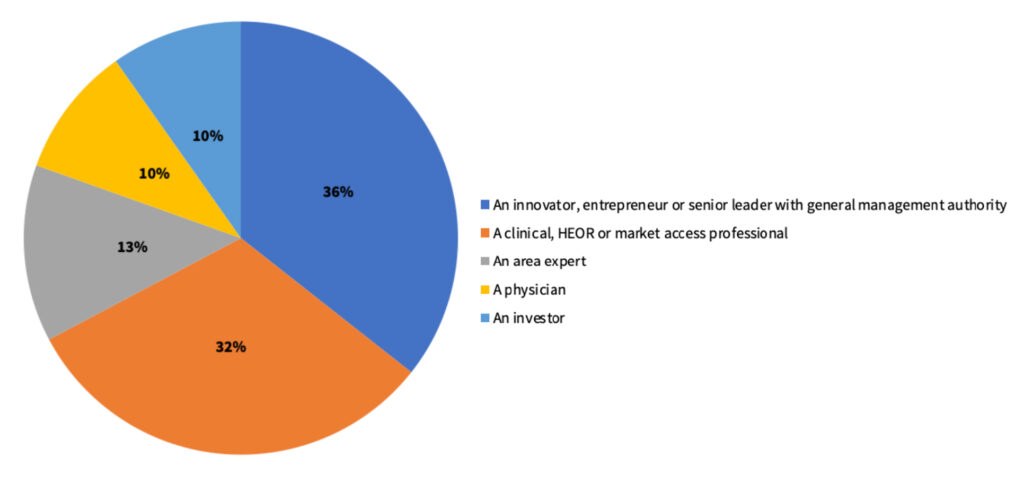
Out of the 174 final respondents, 36% were innovators, entrepreneurs, or senior leaders with general management activity. This was followed by clinical/health economics and outcomes research (HEOR)/market access professionals (32%), area experts (13%), physicians (10%), and investors (~10%).

Figure 1. Distribution of survey respondents based on occupation.
Challenges with the Current CAT I Processes

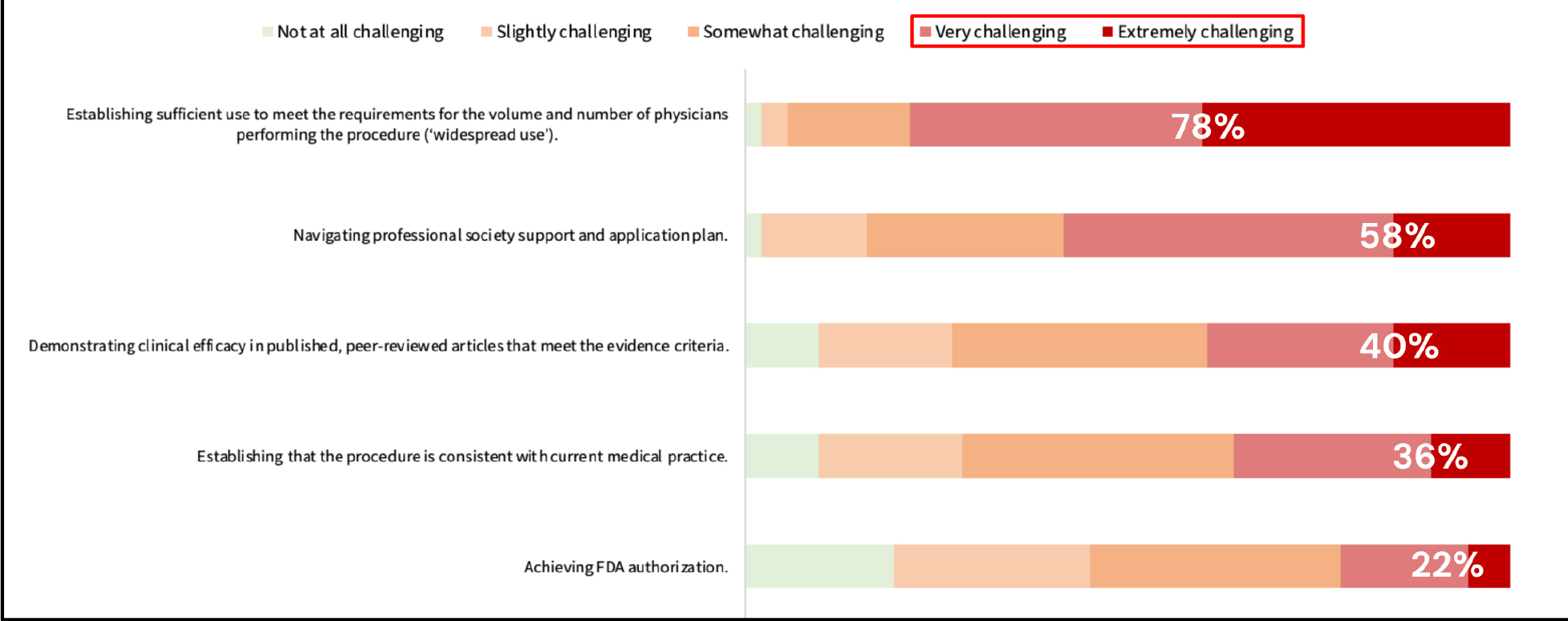
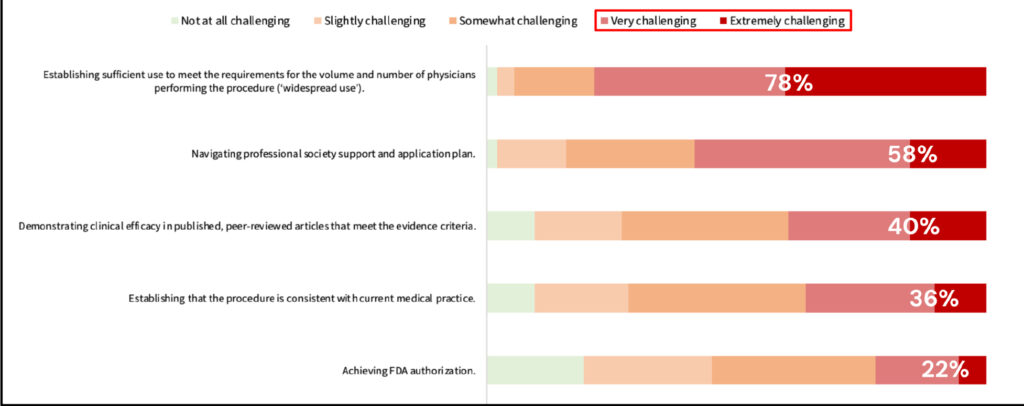
Respondents were asked, “How challenging is it to meet the typical steps in the process of obtaining a CAT I code?” Among the various steps, achieving “widespread use” emerged as the most challenging, with 78% of respondents rating it as very challenging to extremely challenging. Navigating professional society support and application plan was identified as the next most challenging step, with approximately 58% of respondents experiencing difficulty in this process. Demonstrating clinical efficacy in published, peer-reviewed articles that meet the evidence criteria and establishing that the procedure is consistent with current medical practice were very challenging and extremely challenging for 40% and 36% of respondents, respectively. The least challenging step was found to be obtaining FDA authorization, with only 22% of respondents rating it as very or extremely challenging.

Figure 2. Ranked typical steps to obtain CAT I code from most to least challenging.
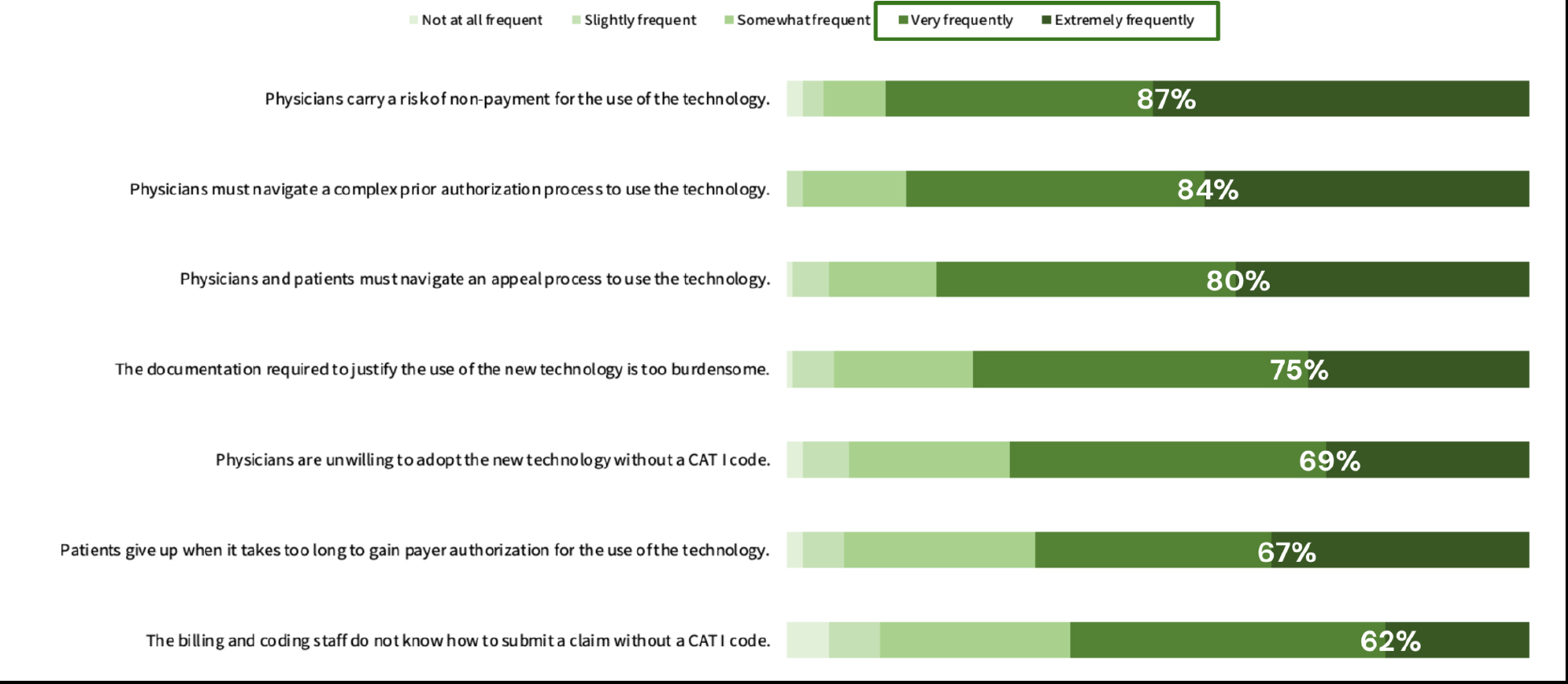
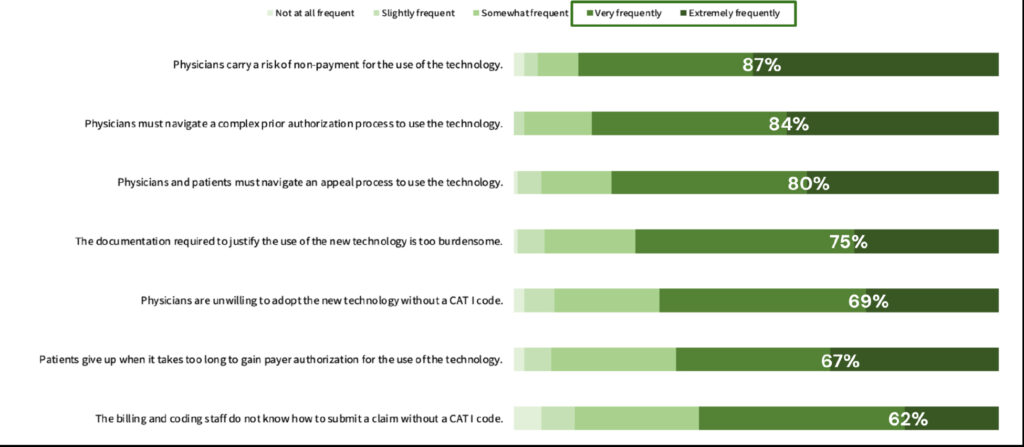
When asked to rate the frequency of objections to using a new technology before the effective date of a CAT I code, respondents identified the top two primary concerns: “physicians face the risk of non-payment for using the technology” and “physicians must navigate a complex prior authorization process to use the technology.” Roughly 87% and 84%, respectively, rated these concerns as occurring very frequently or extremely frequently (Figure 3). The least frequent objection by 62% of respondents was that “billing and coding staff are unsure how to submit a claim without a CAT I code.”

Figure 3. Ranked frequency of the following objections to the use of a new technology prior to the effective date of a CAT I code from most to least frequent.
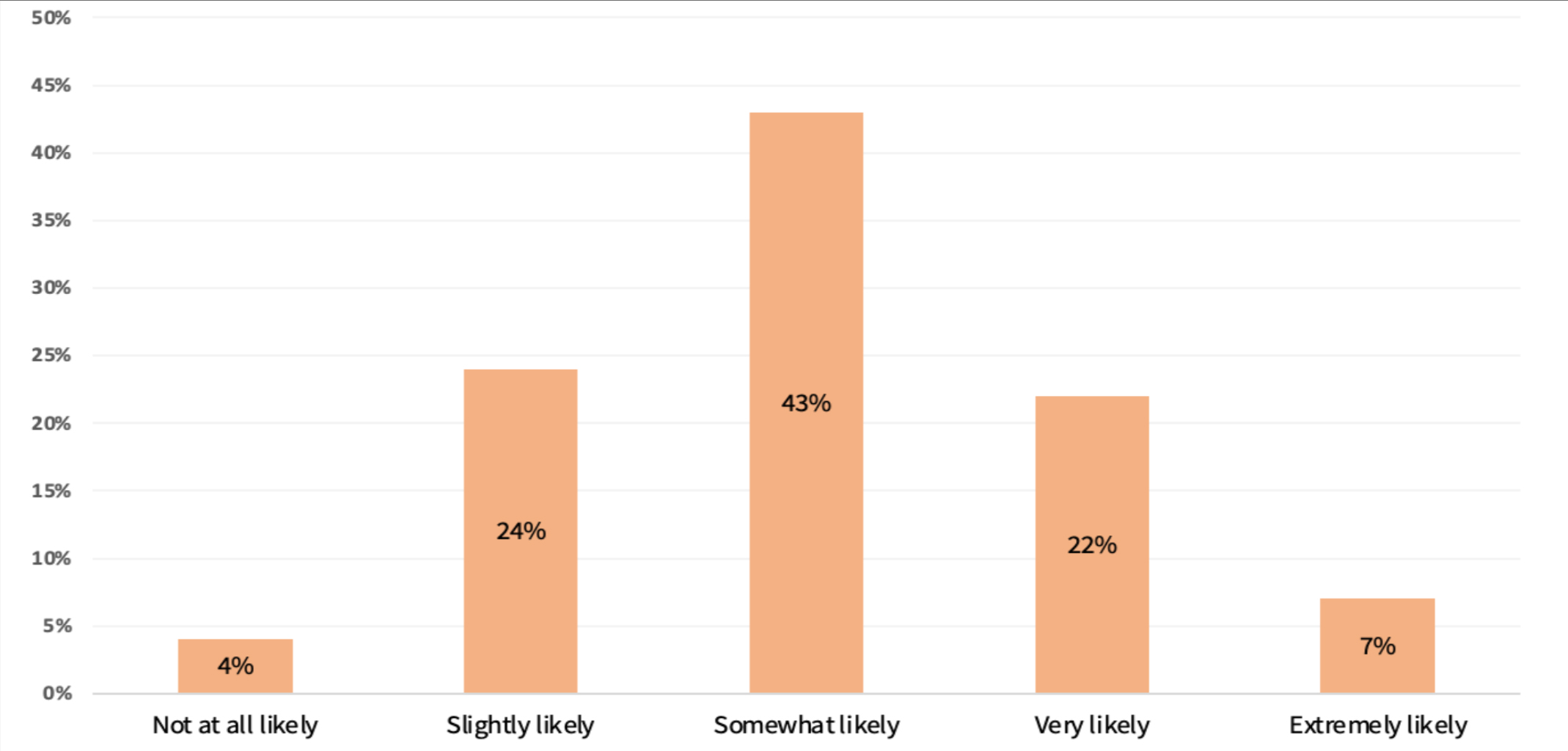
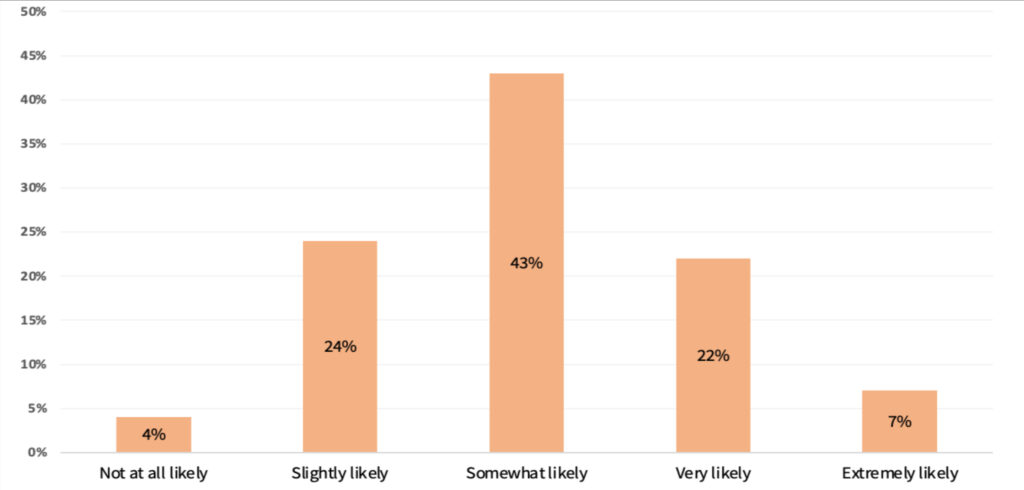
Around 43% of the respondents indicated that they would somewhat likely initiate a new project addressing a compelling unmet clinical need even if it requires obtaining a new CAT I code. Similarly, 29% indicated they are still either very likely or extremely likely to pursue such an opportunity. In contrast, 28% answered slightly likely to not at all likely.

Figure 4. Likelihood to address an unmet clinical need requiring a new CAT I code.
 

Other Challenges with the CAT I Code Process

Several themes emerged from the responses regarding challenges associated with the CAT I process. These themes, as highlighted in the survey, emphasize the impact of such challenges on innovation—especially for small companies or startups with novel technology — and on patient care, as respondents highlighted how these challenges create barriers to accessing interventions.

Challenges in Demonstrating “Widespread Use” and Gathering Evidence

Similar to the results in Figure 2, and reflecting an overall theme of the survey results, the criteria of “widespread use” has been challenging for innovators to meet. “The additional requirement of demonstrating ‘widespread use’ creates a barrier to patient access,” commented one respondent, especially for emerging technologies as “the burden of evidence is overwhelming to have one Level 1 clinical trial and one Level 2 clinical study of non-overlapping patient populations.” Aside from that, respondents mentioned that “widespread use” is not clearly defined. Respondents suggested that widespread use should not be contingent on creating a code for a viable procedure.

High Costs and Resources Required for Obtaining CAT I Code

Respondents voiced that applying for new codes for novel technologies is “arduous, time consuming and capital intensive, especially for small novel companies.” One innovator recalled that it took the company “five years and roughly $10 million for prospective and comparative trials” to manage the process. Another innovator mentioned that it is an additional six to eight years for these technologies to have an existing CPT code. One respondent pointed out, “most startups don’t have these resources,” and that this is an obstacle to adoption of innovative and sometimes life-saving technology.

Lack of Transparency Throughout the Process

Respondents reported the CPT process to be inconsistent, opaque, and lacking in transparency. According to them, the inconsistency arises from the manner in which the CPT Editorial Panel reviews applications, especially in regard to “widespread use.” This results in an opaque process for which the information sources available online “do not necessarily reflect the best practice for obtaining a code.” This results in innovators expending valuable resources, for example hiring an outside market access firm to help guide them through the complexities of the CPT process.

Other respondents have pointed out the difficulty in shifting from CAT III codes to CAT I codes. Respondents cited that CAT III codes are reportedly “still non-covered by most payers” while “some have blanket policies against coverage.” They reported that this, together with the lack of transparency within the entire process, highlights the systemic issues that innovators face.

After a CAT I code has been granted, respondents reported issues with the RUC (AMA/Specialty Society Relative Value Scale Update Committee) process. In addition to the challenge of obtaining a CAT I code, an innovator mentioned that the RUC process can be very “inhibitive to new technology” and lacks transparency. Respondents expressed concerns that this is due to reliance on outdated methodologies, leading to continuous challenges for innovators even after securing a CAT I code.

Lack of Support from Medical Societies and Specialty Groups

Another recurring theme in the survey was the lack of support from medical societies and specialty groups. A respondent mentioned that there is “no willingness to meet with industry to have constructive and creative discussions about supporting market access for new technology.” Respondents wish for a more transparent and objective process, especially when gaining specialty society support. Engaging with the CPT staff of medical societies is initially easy, respondents commented, but the coalition of societies that “need to agree on clinical studies required over and above the established CPT requirements” has become one of the most challenging issues for innovators.

Impact on Innovation and Patient Care

Despite companies following the required processes for FDA approval and CAT I code creation, innovators have voiced that they still encounter an “uphill climb” for payment that can often lead to very limited patient access and company failure. Multiple respondents have mentioned that they have been discouraged with the monumental challenges involved in obtaining a CAT I code. Given the high costs associated with obtaining a new code, innovators stated that they can be left with no choice but to integrate such costs into the selling prices, and as a result, “raising the cost to patients and the healthcare system.”

These ongoing challenges hinder the development of novel concepts that support physicians “who seek to create a better patient outcome above all else,” stated one respondent, signaling that they impact overall innovation and patient care. Respondents mentioned the importance of having this stringent coding process in place, but “achieving a code is a very onerous process.” Ultimately, this process impacts access to innovation for both physicians and patients.

Suggestions for Change

Respondents suggested solutions including societies appointing a designated, full-time expert physician for coding to streamline the process and facilitate collaboration with industry. Additionally, they recommended the creation of a quality system to track new CPT code requests, and standardizing responses to queries and requests from the industry across societies.

Discussion

The survey data emphasize the significant hurdle posed to patient access by the complex, expensive nature of pursuing a new CAT I code for a medical technology. Qualitative themes described current challenges innovators are facing, including demonstrating “widespread use,” high costs and resources, lack of transparency, and insufficient support from physician societies for companies initiating the process. To address these issues, respondents suggest increased transparency and cooperation from societies in establishing CAT I codes.

Societies, however, have also pointed out the challenges in the coding processes that they are encountering. Cathleen Biga, MSN, RN, vice president of non-profit medical society, the American College of Cardiology (ACC), has said that “the system is broken,” and identified the RUC process as a problem. Biga then argues that new technologies play a big role in lowering healthcare costs and improving patient outcomes, but patients cannot benefit from these advances unless insurance and Medicare pays for them. She added that changes in payments are very slow for new technologies that impact patients. Her position aligns with the survey results, as the top two primary objections in using a new technology before the effective date of a CAT I code are “physicians face the risk of non-payment for using the technology” and “physicians must navigate a complex prior authorization process to use the technology.”10

There are also a number of ways in which individual physicians play critical roles in coding. They ensure that the technology is consistent with current medical practices and aid in providing evidence to meet the requirements in processing a CPT code. Physicians are also directly involved in the AMA CPT Editorial Panel, where they are either nominated to be a part of the panel, or work with societies to send proposals for which technologies should have codes.11 Additionally, as a significant part of the process of obtaining a CAT I code, physicians and other healthcare professionals perform the specific procedures or services.11

The volume requirement is usually achieved by physicians going at risk of non-payment in order to support the “widespread use” criteria, which in itself places an economic hurdle on every physician wishing to advance new technology for patient care. This is further compounded by the fact that the actual numerical formula or threshold for clearing the criteria has remained opaque over all these years. This vague and seemingly subjective requirement can present a major hurdle to commercialization, because without a CAT I code, many payers will not reimburse for a product or service.

This creates a “chicken and the egg” situation, in which physicians are hesitant to perform new procedures when, as shown in Figure 3, there are uncertain payment prospects or prior authorization requirements. These uncertainties and complexities have the potential to be solved if a CAT I code were in place. However, such a solution can only be facilitated by widespread uptake of the technology. The result is a stalemate, in which clinicians cannot reliably perform new procedures and no progress is made towards a new code.

The most unfortunate outcome of this process is the resulting limited patient access. Central to a clinician’s payment and operations concerns is a patient who could stand to benefit from a new technology that has already received FDA authorization for patient use. Without coding, clinicians are often unwilling to offer a procedure—leaving a supposedly commercially available technology just out of reach. For clinicians willing to take the risk, their practice, hospital, or patient may be left with large bills for an uncovered procedure.

These challenges to obtaining new CPT codes are well known throughout the medical technology ecosystem, with a previous paper citing the reimbursement pathway as the most important external factor for investment decisions.12 As a result, early risk-analyses for company development may drive the innovation ecosystem as a whole to avoid pursuing new technologies that would not fall under currently available CPT codes. As a consequence, this prevents companies and investors from developing the most novel of technologies that are not categorized through previously established procedures.

Recommendations

The AMA, as the nation’s largest medical association with more than 271,000 members, states that its purpose is “to promote the science and art of medicine and the betterment of public health.” The association also states that it delivers on this mission by representing physicians with a unified voice in courts and legislative bodies across the nation, removing obstacles that interfere with patient care, leading the charge to prevent chronic disease and confront public health crises, and driving the future of medicine to tackle the biggest challenges in healthcare and training the leaders of tomorrow.13

One recent example of the AMA’s commitment to drive the future of medicine and address the needs of providers and patients in a rapidly evolving healthcare environment is its Digital Medicine Payment Advisory Group (DMPAG), initiated in late 2016.14 Over the past few years, DMPAG has achieved a significant and measurable impact on digital medicine intervention adoption by introducing CPT codes for remote physiologic monitoring, remote therapeutic monitoring, AI and other digital innovations. The AMA is also focused on educating members about new innovations and emerging trends in healthcare. But, as stakeholder respondents to the current survey have made loud and clear, more needs to be done to support innovation.

Other agencies integral to innovators’ success, FDA and CMS are doing their part to improve pathways to foster medical innovation and more expediently bring technologies into the hands of healthcare providers and patients. This includes FDA’s Breakthrough Devices Program, with updated final guidance issued in September 2023, intended to provide patients and providers with timely access to medical devices by speeding up development, assessment, and review for premarket approval, 510(k) clearance, and De Novo marketing authorization.15 In parallel, CMS issued a proposed procedural notice outlining a new Medicare coverage pathway to achieve more timely and predictable access to new medical technologies for people on Medicare.16 The Transitional Coverage for Emerging Technologies (TCET) pathway for Breakthrough Devices supports both improved patient care and innovation by providing a clear, transparent, and consistent coverage process while maintaining robust safeguards for the Medicare population.17 In another example, in large part due to strong advocacy efforts by AMA, physicians, and patients, CMS is reforming the costly and inefficient prior authorization process (cited by survey respondents as an issue; see Figure 3) under a newly issued final rule. The new rule will reduce patient care delays and the administrative burdens long shouldered by physicians, and save practices an estimated $15 billion over the next decade, according to CMS.18

Noting the significant strides being made across the medical regulatory and reimbursement ecosystem to improve access to medical innovation and advance patient care, and respondents’ opinions revealed in the current survey, we recommend that AMA policymakers take steps to devote resources to collaborating with innovators, physicians and other healthcare stakeholders to refine and reimagine the “widespread use” criteria—and consider fine-tuning the policy so that specific levels of use are considered—to more appropriately fit the realities of novel medical product and service development.

Innovators themselves can also play an impactful role in planning ahead for their reimbursement strategy and engagement with professional societies for CAT I CPT code coverage. It is essential that innovators develop and execute a robust plan in support of an eventual CAT I code application and approval. This could include partnering with physicians and other thought leaders to design robust clinical studies and appropriate diagnostic and treatment criteria, and ensuring sponsored clinical studies are submitted for peer-reviewed publication. Innovators can familiarize themselves with the process for a CPT code application through the extensive materials on the AMA website and learn about the CPT code decision-making process by attending the public meetings that are held multiple times per year.19

For medical innovators, the process of applying for and achieving a CAT I CPT code is a challenging and costly process that has become fundamental to unlocking reimbursement and patient access in the United States. The CAT I requirement of “widespread use,” in particular, has become a roadblock for innovators with novel products or services and the physicians that use them, that is having a negative impact on the innovation ecosystem and patient care. There is a strong and near-term need for a more transparent, predictable, and achievable CAT I CPT code process to ensure that healthcare innovation and patient access to FDA-cleared and clinically proven therapies can flourish and be preserved for future generations. Ultimately, it is critical that all stakeholders—AMA policymakers, innovators, physicians, and other healthcare providers—collaborate closely to ensure these recommendations are translated into tangible benefits for patient care. By doing so, this will allow for the continuous advancement of medical practices and technologies, for access to cutting-edge medical care and better patient outcomes.

Study Strengths and Limitations

Among the strengths of the current analysis is its reliance on data from a cross-section of healthcare innovation professionals who are personally knowledgeable of the information used to apply for and achieve a CAT I CPT code for a new treatment or diagnostic technology, and thus are qualified to provide an informed opinion of the process.

However, this research is also subject to several limitations. There is potential response bias in the respondent group as the survey was distributed only to the Stanford Biodesign network and the AdvaMed and Medical Device Manufacturers Association membership lists, that together represent a majority, but not all healthtech innovators in the United States. Also, previous research notes that an inherent weakness to surveys is that high-quality survey results come from participants who are motivated to optimize the response process, and who have a desire for self-expression, intellectual challenge, and a desire to be helpful.20

In addition, some respondents’ answers may be biased based on their subjective positive or negative experience with the CPT code process, and the direct impact on the company they were or are associated with that applied for a CAT I CPT code. Additionally, being that the survey included only five questions, its conclusions are limited to the key challenges revealed in this analysis, and in the open-ended feedback provided by respondents.

As there is a lack of existing research on the specific topic of CPT Code process challenges and impact on the healthtech innovation ecosystem, and the conclusions of the current survey point to compelling challenges with the current CAT I process, there is ample future opportunity to elucidate additional valuable insight and recommendations from the different stakeholder groups involved in applying for and achieving a Category I CPT code for a new treatment or diagnostic technology. These future investigations can invite a broader discussion of the critical issues impacting reimbursement and adoption of novel technologies.

Conclusion

The high evidentiary standards that the AMA has established for CPT CAT I criteria are indeed appropriate when assessing novel procedures or services intended for patient use. These standards include the need for well-documented clinical efficacy data, FDA authorization, and consistency with current medical practice. However, it is also clear that the challenges involved in obtaining a CPT CAT I code—specifically, achieving “widespread use”—are negatively impacting the innovation ecosystem and patient care. This discourages some innovators from pursuing innovations that might require a new CPT CAT I code in the future. The subsequent impact of innovators turning away from advancing important new medical innovations due to the challenges of this process could significantly affect patient care and access.

While considering alternatives to CPT’s “widespread use” criteria, it is also important to recognize that there may be some potential drawbacks of removing or modifying the criterion for novel technologies completely.  Doing so may result in the establishment of additional codes at a greater rate, which may increase the workload and turnaround time for decisions made by the editorial panel.  It is also possible that some procedures may obtain a CPT I code but may remain less utilized.  Overall, however, these potential concerns do not substantially overshadow the data reported from this survey which calls into question the utility or reasonableness of setting “widespread use” as a criterion for novel technologies and suggests that improvements and adjustments should be made to ensure that the CPT CAT I process continues to move in time with innovations in medicine.

Considering the fragile state of the health technology innovation ecosystem, along with the rapid pace of scientific progress and medical innovation aimed at addressing urgent unmet clinical needs and improving the quality of life of patients, there is a strong and immediate need for a more transparent, predictable, and achievable CPT CAT I code process. Such improvements are crucial to ensure that healthcare innovation flourishes and that patient access to FDA-cleared and clinically proven therapies is preserved for future generations.

Notes

[*] The survey design and data collection for this paper was generated using Qualtrics software, Version January 2024 of Qualtrics. Copyright © 2024 Qualtrics. Qualtrics and all other Qualtrics product or service names are registered trademarks or trademarks of Qualtrics, Provo, UT, USA. https://www.qualtrics.com

References

  1. Criteria for CPT® Category I and Category III codes. American Medical Association. Published September 22, 2023. Accessed March 22, 2024. https://www.ama-assn.org/practice-management/cpt/criteria-cpt-category-i-and-category-iii-codes
  2. Kuo TY, Manaker S. Reimbursement Strategies and CPT Codes for Device Development. Academic Entrepreneurship for Medical and Health Scientists. Published online April 16, 2021. doi:10.21428/b2e239dc.8e3cdecb
  3. Leslie-Mazwi TM, Bello JA, Tu R, et al. Current Procedural Terminology: History, Structure, and Relationship to Valuation for the Neuroradiologist. AJNR Am J Neuroradiol. 2016;37(11):1972-1976. doi:10.3174/ajnr.A4863
  4. AMA releases the CPT 2024 code set. American Medical Association. Published September 8, 2023. Accessed March 22, 2024. https://www.ama-assn.org/press-center/press-releases/ama-releases-cpt-2024-code-set
  5. Stanford Byers Center for Biodesign, Fogarty Innovation. CPT®: The Language of Medicine for Innovators. Stanford Byers Center for Biodesign. Accessed March 22, 2024. https://biodesign.stanford.edu/programs/policy-program/publications-testimony-events.html
  6. Medicare Payment Systems. Accessed April 17, 2024. https://www.cms.gov/Outreach-and-Education/Medicare-Learning-Network-MLN/MLNProducts/html/medicare-payment-systems.html
  7. QualtricsXM. Qualtrics Version January 2024. Published online 2024. https://www.qualtrics.com.
  8. Microsoft. Microsoft Excel. Published online 2024.
  9. QSR International. NVivo. Published online 2024. https://www.qsrinternational.com/nvivo-qualitative-data-analysis-software/home
  10. Fornell D. Reimbursement challenges raising concerns in cardiology. Cardiovascular Business. Published March 21, 2023. Accessed March 28, 2024. https://cardiovascularbusiness.com/topics/healthcare-management/healthcare-economics/medical-billing-and-coding/reimbursement-challenges-raising-concerns-cardiology
  11. Finch M. Reimbursement Basics. Published online November 10, 2022. Accessed March 22, 2024. https://pressbooks.umn.edu/mdih/chapter/reimbursement-basics/
  12. Ruggles SW, Perl J, Sexton Z, Schulman K, Makower J. The Need for Accelerated Medicare Coverage of Innovative Technologies: Impact on Patient Access and the Innovation Ecosystem. HMPI. Published January 17, 2022. Accessed March 22, 2024. https://hmpi.org/2022/01/17/the-need-for-accelerated-medicare-coverage-of-innovative-technologies-impact-on-patient-access-and-the-innovation-ecosystem/
  13. About the AMA. American Medical Association. Accessed April 16, 2024. https://www.ama-assn.org/about
  14. Digital Medicine Payment Advisory Group. American Medical Association. Published March 20, 2024. Accessed March 22, 2024. https://www.ama-assn.org/practice-management/digital/digital-medicine-payment-advisory-group
  15. Health C for D and R. Breakthrough Devices Program. FDA. Published online March 20, 2024. Accessed March 22, 2024. https://www.fda.gov/medical-devices/how-study-and-market-your-device/breakthrough-devices-program
  16. Notice with Comment – Transitional Coverage for Emerging Technologies (CMS-3421-NC) | CMS. Accessed January 31, 2024. https://www.cms.gov/newsroom/fact-sheets/notice-comment-transitional-coverage-emerging-technologies-cms-3421-nc
  17. Farmer SA, Fleisher LA, Blum JD. The Transitional Coverage for Emerging Technologies Pathway—Enhancing Innovation While Establishing Patient Safeguards. JAMA Health Forum. 2023;4(8):e232780. doi:10.1001/jamahealthforum.2023.2780
  18. New prior authorization reforms show power of physician advocacy. American Medical Association. Published March 14, 2024. Accessed March 22, 2024. https://www.ama-assn.org/practice-management/prior-authorization/new-prior-authorization-reforms-show-power-physician
  19. CPT® code change applications. American Medical Association. Published April 15, 2024. Accessed April 17, 2024. https://www.ama-assn.org/practice-management/cpt/cpt-code-change-applications
  20. Artino AR, Youmans QR, Tuck MG. Getting the Most Out of Surveys: Optimizing Respondent Motivation. J Grad Med Educ. 2022;14(6):629-633. doi:10.4300/JGME-D-22-00722.1


 Appendix 1.


Conflict of Interest 

Dr. Ruggles reported personal fees from Summit Rock Strategy Consulting, Inc (consulting employment and ownership), minority equity from 3NT Medical, BioTrace Medical, Orthini, LLC, and employee stock grants from Acclarent/Johnson & Johnson outside the submitted work; and ongoing nonfinancial relationships with individuals trained at the Stanford Byers Center for Biodesign and others involved in advancing new medical technologies into patient care (e.g., venture investors, corporate leaders, industry associations, and service providers).

Dr. Makower reported personal fees over the past several years from New Enterprise Associates, Patient Square Capital, Elevage, Sofinnova Partners, minority equity and board membership with ExploraMed, Willow Innovations, Revelle Aesthetics, Moximed, X9, Allay Therapeutics, Setpoint Medical, minority equity and former board membership with Intrinsic Therapeutics, minority equity and board membership with Magenta Medical, minority equity in Moon Surgical, Cardionomic, Cala Health, CVRX, Ancora, Starlight Cardiovascular, Candescent Biomedical, iRhythm, former minority equity and former board membership with NeoTract/Teleflex, Acclarent/JNJ, Vesper Medical, Intact Medical, former minority equity from Ivantis and minority equity and former board member with Eargo and DOTS Devices outside the submitted work; in addition, Dr. Makower has more than 300 US patents issued in a wide array of fields related to the companies listed above—no additional financial consideration is associated with these patents. The authors are further supported by unrestricted donations to Stanford University, Stanford Byers Center for Biodesign and Stanford Biodesign Policy Program. Further, Dr. Makower had ongoing nonfinancial relationships with individuals trained at the Stanford Byers Center for Biodesign and others involved in advancing new medical technologies into patient care (e.g., venture investors, corporate leaders, industry associations, and service providers). No other disclosures were reported.

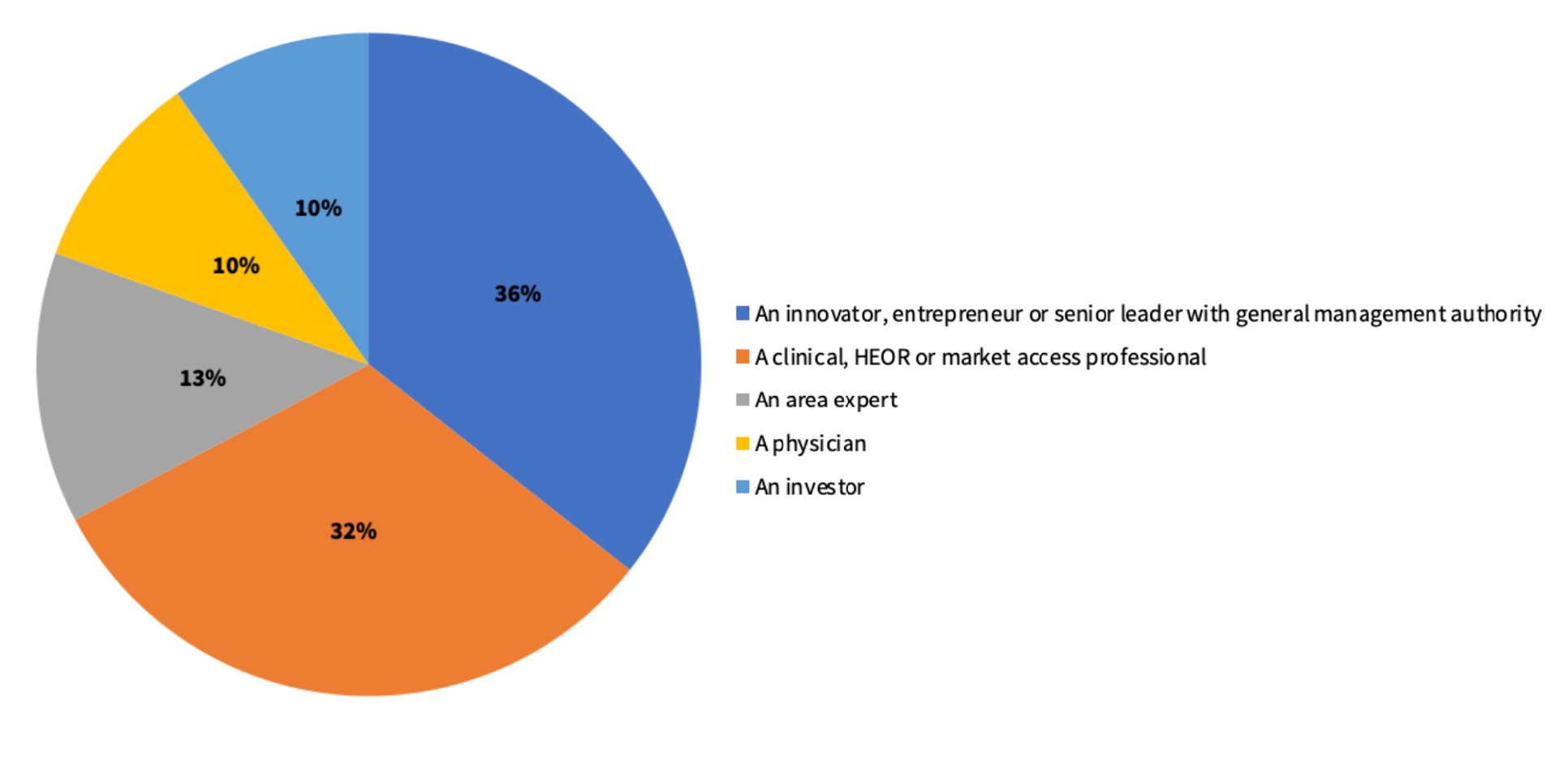
Regi’s “Innovating in Healthcare” Cases

Case: Can Fintech Fix Healthcare Payment Processing? (Case: SM-356; date: 06/07/22; length: 15 pages)

Authors: Morgan Kiss (MBA ’22) and Professor Kevin Schulman, MD, MBA, Stanford Graduate School of Business

Introduction

Doris Petropoulos was a rising star in the payments industry. After five short years, she was promoted to lead corporate development and strategy at a Bay Area-based private fintech company. Their valuation had recently soared to $15 billion and, looking for their next big growth opportunity, senior leadership allocated a large cash budget to her team. Petropoulos led initiatives spanning the company’s larger growth strategy to M&A investment activity and was on the lookout for the next opportunity—only to be surprised where she would find it.

On a recent visit to her primary care doctor, the front office staff asked Petropoulos for her proof of insurance and a method for co-payment. She pulled out her health insurance card and credit card. She tapped her microchip-embedded credit card on the reader and her co-pay was processed instantly. Meanwhile, the front office staff took her insurance card and scanned it, front and back separately, and had to type information from the card into their computer system. She realized that this was the start of a long, arduous process of determining plan enrollment, eligibility, benefits, and, ultimately, her bill.

She began to wonder what went on behind the scenes. Why was her credit card transaction instantaneous, while the health insurance payment process had only just started? She went back to her office to discover a startling discrepancy in the speed and cost of transactions between U.S. health care and financial systems, despite some of the very same technologies being relevant to both sectors. Had she just stumbled upon the next big market opportunity for her company?

Download the case. For inquiries, contact Kevin Schulman kevin.schulman@stanford.edu

Pharmacy Benefit Managers and the U.S. Pharmaceutical Market

Rena M. Conti, Questrom School of Business, Boston University; Brigham Frandsen, Brigham Young University, and James B. Rebitzer, Questrom School of Business, Boston University

Contact: rconti@bu.edu

Abstract

What is the message? Critics of Pharmacy Benefit Managers (PBMs) claim that they contribute to rising spending on prescription drugs, while others argue that PBMs improve market efficiency. This controversy has stimulated new proposed legislation and investigations. The authors describe the PBM business model, clarify their impacts on the U.S. pharmaceutical market, and highlight areas where future research may help inform policymaking.

What is the evidence? An analysis of recent literature, studies and congressional investigations.

Timeline: Submitted: April 3, 2024; accepted after review April 7, 2024.

Cite as: Rena M. Conti, Brigham Frandsen, James B. Rebitzer. 2024. Pharmacy Benefit Managers and the US Pharmaceutical Market. Health Management, Policy and Innovation (www.HMPI.org), Volume 9, Issue 1.

Acknowledgements: Authors thank Michael Powell, Marta Wosinska, and Kevin Schulman for comments on this manuscript and Lawton Robert Burns for insightful discussions. All errors our own.

Improving prescription drug affordability is high on the agenda of patients and policymakers in the United States. Drugs are generally covered by health plans and account for a small share of total annual health expenditures; however, they are ubiquitously consumed, and spending has grown over time.1 Patients are commonly asked to pay some portion of the bill out-of-pocket at the pharmacy counter, and out-of-pocket costs associated with some needed prescription drugs may be quite high.1 The Inflation Reduction Act of 2022, passed by the U.S. Congress in August 2023, aims to moderate public spending on prescription drugs covered by Medicare Part D and out-of-pocket spending by Medicare beneficiaries by improving the generosity of insurance provided by plans, reducing price increases, and negotiating the prices of some existing drugs.

Policymakers are now setting their sights on reforming the practices of other players in the pharmaceutical supply chain, notably pharmacy benefit managers (PBMs).2-4 PBMs are central, yet enigmatic, market intermediaries that manage pharmacy benefits on behalf of health plans.5 Critics claim PBMs contribute to rising spending on prescription drugs, while others argue that PBMs improve market efficiency. This controversy has stimulated new proposed legislation and investigations. The U.S. House of Representatives Committee on Oversight and Accountability produced a series of reports and held hearings which provided some details about PBM practices and their potential impacts on drug pricing and availability. The U.S. Senate has proposed bipartisan-supported reforms to PBM business practices such as the Modernizing and Ensuring PBM Accountability Act (MEPA) (S. 2973 118th Congress 2023-2024), but these proposals were not included in the recently passed 2024 appropriations bill. The Federal Trade Commission (FTC) is also pursuing an investigation into the practices of PBMs.6

In this essay we describe the business model of PBMs, clarify their potentially desirable and undesirable impacts on the U.S. pharmaceutical market, and highlight areas where future research may help inform policymaking. 7

The Role of PBMs in the US Prescription Drug Market

Figure 1 sketches the central intermediary role PBMs play in drug markets. Drug makers bring new brand drugs to market and set the list price of their products. Patients contract with health plans (payors) to provide coverage for needed medical care, including pharmacy benefits. Plans can negotiate with brand drug makers for rebates based on their members’ expected pharmacy use and the drug’s formulary placement or, more commonly, hire a PBM to perform these responsibilities. In turn, PBMs act as a provider of these services to multiple health plans. It is in this sense, that PBMs act as intermediaries for payors. Patients pay premiums to their health plan and an out-of-pocket cost in the form of copays or coinsurance when a prescribed drug is dispensed at the pharmacy counter (for simplicity, we omit pharmacies from the Figure). The out-of-pocket cost patients incur for a dispensed brand drug is usually far less than the transaction price at which the drug is purchased by the pharmacy from the drug maker. The remainder of the cost of the dispensed drug is paid by the health plan to the pharmacy as reimbursement. Finally, the transaction, or ‘net’, price of a drug is the list price set by the drug maker minus any rebates offered to the PBM. Typically, drug makers only pay rebates to PBMs on brand drugs.

Figure. Pharmacy Benefit Managers as an Intermediary between Drug Makers, Health Plans, and Consumers


PBMs influence the rebates offered by brand drug makers through the design of formularies. Formularies place drugs on different tiers, each with a different out-of-pocket cost to patients. Patients typically can acquire generic drugs for minimal out-of-pocket expenses because the PBM has placed them in the lowest tier. Preferred brand drugs are placed in a higher tier, and consumers pay higher, but still low, out-of-pocket costs for these drugs. To access non-preferred drugs, consumers will have to pay even higher out-of-pocket costs.

Potentially Desirable Effects of PBMs on the U.S. Pharmaceutical Market

PBM formularies provide convenience and create efficiencies for payors. Instead of each plan setting up and managing its own formulary, PBMs may operate the same formulary or similar formularies on behalf of multiple plans. Thus, PBMs consolidate health plans’ negotiations with drug makers for formulary placement. PBMs also negotiate pharmacy fees on behalf of multiple health plans.

Formularies operated by a PBM encourage patients insured by plans to choose inexpensive generic drugs because the lowest tier gives patients access to generic drugs at a nominal out-of-pocket cost. The use of generic drugs, especially those commonly used to manage such chronic illnesses as diabetes, depression, and cardiovascular disease, creates significant cost savings for plans and patients.1,4  Indeed, with the increasing prominence of PBMs in the U.S. market, we have seen a dramatic shift towards the use of generic drugs over the past two decades.  More than 90% of prescriptions filled in the United States in 2022 were for generic drugs.8

Formularies also steer patients to use preferred brand drugs over non-preferred brands. This steering effect reduces the net price of drugs because brand drug makers offer higher rebates to PBMs to increase the chances that their drug will be placed on a preferred brand tier rather than a less desirable non-preferred brand tier.9 In effect, formulary design heightens competition between the makers of brand drugs. From this perspective, it is perhaps not surprising that rebates offered by drug makers grow with the extent of competition in a drug’s therapeutic class and are concentrated in a relatively small number of products.4 Weinstein and Schulman (2020) report evidence that PBM formulary exclusions of brand drugs grew between 2011 and 2020 and are associated with more extensive rebate payments by drug makers to PBMs.10 In addition, recent work by Kakani, Chernew and Chandra (2020) and Feng and Maini (2024) suggest PBMs act to lower net prices and consequently spending on prescription drugs.11, 12

PBMs may also steer patients toward low-priced pharmacy services. Like managed care organizations, PBMs construct ‘preferred’ pharmacy networks on behalf of health plans. Researchers have found that beneficiaries of Medicare Part D plans with preferred pharmacy networks pay lower out-of-pocket prices for retail prescription drugs.2,3 PBMs also operate their own mail order pharmacies. Patients may prefer mail order for the convenience of obtaining prescriptions at home rather than having to travel to a pharmacy. Prescriptions of drugs used chronically are commonly dispensed through mail order in higher quantities, such as a three-month supply, and mail order dispensing services may also be less costly than through retail pharmacies providing cost savings to patients and plans. PBM-owned pharmacies, such as CVS-Caremark, also compete with large standalone pharmacy chains, such as Walgreens, and the pharmacies of retail grocery store chains. Competition may increase service quality and decrease the prices paid for pharmacy dispensing fees.

Health plans compensate PBMs for delivering these various services. Generally, PBMs are paid using one of two models. In the first model, sometimes called the ‘pass-through’ model, the PBM bills the plan the exact cost of the dispensed drug and passes that amount to the pharmacy, and also passes 100% of the rebates it receives from the brand drug maker to the plan. In this model, compensation for the PBM’s services takes the form of fees, so there is a transparent connection between the services provided and the fees paid. In the second model, sometimes called the ‘spread-pricing’ model, the PBM is paid through spread-pricing or rebate retention. Under spread-pricing, the contract permits the PBM to bill the plan a rate per dispensed prescription that is higher than the PBM pays to the pharmacy per dispensed prescription and to retain the difference. Under rebate retention, the PBM retains a specified percentage of the rebates it receives from brand drug makers and passes the remainder to the plan. These PBM payment models compete as alternatives in the marketplace, and plans often have a choice of one or the other, or a hybrid of the two. PBMs may also receive fees from drug makers.

Potentially Undesirable Effects of PBMs on the U.S. Pharmaceutical Market

One concern raised about the impact of PBMs is patient access to prescription drugs. Some empirical evidence suggests patient out-of-pocket costs on brand drugs have grown, even as rebates extracted from drug makers have also increased.13 Others suggest rebates have increased without a measurable impact on access.12

Drug makers may react to PBM formularies in ways that undermine competition and increase costs. For example, brand drug makers may offer copay coupons or other types of patient assistance that shields patients from out-of-pocket expenses when using high-priced drugs placed in less desirable formulary tiers.14 These activities may undermine the incentives to use generics when available. Brand drug makers may also undermine formulary competition by offering expanded rebates to PBMs in exchange for favorable formulary placement for a bundle of drugs they sell.4,5 While this pricing strategy reduces net prices paid for drugs in the bundle, it may also reduce competition from drugs not in the bundle. It is possible that this strategy may contribute to the surprisingly limited uptake of available biosimilars (generic versions of biologic drugs).15

The economics of drug rebates may also cause PBMs to favor brand drugs with higher list prices. To see why, consider that a high list price brand drug with large rebates allows the PBM to offer a larger discount to health plan beneficiaries even if the transaction price of the drug (that is, the list price net of rebates) is unchanged. This can create a race to the top in list prices, a practice sometimes termed ‘shadow pricing’. The House Oversight and Accountability Committee reported numerous examples of shadow-pricing behavior by brand drugs facing brand competition, including that of Humira and Embrel and various brand insulin pens. This behavior causes patient harm. Contrary to the conventional wisdom that ‘nobody pays list price’, uninsured patients do. Also, high list prices can increase costs for patients paying deductibles and coinsurance because list prices are used in calculating these payments.

Finally, the growing market power of PBMs may distort the operation of markets. PBMs have grown to become huge entities.2-5 One PBM, Express Scripts, was more profitable than the health plans Anthem, Cigna, Aetna, or Humana in 2016.7,16 Their concentrated buying power may allow PBMs to capture too much of the value they create through formulary design and the other services they provide to health plans. This value capture may involve charging high fees or retaining significant rebates for their services. Indeed, some House Oversight reports and recent work by Van Nuys et al (2021) suggest PBMs may be capturing an increasing amount of the value they create.13  PBMs are also known to sign most-favored-nation (MFN) contracts with drug makers.5,7 These contracts, which guarantee that a drug maker supplies drugs to a single PBM at the lowest price available in the market, make it more difficult for new entities to enter the market for PBM services and disrupt incumbents. They also may inhibit the generation of horizontal or vertical merger-related efficiencies. Information about MFNs and other potentially anticompetitive practices is not generally available.  Analysts are learning more about these practices and potential harms through government investigations and documents obtained as part of lawsuits.17

Targets for Reforming PBMs and a Research Agenda

Our analysis of PBMs points to ways that they potentially enhance the efficiency of drug markets. Realizing this potential, however, requires that regulators and market participants pay attention to important threats. Some of these threats are the subject of proposed reforms or ongoing investigations into industry practices. Others, we believe, deserve additional investigation.

Antitrust regulators have well-established tools to assess and limit PBM mergers or MFN contracts that harm consumers. In contrast, the effects of the substantial vertical integration between PBMs, insurers, and pharmacies observed in the pharmaceutical market, are not well understood.  We are particularly interested in the results of the ongoing FTC investigation into PBMs that are vertically integrated with large, national health insurers. Specifically, the FTC has announced an investigation into the business practices of three companies, Caremark, Express Scripts, and Optum Rx, that are vertically integrated with health insurers Aetna, Cigna, and UnitedHealthcare, respectively. Proposed legislative reforms also require the HHS Office of Inspector General (OIG) to investigate the impact of vertical integration between Part D plans, PBMs, and pharmacies, including effects on firm profits, premiums, beneficiary out-of-pocket costs, and Medicare spending under the Part D program.

Our analysis also points to other aspects to drug makers and PBM practices that deserve deeper investigation. These include the potential anticompetitive effects of brand copay coupons, the bundling of brand drug rebates paid to PBMs, and the strategic manipulation of brand drug list prices.

Given the size, impact, and importance of the U.S. pharmaceutical industry, it is remarkable that we still know so little about the organization, financing, and impacts of PBMs. For example, while list price data is easily available, data on the rebates PBMs negotiate with drug makers are closely held secrets. One rationale for such secrecy is that firms believe that keeping rebates secret helps them retain a competitive advantage. However, this interest ought to be weighed against the potential benefits greater transparency would bring to policymaking, regulation, and analysis.

Given the complexity and centrality of PBMs to modern drug markets, economists, regulators, and legislators should devote substantial efforts to learning more about PBM operations, finances, and effects on patients and payors.


References

  1. Congressional Budget Office (2018). Prescription Drugs: Spending, Use, and Prices. Retrieved on October 24, 2023 from: Prescription Drugs: Spending, Use, and Prices | Congressional Budget Office (cbo.gov)
  2. U.S. House of Representatives Committee on Oversight and Reform (2021). A View from Congress: Role of Pharmacy Benefit Managers In Pharmaceutical Markets. Retrieved on October 24, 2023 from: PBM-Report-12102021.pdf (house.gov)
  3. U.S. Senate Committee on Finance, Minority Staff (2018). A Tangled Web: An Examination of the Drug Supply And Payment Chains. Retrieved on October 24, 2023 from: A Tangled Web.pdf (senate.gov)
  4. Government Accountability Office (2023). Medicare Part D: CMS Should Monitor Effects of Rebates on Plan Formularies and Beneficiary Spending (GAO-23-105270). Retrieved on October 24, 2023 from: GAO-23-105270, MEDICARE PART D: CMS Should Monitor Effects of Rebates on Plan Formularies and Beneficiary Spending
  5. Burns LR. The Healthcare Value Chain: Demystifying the Roles of GPOs and PBMs (Palgrave Macmillan, 2022).
  6. Federal Trade Commission. Press Release: FTC Launches Inquiry Into Prescription Drug Middlemen Industry. June 7, 2022.
  7. Conti, Rena, Brigham R. Frandsen, Michael Powell, and James B. Rebitzer. 2021. “Common Agent or Double Agent? Pharmacy Benefit Managers in the Prescription Drug Industry.” NBER Working Paper w28866.
  8. IQVIA Human Data Institute. The Use of Medicines in the U.S. 2023. Usage and Spending Trends and Outlook to 2027. May 2, 2023.
  9. Ho K, R Lee. Contracting over Rebates: Formulary Design and Pharmaceutical Spending. October 2023. Mimeo.
  10. Weinstein EP, Schulman K. Exploring payments in the US pharmaceutical market from 2011 to 2019: Update on pharmacy benefit manager impact. Am Heart J. 2020 Sep;227:107-110.
  11. Kakani, Pragya, Michael Chernew, and Amitabh Chandra. 2020. “Rebates in the Pharmaceutical Industry: Evidence from Medicines Sold in Retail Pharmacies in the U.S.” NBER Working Paper 26846.
  12. Feng J, L Maini. Demand Inertia and the Hidden Impact of Pharmacy Benefit Managers. Management Science. Published online March 18 2024.
  13. Van Nuys K, Ribero R, Ryan M, Sood N. Estimation of the Share of Net Expenditures on Insulin Captured by US Manufacturers, Wholesalers, Pharmacy Benefit Managers, Pharmacies, and Health Plans From 2014 to 2018. JAMA Health Forum. 2021;2(11):e213409.
  14. Dafny L S, C Ody, M Schmidt. When Discounts Raise Costs: the Effect of Copay Coupons on Generic Utilization. American Economic Journal: Economic Policy, 2017, 9(2): 91–123.
  15. Hakim A, Ross JS. Obstacles to the Adoption of Biosimilars for Chronic Diseases. JAMA. 2017 Jun 6;317(21):2163-2164.
  16. Schulman KA, Dabora M. The relationship between pharmacy benefit managers (PBMs) and the cost of therapies in the US pharmaceutical market: A policy primer for clinicians. Am Heart J. 2018 Dec;206:113-122.
  17. Balto D. Federal and State Litigation Regarding Pharmacy Benefit Managers, available online: http://www.pbmwatch.com/pbm-litigation-overview.html


The Business of Health Care: AI, Elections, and the Economy

Abstract

Karoline Mortensen, Steven G. Ullmann, Richard Westlund, University of Miami Herbert Business School

Contact: sullmann@bus.miami.edu

What is the message? The University of Miami’s 13th annual Business of Health Care Conference brought together noted panelists from major areas of the health sector to discuss “AI, Elections, and the Economy.”

What is the evidence? A summary of the panelists’ discussion provided by the authors.

Timeline: Submitted: April 7, 2024; accepted after review April 16, 2024.

Cite as: Karoline Mortensen, Steven G. Ullmann, Richard Westlund. 2024. The Business of Health Care: AI, Elections, and the Economy. Health Management, Policy and Innovation (www.HMPI.org), Volume 9, Issue 1.

The University of Miami Herbert Business School and its Center for Health Management and Policy held the 13th Annual Business of Health Care conference. This year’s theme was “AI, Elections, and the Economy.”

One of the signature events of this annual conference is a panel with leaders in key healthcare sectors. The panelists this year were Matthew Eyles, immediate past president and CEO of America’s Health Insurance Plans (AHIP); Halee Fischer-Wright, M.D., president and CEO of the Medical Group Management Association (MGMA); Jennifer Mensik Kennedy, president of the American Nurses Association (ANA); C. Ann Jordan, Esq., president and CEO of the Healthcare Financial Management Association (HFMA); Yolanda Lawson, M.D., president and CEO of the National Medical Association (NMA); Mary Mayhew, president and CEO of the Florida Hospital Association; and Stephen Ubl, president and CEO of the Pharmaceutical Research and Manufacturers of America (PhRMA). The panel was moderated by Patrick Geraghty, president and CEO of Florida Blue and Guidewell Mutual Holding Corporation.

Artificial Intelligence

During the session, entitled “New Opportunities and Ongoing Challenges,” the discussion initially revolved around the positive deployment opportunities of artificial intelligence in the various sectors of the healthcare industry. Reflecting upon the potential for AI in the pharmaceutical sector, Ubl with said that AI-based pattern recognition can narrow the drug development sector early in the process, and can be effective in clinical trials and in picking up issues associated with drug safety. Further, AI can be used to determine why some patients react to certain medications through the matching of medications to individual genetic information. AI is a tool that is helping in gene sequencing, allowing for enhanced accuracy, as well as time and cost efficacy, Ubl said.

From the financial perspective, Jordan, the CEO and president of the HFMA, said that AI can indeed lower costs by providing an incentive to move away from traditional models. There are other healthcare business applications as well. The MGMA’s Fischer-Wright indicated that AI can help to alter and simplify various processes reducing administrative time and costs. One example would be using AI to simplify the time-consuming process of patient charting.

Eyles, the recent AHIP president and CEO, added that the use of AI can create a smoother patient and provider experience that allows for greater transparency and improved outcomes. Mayhew echoed these sentiments from the hospital sector, noting that applications can result in an improved work environment and enhanced patient care.

From the clinical perspective, Dr. Lawson said that AI can expedite decision-making in areas like radiology and pathology. But, Kennedy added that nurses and other clinicians need to maintain the human perspective when deploying AI tools. Further, Dr. Lawson indicated that AI tools may be out of reach for community providers, both in terms of expense as well as the ability to learn how to use these tools.

There were a number of other caveats discussed in terms of utilizing AI in the health care sector. Mayhew, with the Florida Hospital Association, pointed out that generative AI tools are trained on large language models using information pulled from the Internet and may result in misinformation. Dr. Lawson added that underserved communities are especially concerned about misinformation and even the potential for information to be used against them.

Eyles said that inappropriate use of AI could lead to greater mistrust in healthcare, already a huge problem in this sector. Yet, as Fischer-Wright indicated, if AI is used for greater efficiency, then resources can be shifted to focus on disparities and lead to improvements in outcomes associated with the social determinants of health. Ubl added that the pharmaceutical industry is identifying underserved sites to encourage clinical trials, offering free care and, given the awareness of trust issues working, with civic organizations.

What of the future potential for AI? There was agreement that AI can lower the cost of drugs and health premiums, and provide for more integrated care. Mayhew gave the example of a child with developmental disabilities who currently receives multiple services from numerous agencies that do not communicate with each other. AI has the ability to integrate such services, allowing for better decision-making for the family.

Along the same lines, Fischer-Wright said that AI could support the long-held objective of integrating an individual’s medical record from multiple healthcare systems across the country. She added that this interoperability has been a health IT goal since the 1980s. However, the issue of patient data needs to be navigated carefully, according to Eyles. He said it is not clear whether such patient data belongs to the individual or to the healthcare system.

On the other hand, Dr. Lawson said that access to AI tools to enhance health equity will not improve outcomes if underserved communities lack broadband access. Further, AI applications need to be culturally sensitive to these neighborhoods, she said.

From a patient care perspective, Kennedy, the ANA’s president, noted that nurses are often presented with new technology without being given an opportunity to provide input. She emphasized the importance of nursing staff providing feedback on AI tools, as that can make a major difference in terms of acceptance and engagement.

To summarize this aspect of the panel discussion, AI can support positive movement in the direction of wellness and prevention. Predictive analytics can provide both patients and providers with real-time data to manage health risks. Also, AI may help change patient expectations about where they receive care and give them responsibility for making decisions. This is especially important for young people, as Dr. Lawson said, to allow them to ascertain basic knowledge around health and how to use health insurance.

Health Equity

The panel addressed a number of other timely issues, one of them the longstanding challenge of health equity. Dr. Lawson was concerned about attacks on the principle of health equity and the negative impact on underserved communities. Fischer-Wright, the MGMA president and CEO, said that the pandemic exacerbated health disparities and political discord. On the other hand, Mayhew said that some hospital systems are focusing on social determinants of health and realizing they can help address issues like food insecurity, community housing, and transportation as well as assuring that healthcare is provided in an equitable manner.

As Jordan indicated, better health outcomes translate to financial sustainability as well. Finances in the rural hospital sector are especially concerning given the important role of rural hospitals in their communities. These hospitals provide outpatient care and subsidize primary and pediatric care. Provision of care to frail elderly is also part of their mission. But high fixed costs and low patient volumes are negatively impacting the ability of rural hospitals to provide care. Eyles indicated that the support from Medicare and Medicaid is critical in reducing health disparities. As Kennedy noted, a continued deficit of minorities and males in the nursing workforce impacts both the delivery of individual and culturally sensitive patient care in underserved communities.

An Election Year

Finally, the panelists discussed the role of government in healthcare, focusing on the issues that will be front and center in the months leading up to the November 5, 2024 elections. Eyles, with AHIP, said that the Democrats will emphasize passage of the Inflation Reduction Act, lower prices for insulin, and enhancements to the Affordable Care Act, while the Republicans at this point do not have a healthcare platform.

Dr. Lawson said that the election results could result in a larger crisis for women’s healthcare, including maternal-child health. She went on to say that issues around access to care will not be going away, regardless of which party controls Congress and the Executive Branch. Ubl said that the pharmaceutical industry will be an area of focus in an election year. He added that the concerns regarding the high costs of drugs in the U.S. do not take into account the billions of dollars spent in developing drugs over a long time span.

Fischer-Wright, with the MGMA, indicated her biggest election concerns are related to financial matters, including the sustainability of Social Security for seniors and the low reimbursement rates for providers at a time of relatively high inflation. Mayhew, with the Florida Hospital Association, said that the government rarely has the innovative answers needed to help propel health care forward. Instead legislation passed with the best of intentions can stifle the creativity and flexibility needed for a patient-centered approach. Again, referring to reimbursement, Mayhew said there is a need for government to intervene in dealing with reimbursement issues for providers.

Jordan, the HFMA president and CEO, spoke about how partisan politics in healthcare add to the high level of mistrust by healthcare consumers. She added that concerns regarding federal policies have been encouraged by non-traditional providers entering the industry and may have a long-term positive impact.

Reflecting on the session, it is apparent that the level of change in the healthcare industry remains at a high level in regard to AI and other technologies, patient expectations, the delivery of care, and pharmaceutical development. In addition, the 2024 election cycle may result in even more change. There is no doubt that there will be much to discuss a year from now when we reconvene the Business of Health Care conference and bring together leaders from multiple sectors to discuss the top issues facing the health care industry in 2025.